Where Does Complexity Live? Rethinking Hydroponics
Provided by:
Written By

Related Resources


Part of the controversy surrounding hydroponics stems from ongoing debates within the organic agriculture community. Some view soil as essential to ecological farming, while others argue that carefully managed hydroponic systems can also contribute to sustainable food production. Regardless of where one stands in that debate, the broader question remains: how should we evaluate the role of hydroponics within resilient food systems?
Hydroponic production often sparks strong opinions. Supporters see it as the future of food production: efficient, innovative, and capable of producing fresh vegetables close to where people live. Critics see it as agriculture disconnected from nature, dependent on technology and removed from the ecological foundations that have sustained farming for thousands of years.
Both perspectives capture part of the story, but neither fully answers the more important question: not whether hydroponics belongs in a resilient food system, but where and under what circumstances it fits.
As agriculture responds to growing pressures such as urbanization, climate variability, labor shortages, water constraints, and changing consumer expectations, hydroponics has emerged as one of many tools available to producers. The challenge is deciding where it works best, what tradeoffs it creates, and under what conditions can it contribute to sustainable and resilient food production.
Hydroponics Is Growing for a Reason
Hydroponic production did not emerge in a vacuum. It developed in response to real agricultural challenges. Population growth and urbanization have increased demand for fresh food near cities. Water scarcity has become a major limitation in many agricultural regions. Extreme weather events can disrupt field production and supply chains. At the same time, consumers increasingly expect access to fresh produce throughout the year.
Hydroponic systems offer solutions to some of these challenges. They can produce leafy greens close to urban populations, reduce water consumption in arid regions, and maintain production regardless of seasonal weather conditions. In places with contaminated soils or limited arable land, hydroponic systems may provide opportunities that soil-based agriculture cannot.
For these reasons alone, hydroponics deserves attention as part of the evolving agricultural landscape.
Every Agricultural System Makes Tradeoffs
Discussions about sustainability sometimes imply that there is a perfect agricultural system waiting to be discovered. In reality, every system involves tradeoffs.
Soil-based agriculture relies on healthy soils, biological nutrient cycling, sunlight, rainfall, and broader ecological relationships. Hydroponics reduces dependence on some of those factors but increases dependence on other kinds of infrastructure, including electricity, pumps, climate controls, manufactured nutrients, plastics, and technical expertise.
Every agricultural system draws resources from somewhere. The relevant question is not whether inputs exist, but where they come from, how we manage them, and whether those dependencies enhance or reduce long-term resilience.
A field crop may depend on healthy soil biology and favorable weather patterns. A hydroponic greenhouse may depend on reliable electricity and carefully managed nutrient solutions. Each system possesses strengths, vulnerabilities, and environmental impacts we need to consider within its specific context.
Where Does Complexity Live?
One of the biggest differences between soil-based farming and hydroponics is where complexity resides. In soil-based systems, much of that complexity operates within living ecosystems. In hydroponic systems, more of it must be actively managed by growers.
A healthy soil ecosystem appears relatively simple from the surface. Yet beneath our feet are billions of microorganisms, fungi, insects, roots, and other living organisms continuously performing essential work. These biological communities cycle nutrients, regulate water movement, suppress many plant diseases, build soil structure, and support crop growth. Farmers manage these systems, but much of the complexity resides within the ecosystem itself.
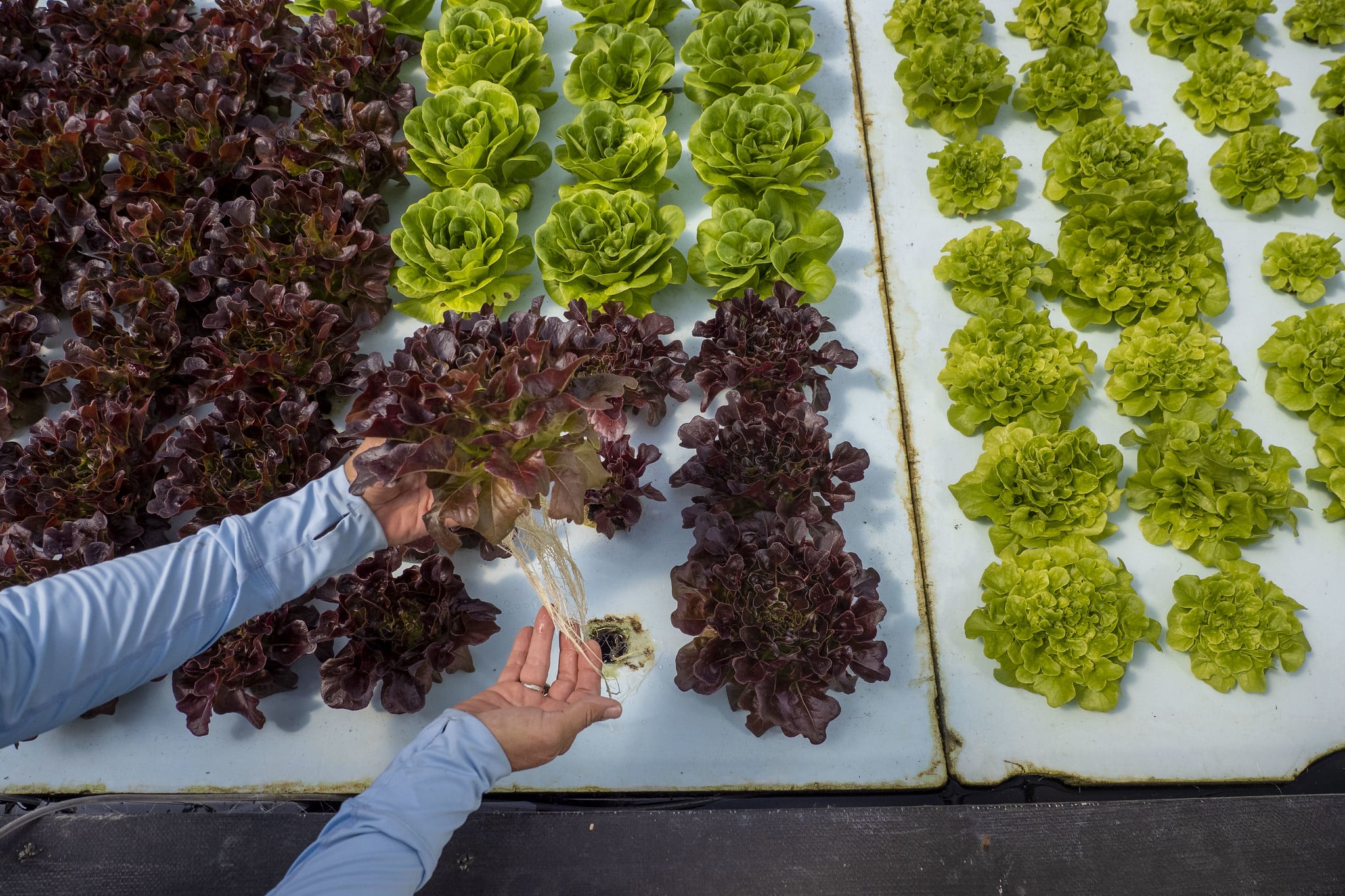
Hydroponic systems do not eliminate complexity. Instead, they relocate it from soil processes to technical inputs. Instead of relying on soil organisms to cycle nutrients, growers formulate nutrient solutions. Instead of soil structure storing and distributing water, pumps and plumbing move water through the system. Instead of ecological feedback occurring through biological relationships, sensors, meters, and monitoring equipment provide information to the grower.
The plants still require nutrients, water, oxygen, light, and favorable growing conditions. The difference is how those needs are met.
Neither system is truly simple. Both involve complex management. They simply organize complexity differently.
This raises an important question that extends beyond hydroponics and applies to agriculture more broadly: What do we gain or lose when we replace biological processes with manufactured systems?
Pros and Cons of Hydroponics
Engineered systems can provide precision and control. They allow growers to produce crops in environments where soil-based agriculture may be difficult or impossible. They can reduce water use, avoid certain soil-borne diseases, and create highly productive growing conditions in relatively small spaces.
Healthy agricultural soils do more than produce crops. They store carbon, filter water, provide habitat for countless organisms, cycle nutrients, and contribute to broader ecosystem health. These functions extend beyond food production and support resilient landscapes.
A hydroponic greenhouse can grow exceptional lettuce, but it cannot replace all the ecological functions provided by a healthy agricultural landscape. The more useful question is whether the systems we build can sustain productive farms, healthy communities, and resilient landscapes over the long term.
Appropriate Technology Depends on Context
This is where the concept of appropriate technology becomes especially valuable. Appropriate technology has never meant rejecting technology, nor has it meant automatically embracing every innovation. Instead, it asks whether a particular tool is well matched to local conditions, available resources, community needs, and long-term goals.
Viewed through this lens, hydroponics may be highly appropriate in some contexts and inappropriate in others. It may make sense in regions where water is the primary limiting factor. It may be useful in urban environments where farmland is scarce. It may provide opportunities for production in schools, community projects, northern climates, disaster recovery efforts, or locations with contaminated soil.
At the same time, producers and communities must consider questions about energy use, supply chains, maintenance requirements, and economic ownership. A technology’s appropriateness depends not only on what it produces, but also on what it depends upon. Long-term appropriateness also includes considering what happens when infrastructure reaches the end of its useful life, including the costs, waste streams, and material requirements associated with replacement.
The Future Is Likely Both, Not Either/Or
Hydroponics is unlikely to replace field agriculture. Nor is field agriculture likely to meet every future food production challenge on its own. A more realistic future is one in which diverse production systems operate side by side, each serving different purposes.
Hydroponics may excel at producing high-value vegetables close to population centers or in regions with limited water. Soil-based agriculture will remain essential not only for commodity crop production, but also for diverse grazing systems, agroforestry, orchard production, seasonal specialty crops, and the ecological functions that extend far beyond food production.
Rather than competing, these systems may complement one another. Perhaps the most important question is not whether hydroponics replaces soil-based farming, but how different forms of agriculture can work together to strengthen food security, support local communities, and build resilience.
Hydroponics does not eliminate complexity. It relocates it.