Advantages of Farm-to-School Marketing
Provided by:
Written By

Related Resources


Uncertainty in agricultural markets has increased in recent years. As a farmer, your saving grace might be in your own neighborhood: Your local school systems. Schools are institutional markets that offer many advantages that other markets for small- to medium-sized farm operations often lack. I’ve been working on NCAT’s Bringing the Farm to School project, where we work to bridge the gap between farms and schools, and in this blog I’d like to share some of the benefits farmers can get from farm-to-school marketing.
Predictability
Selling to schools can give you economic predictability. Many schools serve fresh products to hundreds of students daily, with menus they plan months in advance. This allows you as a farmer to properly plant crops in the right windows to take advantage of seasonal demand. And the predictability doesn’t end there! Many school orders are fulfilled with contracts negotiated in advance. This helps protect you from market price fluctuations which, in many cases, drastically reduce the price farmers can get for their commodities. Yes, having diverse market channels that you sell to is important for risk management, but it’s always advantageous to have a large, fixed contract secured.
Logistics
Selling to schools also offers advantages for your product delivery logistics. It’s not uncommon that small- to medium-scale farmers serve markets that require dropping off small quantities of products to many locations. Farm to school deliveries usually require dropping off at one location such as a centralized kitchen. Even in small or rural school districts, the number of schools isn’t unreasonable, logistically. These locations have designated drop-off times and are in locations that farmers can access even in the larger vehicles they might use for deliveries. Learning and understanding the logistics behind farm-to-school markets can also help farmers be prepared to capitalize on other institutional market opportunities.
Community Connections
An essential component of any business’ mission is how the activities as a business impact the community. A farm that sells to schools isn’t just an anonymous farm anymore—it becomes the farm that provides blueberries for children’s school meals. Kids and parents alike can become more familiar with the people growing their food. This community investment builds a culture of trust in buying local. Deeper community connections integrate farms into local economies, and that benefits everyone.

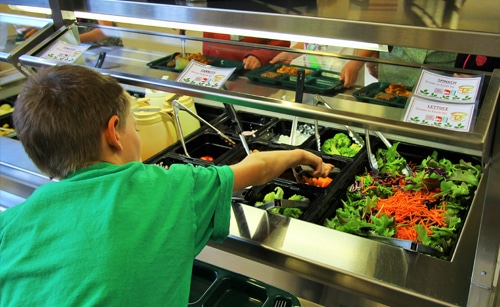
Elementary students enjoying fresh produce in their school lunch. Photo: USDA, Lance Cheung
So as a farmer, the next time you see the school bus go by, I hope you can picture it: the fresh fruits, vegetables, dairy, meat, or grains you so carefully produce could be a part of the meal that feeds those hungry students. It’s a chance to not only feed the kids of your community but to show them where their food truly comes from. What you do every day matters deeply and seeing food you’ve grown on a child’s lunch tray is one of the most rewarding ways your impact comes to life.
This blog is produced by the National Center for Appropriate Technology through the ATTRA Sustainable Agriculture program, under a cooperative agreement with USDA Rural Development. NCAT.ORG/ATTRA.