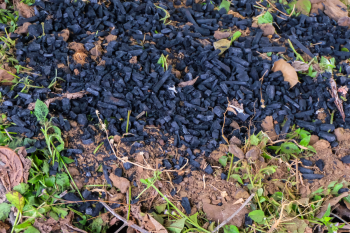
 If you have ever stared into the coals of a fire pit, you have witnessed the powerful chemical reaction between heat and organic matter. But what if the blackened remains of a bonfire could be used to grow better food, prevent catastrophic wildfires, and slow the acceleration of climate change?
It’s hard to believe such a low-tech innovation could have so many benefits, but that’s the power of a material called “biochar.”
The charcoal-like substance is made by burning organic material from agricultural and forestry wastes (wood chips, logging slash, manure, or other plant byproducts) in a low-oxygen environment. This process, called pyrolysis, heats biomass with the absence of oxygen. It traps the carbon in the biochar itself, converting it into a solid form rather than letting it escape into the atmosphere.
Far from a new concept, biochar is as old as agriculture itself. Adding charred organic waste to fields has been done effectively by Indigenous people for millennia. Still, the idea that biochar could be perfected to maximize soil productivity and mitigate climate change has been around for less than 20 years.
While biochar isn’t a fertilizer, research indicates it supports healthy soil biology. It can help retain nutrients and water in the soil due to its charged surface, which allows it to absorb nutrients like nitrogen, phosphorus, and other essential elements. It can last in the environment anywhere from hundreds to thousands of years, making it an effective tool to sequester carbon.
From waste to energy
Gordon West, founder and CEO of Silver City-based Trollworks LLC, has worked for 35 years experimenting with alternative uses for wood waste and forest products. He grew from operating his own woodworking business to researching forest restoration, then pivoted to using wood chips in commercial products like concrete and erosion control systems. One day in 2012, a local inventor introduced him to biochar cooking stoves, and the wheels started turning.
 “We were trying to turn that waste material into an asset, and so my approach changed from making biochar to making heat with biochar as a co-product,” he said.
West believes the biochar byproduct is cheaper than natural gas and roughly as clean when burned correctly. “The energy is actually free, carbon-negative energy created by restoring the environment,” he said. “It’s a clean renewable from a liability. I call it reverse coal mining. Plants remove carbon from the atmosphere. We convert the plant biomass to carbon and a flammable gas (smoke), burn the smoke for energy, and put the carbon in the soil to improve plant growth.”
Biochar producers find that forest and farm waste are excellent free carbon sources. Alternative materials like rice stalks, weeds, pecan shells, and cotton stalks have become popular in New Mexico. Only 1% of the cotton plant is used for cotton. The rest is waste.
The continued evolution of biochar has innovators like West thinking big. “We can replace huge amounts of fossil fuels,” he said. “Because of pyrolysis, you’re still getting a flammable gas to drop into traditional kinds of heaters or even to fuel electrical generators.”
West is currently focused on soil regeneration, thermal fuels, and coupling biochar pyrolysis units to existing boilers and HVAC systems to meet consumer heating needs. He said the greatest interest he’s seen in biochar has been as an energy source–he recently won a grant to heat a classroom building at Northern New Mexico College while making biochar.
He’s optimistic about transforming biomass waste into “bioenergy” while sequestering carbon and creating jobs in rural communities. “Biochar is a new thing, so it’s like trying to grow a market from scratch,” he said. “We hope to grow both things incrementally.”
Accelerating Biochar
To realize biochar’s potential, America needs a coordinated research program. Congress is crafting the 2023 Farm Bill, which presents a big opportunity to ensure the promise of biochar is realized.
The National Center for Appropriate Technology (NCAT) is asking Congress to invest in biochar research through the Farm Bill, specifically under the Biochar Research Network Act. It will authorize the USDA to establish a national-scale research program to test different biochar types in different soils and circumstances. With better research will come innovation and practical tools for farmers, ranchers, foresters, and businesses to lean into biochar as a climate solution.
The continued evolution of biochar has innovators like West thinking big. “For many people, biochar is new, so it’s like trying to grow a market from scratch. But I believe we can replace huge amounts of fossil fuels and transform waste into “bioenergy” while sequestering carbon and creating jobs in rural communities.”
Real-world applications
Biochar improves soil health by reducing acidity, upping water and nutrient storage, and providing better drainage and aeration. Biochar can invigorate soils by increasing microbial activity, nutrient availability, and reducing heavy metal toxicity. When using biochar, some farmers have been able to reduce their phosphorus use by 100% and nitrogen by 85% after a few years.
According to West, farmers use biochar and compost as an extract, brew it in water like a teabag, and spray it on fields as a liquid input. It can also be used as a clay-like seed coating to give seeds a microbial head-start in their growth.
As for alternative uses, biochar can be incorporated as aggregate into concrete, used as a component in asphalt road construction, or as a replacement for activated charcoal to filter and absorb contaminants. Forest Service scientists are researching how applying it to soils at abandoned mines can improve water quality, bind heavy metals, and decrease toxic chemical concentrations while improving soil health to establish sustainable plant cover.
West says the ultimate goal of his work is “giving people things they can do every day” to fight the effects of climate change. “Everybody feels pretty hopeless about these large problems. These ideas have been around forever, and there’s nothing complicated about the technology. It’s just thinking about things differently.”

The ‘Black Gold’ that Can Save Soils, Fight Forest Fires, and Power the Planet
It’s hard to believe such a low-tech innovation could have so many benefits, but that’s the power of a material called “biochar.”
The charcoal-like substance is made by burning organic material from agricultural and forestry wastes (wood chips, logging slash, manure, or other plant byproducts) in a low-oxygen environment. This process, called pyrolysis, heats biomass with the absence of oxygen. It traps the carbon in the biochar itself, converting it into a solid form rather than letting it escape into the atmosphere.
Far from a new concept, biochar is as old as agriculture itself. Adding charred organic waste to fields has been done effectively by Indigenous people for millennia. Still, the idea that biochar could be perfected to maximize soil productivity and mitigate climate change has been around for less than 20 years.
While biochar isn’t a fertilizer, research indicates it supports healthy soil biology. It can help retain nutrients and water in the soil due to its charged surface, which allows it to absorb nutrients like nitrogen, phosphorus, and other essential elements. It can last in the environment anywhere from hundreds to thousands of years, making it an effective tool to sequester carbon.
From waste to energy
Gordon West, founder and CEO of Silver City-based Trollworks LLC, has worked for 35 years experimenting with alternative uses for wood waste and forest products. He grew from operating his own woodworking business to researching forest restoration, then pivoted to using wood chips in commercial products like concrete and erosion control systems. One day in 2012, a local inventor introduced him to biochar cooking stoves, and the wheels started turning.
West believes the biochar byproduct is cheaper than natural gas and roughly as clean when burned correctly. “The energy is actually free, carbon-negative energy created by restoring the environment,” he said. “It’s a clean renewable from a liability. I call it reverse coal mining. Plants remove carbon from the atmosphere. We convert the plant biomass to carbon and a flammable gas (smoke), burn the smoke for energy, and put the carbon in the soil to improve plant growth.”
Biochar producers find that forest and farm waste are excellent free carbon sources. Alternative materials like rice stalks, weeds, pecan shells, and cotton stalks have become popular in New Mexico. Only 1% of the cotton plant is used for cotton. The rest is waste.
The continued evolution of biochar has innovators like West thinking big. “We can replace huge amounts of fossil fuels,” he said. “Because of pyrolysis, you’re still getting a flammable gas to drop into traditional kinds of heaters or even to fuel electrical generators.”
West is currently focused on soil regeneration, thermal fuels, and coupling biochar pyrolysis units to existing boilers and HVAC systems to meet consumer heating needs. He said the greatest interest he’s seen in biochar has been as an energy source–he recently won a grant to heat a classroom building at Northern New Mexico College while making biochar.
He’s optimistic about transforming biomass waste into “bioenergy” while sequestering carbon and creating jobs in rural communities. “Biochar is a new thing, so it’s like trying to grow a market from scratch,” he said. “We hope to grow both things incrementally.”
Accelerating Biochar
To realize biochar’s potential, America needs a coordinated research program. Congress is crafting the 2023 Farm Bill, which presents a big opportunity to ensure the promise of biochar is realized.
The National Center for Appropriate Technology (NCAT) is asking Congress to invest in biochar research through the Farm Bill, specifically under the Biochar Research Network Act. It will authorize the USDA to establish a national-scale research program to test different biochar types in different soils and circumstances. With better research will come innovation and practical tools for farmers, ranchers, foresters, and businesses to lean into biochar as a climate solution.
The continued evolution of biochar has innovators like West thinking big. “For many people, biochar is new, so it’s like trying to grow a market from scratch. But I believe we can replace huge amounts of fossil fuels and transform waste into “bioenergy” while sequestering carbon and creating jobs in rural communities.”
Real-world applications
Biochar improves soil health by reducing acidity, upping water and nutrient storage, and providing better drainage and aeration. Biochar can invigorate soils by increasing microbial activity, nutrient availability, and reducing heavy metal toxicity. When using biochar, some farmers have been able to reduce their phosphorus use by 100% and nitrogen by 85% after a few years.
According to West, farmers use biochar and compost as an extract, brew it in water like a teabag, and spray it on fields as a liquid input. It can also be used as a clay-like seed coating to give seeds a microbial head-start in their growth.
As for alternative uses, biochar can be incorporated as aggregate into concrete, used as a component in asphalt road construction, or as a replacement for activated charcoal to filter and absorb contaminants. Forest Service scientists are researching how applying it to soils at abandoned mines can improve water quality, bind heavy metals, and decrease toxic chemical concentrations while improving soil health to establish sustainable plant cover.
West says the ultimate goal of his work is “giving people things they can do every day” to fight the effects of climate change. “Everybody feels pretty hopeless about these large problems. These ideas have been around forever, and there’s nothing complicated about the technology. It’s just thinking about things differently.”
Choose Local, Shop Your Montana Farmers Market
Montana joins markets across the country in celebrating National Farmers Market Week, August 6-12, 2023. The National Center for Appropriate Technology (NCAT), which coordinates the Montana Farmers Market Network, encourages everyone to celebrate by shopping at local farmers markets this week and every week. Farmers markets connect community members with the people who grow our food, which can work to create a more fair and sustainable food system.
“Farmers Markets in Montana are hubs of economic development, often acting like new business incubators,” says Tammy Howard, an agriculture specialist at NCAT. “Farmers markets create opportunities for vendors to expand their marketing platforms through product development, testing, and brand recognition.”
National Farmers Market Week is an annual celebration of farmers markets proclaimed by the U.S. Department of Agriculture and coordinated by the Farmers Market Coalition, a membership-based nonprofit organization that supports farmers markets nationwide through training, technical assistance, and network-building. This year, the campaign is centered around the essential role that farmers market operators play, both in our local food systems and in our communities. For more than 50 years, farmers markets have influenced the way we eat, shop, and connect to our food, farmers, and each other.
“Over the last three years, I have seen firsthand how farmers markets provide a place for small operations to grow into thriving businesses,” says Maura Henn, Community Food Systems Specialist at NCAT. “Farmers markets not only help communities understand where their food and farm products come from, but also encourage more people to grow and prepare their own food,” says Henn.
In a 2022 report, Montana Farmers Markets were found to provide an average of 250 full-time jobs. In addition to this, the report found that nearly 5,000 individuals work to produce the goods and services offered each week during Montana farmers market season.
There are 76 farmers markets in Montana operating in 2023 according to the Abundant Montana Directory. Of those markets, 29 accept SNAP benefits making fresh, locally produced products accessible to more Montanans and 20 farmers markets also participate in the Double SNAP Dollars Program which matches a customer’s SNAP benefit. The Double SNAP Dollars program has served nearly 9,000 Montanans and has recirculated more than $1 million to local farmers, ranchers, and farmers markets.
In addition to special events like music, cooking classes, or yoga, some markets provide educational opportunities to learn about local food through the Montana Harvest of the Month Program. This year, five markets offer Harvest of the Month activities. Farmers markets are also important partners in the SNAP-Ed program. In 2022, 19 farmers markets participated in SNAP-Ed which helped increase access to and promotion of fruits and vegetables to youth and adults in Montana.
Montana farmers markets are also important for vulnerable populations to access nutritious foods. Almost 200 farmers statewide accept Senior Farmers Market Nutrition Program coupons which provide almost $50 in coupons to help seniors purchase Montana grown fresh fruits, vegetables, and raw honey. In 2023, 88 farmers are authorized to accept the Women, Infant, and Children Farmer Market Nutrition Program (WIC FMNP) vouchers, many of whom operate at farmers markets.
To find a farmers market near you visit AERO’s Abundant Montana Directory.
The Montana Farmers Market Network is a coalition of partners coordinated by NCAT, including farmers market managers, the Community Food and Agriculture Coalition, AERO, and the Montana Department of Agriculture.
NCAT Announces its New Executive Director
The National Center for Appropriate Technology’s (NCAT) Board of Directors today announced it has selected Fred Bahnson to lead the organization.
Bahnson joins NCAT after a competitive national search.
“Fred brings to NCAT two decades of leadership experience in regenerative agriculture and climate advocacy,” said NCAT Board Chairperson Jackie Hutchinson. “His depth of knowledge, and passion for our work, will benefit NCAT as it leans into its next chapter.”
Created as a result of the energy crisis of the 1970s, NCAT’s mission to build a more sustainable future is focused today on providing trusted and practical tools for communities, farmers, local governments, and other nonprofits working toward regenerative agriculture and renewable energy efforts. With staff in 12 states, NCAT is headquartered in Butte, Montana. Bahnson lives in southwest Montana and will work in a hybrid capacity, connecting regularly with the Butte office while also traveling to connect with NCAT’s many partners and field staff around the country.
Bahnson is the founding director of two environmental nonprofits. In 2005 he co-founded and directed a congregation-supported agriculture project in North Carolina to support local food security, and in 2012 became the founding director of the Food, Health, and Ecological Well-Being Program at Wake Forest University School of Divinity, a program that trains faith and nonprofit leaders to create more just and healthy food systems.
Bahnson is also a journalist, author, and documentary filmmaker. His work has been published in venues like Harper’s, Christian Science Monitor, Orion, and Best American Travel Writing, and has been supported by journalism grants from the Pulitzer Center on Crisis Reporting and Boston University’s Religion and Environment Story Project fellowship. He was awarded a two-year W.K. Kellogg Food and Society Policy Fellowship, which allowed him to research small-scale regenerative agriculture practices. That work culminated in his first book, Soil & Sacrament: A Spiritual Memoir of Food & Faith (Simon & Schuster, 2013). Most recently he worked for a climate tech company helping catalyze nature-based solutions to the climate crisis.
“I’m hugely honored to be joining NCAT at this pivotal moment in the organization’s history,” Bahnson said. “From the Soil for Water and Armed to Farm programs, to its AgriSolar Clearinghouse and energy assistance work, NCAT is known nationally as a trusted and reliable partner that helps underserved communities become more resilient. In the face of a changing climate, that work has never been more vital and necessary. I’m excited to help share NCAT’s story with wider audiences, grow our partnerships, and expand our funding base to better support the communities we serve.”
To learn more about NCAT and its mission visit, NCAT.ORG.
CBS ‘Saturday Morning’ Features AgriSolar
CBS Saturday Morning featured NCAT’s AgriSolar Clearinghouse and one of the farmers who is partnering with an energy company to graze his sheep among their solar panels during a six-minute piece that aired nationwide.
Pairing farming with solar energy production offers many “stacked benefits,” according to CBS.
“This is going to be a game changer,” NCAT Energy Program Director Dr. Stacie Peterson told CBS. “This is taking off all across the country. We’re here to help you figure out what’s best for your area and connect you with the right people to help you do this if you want this on your farm or in your community.”
“We’re producing food, fiber, and energy all from the same acre of land,” said Solar Shepherd Founder Dan Finnegan. “It’s a smarter way to use this land.”
To learn more about agrisolar, or agrivoltaics, visit NCAT’s AgriSolar Clearinghouse.
Harvesting Helena Workshop to Showcase ‘Montana Harvest of the Month,’ Community Food Programs
An August workshop in Helena will offer a day of training and tours for anyone interested in getting more Montana grown and raised food into their community.
The event, Farm to School Workshop: Harvesting Helena, will provide general training on farm to school programs and Montana Harvest of the Month, which promotes Montana foods in Montana communities. Each month, sites taking part in Harvest of the Month spotlight a product grown in the state and serve it in at least one meal, snack, or à la carte offering.
The National Center for Appropriate Technology (NCAT) coordinates Montana Harvest of the Month in collaboration with Montana Team Nutrition. Helena Food Share, Old Salt Co-op, St. Peter’s Health, and Helena Public Schools are among the other partners hosting the August workshop.
“Helena has a lot going on in the local food space,” said NCAT Local Foods Specialist Molly Kirkham. “Not only do they have their very own Harvest of the Month Community Coordinator, but there are also many Helena-based organizations implementing the program. Folks are especially excited to learn more about the organizations increasing access to local food.”
Kirkham said anyone with an interest in locally grown food is encouraged to attend the event Thursday, August 10, at Central Elementary School, located at 402 North Warren Street. It will begin at 9 a.m. and end at 4 p.m.
The workshop will include tours of Old Salt Co-op’s new processing facility, school gardens, Helena Community Gardens, and Helena Food Share’s pantry and mobile kitchen. Along with the tours and training opportunities, there will be time for networking, tasting local foods, and action planning.
The cost for the Farm to School Workshop: Harvesting Helena is $25 for an individual, and some scholarships are available. Registration includes lunch and snacks made with local foods.
For more information on the conference and scholarships and to register, go here: https://mtharvestofthemonth.org/harvestinghelena/ .
NCAT Releases New Guide to Saving Water, Energy for Irrigators
Responding to water shortages and uncertainties throughout the western United States, the National Center for Appropriate Technology (NCAT) has released a new edition of its popular The Irrigator’s Pocket Guide.
“With growing conflict over water supplies, and with irrigators feeling the pinch to save water, energy, and money, we wanted to come up with a concise and super-useful guide to water and energy conservation,” said Mike Morris, NCAT’s Southwest Regional Director, who headed up the project.
Irrigation experts from more than 20 states have weighed in on The Irrigator’s Pocket Guide over the years, and more than 30,000 copies have been distributed.
This new edition was developed through NCAT’s Soil for Water project, with funding from USDA’s Natural Resources Conservation Service (NRCS).
“In this new edition of The Irrigator’s Pocket Guide, we decided to go beyond pump and motor maintenance and irrigation scheduling and incorporate recent advances in soil science,” Morris said. “When soil gets healthier, it catches and holds more water. Taking care of soil health therefore needs to be a priority for all irrigators.”
The Equipment Maintenance half of the book features clear and detailed maintenance and troubleshooting procedures for pumps, motors, engines, control panels, and distribution systems. The Water Maintenance section of the book covers soil health and gives step-by-step instructions for running all common types of irrigation systems efficiently — matching water applied to crop needs.
The compact 150-page book includes dozens of diagrams, tables, and handy conversions and formulas for calculating things like flow rates, area, pressure, power, friction losses, and how long to run a system to apply a given volume of water. With its small 4-inch by 6-inch size and durable waterproof covers, the book is a friendly companion to carry in your hip pocket or the glove box of your truck.
Free copies are available by mail or online at the ATTRA website.
Along with the updated edition of the original The Irrigator’s Pocket Guide, new state-specific editions are also available for irrigators in Colorado, New Mexico, and Texas, as well as an updated version of the popular The California Microirrigation Pocket Guide. All these books can be found on the ATTRA website.
WATCH: How AgriSolar Helped the Cows Come Home to One Northeast Farm
For more than 150 years Knowlton Family Farms in Grafton, Massachusetts has been a family-owned operation. It’s grown and shrunk over the years, and now is back in a period of expansion thanks to combining solar energy production with agriculture.
The National Center for Appropriate Technology’s (NCAT) AgriSolar Clearinghouse today released its short film “The Cows Come Home,” which shows viewers how the Knowlton family has been able to reintroduce cattle to their farm. Owner Paul Knowlton says the last of their dairy cows were sold in 1995, and now they’ve been able to bring cattle back to the farm to graze among solar panels.
“We really wanted to try to do something different, and we made it happen, it’s a reality, and I couldn’t be more pleased with the results,” Paul Knowlton said. “It was designed with the cows in mind, vegetables in mind, and also we can put a variety of different animals in here for grazing. They [the cows] took to it like fish to water.”
AgriSolar or agrivoltaic partnerships are growing across solar-appropriate farmland in the U.S., providing a new revenue source for farmers, clean energy for surrounding communities, and myriad benefits to crops, livestock, and pollinators.
Knowlton says agrisolar is what has allowed his farm to remain a viable family business.
“Nationwide, this could be a new standard,” Knowlton adds. “The idea of year-round revenue is really, really important. Having a farm that has the ability to survive is just so important. This is a way to keep the farmland going.”
NCAT’s AgriSolar Clearinghouse is connecting businesses, land managers, and researchers with trusted resources to support the growth of co-located solar and sustainable agriculture.
“AgriSolar partnerships are helping to keep family farms in family hands,” said NCAT Energy Director Stacie Peterson, PhD. “We can maximize finite resources for the benefit of communities, the environment, and businesses when agriculture and energy come together.”
Montana Military Veteran Champions the Power of ‘Armed to Farm’ Alumni Network
“Learning to farm is more than a notion,” Armed to Farm alum and Montana farmer-veteran Lawrence Rhone recently told KRQE-TV. “It’s another language.”
Rhone is among nearly 1,000 military veterans who’ve completed the hands-on, intensive Armed to Farm training program. First launched in 2013 through a cooperative agreement with USDA-Rural Development, Armed to Farm is funded in part by ATTRA. That same year, Rhone bought his farm in northeast Montana.
Now, Rhone is a vocal advocate for the Armed to Farm program, and he has said that a unique value of the program is the lasting relationships that have formed among the network of alum. For new farmer veterans just getting started, he said there’s no other program like Armed to Farm.
“Get to an Armed to Farm alumnus or contact NCAT because you have put together a tremendous program that helps you figure out how to break the ice.”
The weeklong Armed to Farm training features farm tours and hands-on activities at a variety of successful farms. Participants learn from seasoned farmers and gain direct experience on livestock, vegetable, fruit, and agritourism operations. Farmer veterans learn how to create a business plan and market their products, access USDA programs, set business goals, and develop mentorships with seasoned farmers.
“We don’t just have classroom time. We leave the classroom and go to farms of veterans who are walking the walk and that is powerful,” said Rhone. “When we went into the military, that’s the same way we did that type of training.”
NCAT Supports Bipartisan Effort to Expand AgriSolar Research
The National Center for Appropriate Technology (NCAT) applauds Senator Martin Heinrich (D-NM) and Senator Mike Braun (R-IN) for introducing a bill that will expand research for agrivoltaics, or agrisolar, which pairs appropriate farmland with solar energy production.
“Expanding agrisolar is all about maximizing our resources to grow both food and renewable energy on the same piece of land, while at the same time diversifying revenue sources for farmers,” said NCAT Executive Director Steve Thompson. “NCAT’s AgriSolar Clearinghouse has spent the last two years working with farmers, land managers, and solar companies to harvest the sun twice. This bipartisan bill will allow us to take agrivoltaics to the next level in this country.”
Agrisolar or agrivoltaic partnerships are growing across solar-appropriate farmland in the U.S., providing a new revenue source for farmers, clean energy for surrounding communities, and myriad benefits to crops, livestock, and pollinators.
The Agrivoltaics Research and Demonstration Act of 2023 will direct $15 million to the U.S. Department of Agriculture for the study of agrisolar systems to develop best practices for farmers, ranchers, solar developers, and communities who want to adopt or expand the use of agrivoltaics.
Supporters of the bill include NCAT, American Farmland Trust, the National Sustainable Agriculture Coalition, and the American Solar Grazing Association, among others.
“We applaud Senator Heinrich and Senator Braun for their forward-thinking leadership in introducing this bill,” said Tim Fink, Policy Director for American Farmland Trust. “As the essential transition toward renewable energy accelerates across the country, it must be done in a way that strengthens rural communities and minimizes the footprint on our most productive farmland. This legislation would help advance the potential for agrivoltaics to do both.”
NCAT’s AgriSolar Clearinghouse connects businesses, land managers, and researchers with trusted resources to support the growth of co-located solar and sustainable agriculture. The Clearinghouse includes an interactive atlas of agrisolar sites, funding opportunities and state-specific incentives, an information library with more than 500 peer-reviewed articles, multimedia tools like photos, podcasts, and videos, and one-on-one technical assistance for farmers and solar developers.
NCAT’s Free Farmer-Veteran Training Headed to Massachusetts
The National Center for Appropriate Technology (NCAT) is partnering with New Entry Sustainable Farming Project (NESFP) to bring NCAT’s free Armed to Farm training to the Bay State for the first time. Armed to Farm will take place July 24-28, 2023, in Danvers, Mass. Farmer-veterans will attend classroom sessions and travel to local farms for hands-on learning experiences. The deadline to apply is June 9.
Armed to Farm trainings include an engaging blend of farm tours, hands-on activities, and interactive classroom instruction. NCAT Sustainable Agriculture specialists will teach the training sessions, along with staff from USDA agencies and NESFP. Experienced crop and livestock producers will provide additional instruction.
“We’re eager to bring Armed to Farm to Massachusetts,” said Andy Pressman, NCAT Sustainable Agriculture and Rural Communities Director. “Armed to Farm has served nearly 1,000 veterans in all corners of the country as they start or grow their own sustainable farm business.”
Armed to Farm is a sustainable agriculture training program for military veterans. NCAT, a national nonprofit organization based in Butte, Montana, developed Armed to Farm in 2013 through a cooperative agreement with USDA-Rural Development. Farmer veterans learn how to make a business plan and market their products, how to access USDA programs, set business goals, and develop mentorships with seasoned farmers.
“Armed to Farm was instrumental in helping us learn so much about how to begin our farm,” said program alum Lanette Lepper of Dudley, Massachusetts. “From mistakes to avoid, what crops to grow (or not), and practicalities we never would have thought of ourselves, the experience was invaluable! Just six months after attending, Armstrong Acres was born!”
This training is for military veterans in the Northwest, with selection priority given to Massachusetts residents. The number of participants will be limited. One spouse or farm partner is welcome to attend with a veteran but must submit a separate application.
Applications are available here and are due by June 9, 2023. NCAT will notify selected participants by June 16.
Armed to Farm Massachusetts is supported by USDA’s Office of Partnerships and Public Engagement. Successful applicants may also receive a travel stipend thanks to our partnership with California-based Ranchin’ Vets.
Learn more about NCAT’s Armed to Farm and additional training series at ARMEDTOFARM.ORG.