Remember scraping off your tray in the lunchroom as a kid? Did you ever think about where that waste was going or if it could be more than just garbage? One nonprofit in Silver City, New Mexico is getting its hands dirty and helping kids and school districts reduce lunchroom waste into a valuable learning experience.
The New Earth Project is developing compost processes to create a symbiotic relationship and benefit the community. Carol Ann Fugagli, Education and Outreach Director for the Upper Gila Watershed Alliance and the New Earth Project, explained how they use everyday materials to teach students about climate change and sustainability.
“The looming climate and biodiversity crisis is a real existential threat, and we want to create community resilience,” Fugagli said. “We are focused on educating, inspiring, and empowering youth in our community through educational activities and employment opportunities.”
Carbon capture through composting
New Earth collects food surplus from three school cafeterias and combines it with woody biomass, agricultural byproducts, and biochar in Johnson-Su compost bioreactors. Every week, they fill these bioreactors with this waste and divert approximately 1200 pounds of food waste from the local landfill. The Johnson-Su composting method is a static, aerobic process that produces a diverse, fungal-dominant mix that interacts with plants to sequester carbon in soils, increase water infiltration and retention, fix nitrogen, and increase plant growth.
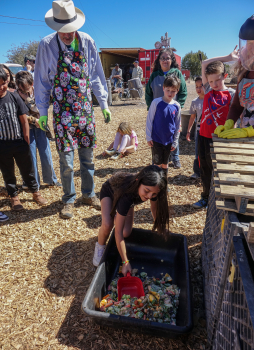
Students participating in the New Earth Project biochar effort in New Mexico.
To increase the value and effectiveness of the compost, they add 10% biochar into the mix. Biochar is a charcoal-like substance made by burning organic material from agricultural and forestry wastes (wood chips, logging slash, manure, or other plant byproducts) in a low-oxygen environment. This process, called pyrolysis, turns into pure carbon, converting it into a solid form rather than letting it escape into the atmosphere.
While biochar isn’t a fertilizer, research indicates it can help retain nutrients in the soil due to its high porosity, allowing it to absorb nutrients like nitrogen, phosphorus, and carbon. Think of a housing complex for billions of needed microbes. It can last in the environment anywhere from hundreds to thousands of years, making it an effective tool to sequester carbon.
After three months of experimenting with the amount and type of biomass and biochar, New Earth found just the right mix to yield the best result. Now that the project has perfected its compost “recipe,” they plan to experiment using other waste streams such as salt cedar, cardboard, and compostable plastics.
Accelerating Biochar
The New Mexico Legislature recently gave a vote of confidence to New Earth’s activities, approving a $100,000 general appropriation to the project in the 2023 spring legislative session.
“Young people are freaked out about the climate crisis. Our project is all about instilling the ethic of restoration and hope in young people. We hope to get a composting system into every school so students can have a project to plug into, giving them real power.”
To realize biochar’s potential, America needs a coordinated research program. Congress is crafting the 2023 Farm Bill, which presents a big opportunity to ensure the promise of biochar is realized.
The National Center for Appropriate Technology (NCAT) is asking Congress to invest in biochar research through the Farm Bill, specifically under the Biochar Research Network Act. It will authorize the USDA to establish a national-scale research program to test different biochar types in different soils and circumstances. With better research will come innovation and practical tools for farmers, ranchers, foresters, and businesses to lean into biochar as a climate solution.
Real-world applications
Biochar-enhanced compost can improve soil health by reducing acidity, upping water and nutrient storage, and providing better drainage and aeration. By increasing pH, biochar can invigorate soils by increasing microbial activity, nutrient availability, and reducing heavy metal toxicity.
Fugagli explained how costly fertilizer may be doing more harm than good. “We’ve killed all the microbiology in the way we grow food. Biochar in the ground makes it a little apartment complex for these microorganisms to give them their housing so they can live in this soil.”
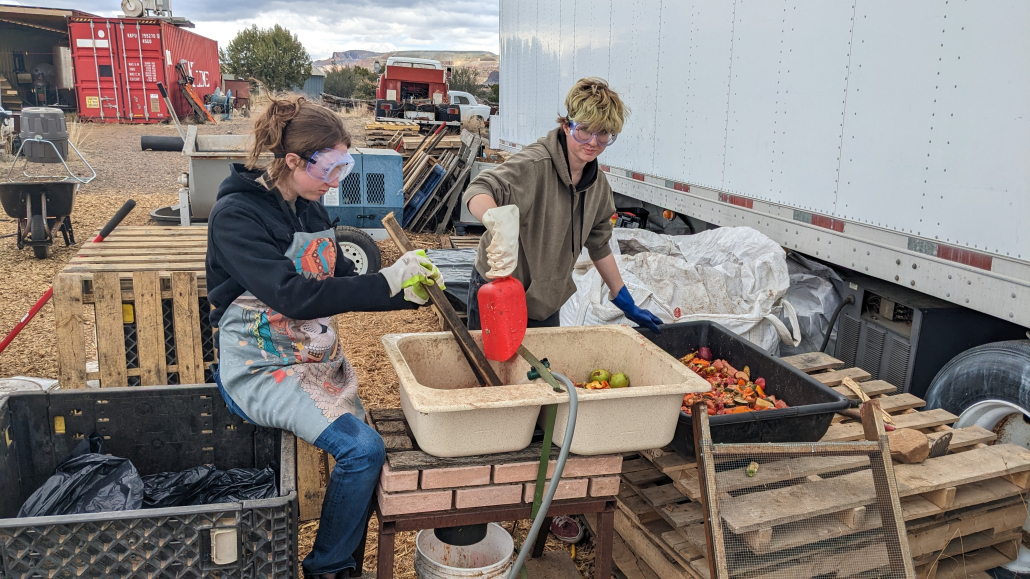
New Earth Project staff grind cafeteria food waste for biochar.
“Many biochar producers are not finding a market to sell to because, for many, biochar is new,” Fugagli said. “We work with Trollworks here in the state and have bought them out more than once. Combining biochar with compost makes sense because we can keep carbon at the roots of our plants where it’s needed rather than in the atmosphere where it causes so much damage.”
The New Earth Compost sits for one year before it can be used. December 2023 is when the first batch will be ready. Marketing their product is their next step. Fugagli said she is contacting larger buyers like a local mine and the New Mexico Department of Transportation to gauge interest in soil remediation projects. They also know that revitalizing agricultural land is a big part of the equation.
“There is no solving our climate crisis without solving the agricultural emissions problem,” she said. “We are working to educate users because you don’t apply it as regular compost – which is what people are used to. You can, but a little goes a long way. Biochar-enhanced compost can help transform ag soils into living soils.”

Program Expanded for Women Beginning Sustainable Livestock Farms
‘Women, Livestock, and the Land’ Adds Mississippi, Alabama, Louisiana, Florida, and Georgia
JACKSON, MS – Women who are beginning sustainable livestock operations in five Gulf-region states will soon have the chance to join a program that can provide them with trusted technical assistance and connect them with a growing national network of their peers.
The program, “Women, Livestock, and the Land,” (WLL) aims to help farmers and ranchers from historically underserved, limited resource, or socially disadvantaged backgrounds start their livestock operations on the right foot. They will learn information and skills to improve the sustainability and profitability of their farms, including goal setting, soil health, regenerative grazing, animal handling, health, equipment and tools, and direct marketing. It is sponsored by the USDA through its Grazing Land Conservation Initiative.
Participating in “Women, Livestock, and the Land” also gives them an opportunity to connect with mentors and newly formed, regionally focused peer-to-peer networks.
The pilot project was offered in Arkansas and Tennessee, and it will now be expanded to include farmers and ranchers in Mississippi, Alabama, Louisiana, Florida, and Georgia.
Applications for “Women, Livestock, and the Land” opened December 19, 2023, and will end on April 30, 2024. To apply for the program, click here.
Past participants in the WLL program stated that this educational opportunity was highly beneficial to them as beginning farmers. “This course was a total game changer for me as I am very new to farming,” one participant wrote in her final review. Another shared, “This course has enlightened me on the community of women in farming.” A third woman said the course “definitely gave me more of an idea of things to be aware of, how to make connections, and some amazing resources! It also provided tons of moral support because of the time with like-minded women farmers!”
NCAT Sustainable Agriculture specialist Linda Coffey, who led the first WLL trainings, was inspired by the cohort of women farmers she worked with. “This has been the best project I’ve done in my 20+ years with NCAT. The women were so supportive of each other, so eager to learn, so hard-working, and so positive. Everybody in the group had something to contribute. It was really fun and really impactful.
I’m glad it is continuing in more states. Women in agriculture working together is so powerful. It has been thought of as a male-dominated occupation, but I think women make great farmers. They are intuitive, observant, and hard-working.”
The National Center for Appropriate Technology (NCAT) began “Women, Livestock, and the Land,” as a pilot program in 2022. NCAT is excited to partner with Food Animal Concerns Trust (FACT) in this project expansion. The program is also supported by Alabama A&M and JG Research & Evaluation, which is based in Bozeman, Mont.
Biochar Is Key to Cascading Benefits in Innovative Carbon Chicken Project
Fifth-generation Arkansas farmer Jody Hardin was introduced to a potentially game-changing soil additive through a USDA Conservation Innovation Grant in 2011. That’s when Hardin began studying biochar—a charcoal-like material that can be mixed in soil to improve overall soil health.
“I had this huge, eye-opening experience,” Hardin said. “That’s when I started actually using biochar on my crops, doing workshops, and teaching farmers how to make it.”
Biochar is created by heating biomass, such as forest waste or animal manure, in a low-oxygen environment—a process known as pyrolysis. Carbon stored in this form can be added to soil to improve moisture retention, nutrient availability, and aeration and create habitat for beneficial soil microbes, all of which can potentially boost soil productivity. Biochar can also last for thousands of years in soil, so it’s increasingly being viewed as an effective means of sequestering carbon.
Now, Hardin wants to use the knowledge he’s gained to tackle some big challenges across the state by using biochar to clean up the Illinois River watershed, reduce greenhouse gas emissions, and help farmers improve the quality of their soil through his innovative initiative called the Carbon Chicken Project.
Many birds with one stone
The Carbon Chicken Project, which aims to develop a market-based, carbon-negative farming ecosystem, has taken shape in Northwest Arkansas, an area with a strong poultry production industry. In fact, the state of Arkansas ranks third in the country for the number of broilers produced (1 billion in 2022). Hardin’s plan is specifically designed to address three things: The first is runoff from poultry litter from the region’s many chicken houses that deposits excess phosphorus into the Illinois River watershed. The second is an abundance of forest and sawmill waste, which releases greenhouse gasses into the atmosphere if left to decompose. Third, Hardin and other farmers are seeking new ways to increase their yields by improving soil health.
For many, this win-win-win solution would be enough. But for Hardin—an agricultural entrepreneur with an economics background—it’s a foundation for a larger vision.
“We’re trying to build this whole ecosystem around biochar that’s very extensive, but when you think about an ecosystem, it’s really a circular economy,” Hardin said. “We can sell the carbon credits, we can sell the biochar, and we can make electricity, and we can clean up a watershed, and we can sequester carbon and prevent climate change. It’s just cascading the benefits of what this product does.”
Accelerating biochar
Producers across the country are looking to Congress to realize biochar’s immense potential. With the most recent Farm Bill recently expired, the National Center for Appropriate Technology (NCAT) is asking Congress to invest in biochar research through the next Farm Bill, under the bipartisan Biochar Research Network Act. If passed, the bill will authorize the U.S. Department of Agriculture (USDA) to establish a national-scale research program to test different biochar types in different soils and circumstances. With better research will come innovation and practical tools for farmers, ranchers, foresters, and businesses to lean into biochar as a climate solution that improves their bottom line.
On the research front, a recent USDA study showed that biochar made from poultry litter adds value and could be an attractive solution for waste disposal for the industry.
Hardin knows the impact that investment in biochar research can make, referring to his own introduction to biochar—and subsequent learning, experimentation, and research—stemmed from a grant from Natural Resources Conservation Service (NRCS) Conservation Innovation Grants (CIG).
“The Carbon Chicken Project would have never ever happened if it wasn’t for this CIG grant,” Hardin said. “That innovation grant really worked because we’ve created this massive environmental solution for Northwest Arkansas’s watershed using a scaled-up idea that started with that little grant.”
Next steps
“I’ve been doing biochar research here on my farm for a good year, and I’ve got feedstock sources, I’m building pyrolysis units, I’ve got different application rate studies already going,” he said. “I’m trying to use this as a base to organize farmers so that they can see the amazing benefits and the yield increases, and all the things that we’re doing.”
Organic Transition Training Coming to Great Falls
Stipends Available for Beginning Farmers and Ranchers to Attend
The National Center for Appropriate Technology, along with nationally recognized organic leaders, will offer an Organic Academy Road Show (OARS) training at the Mansfield Convention Center in Great Falls, Montana, on December 6 and 7, 2023. Beginning farmers and ranchers in the Northern Great Plains will have the opportunity to explore regenerative, certified organic production systems for livestock, grains, oilseeds, and pulses.
Thirty stipends for beginning farmers and ranchers are available for up to $200 each to defray the costs of attending. There is no registration fee, but registration is required. Online registration is available at NCAT.ORG/EVENTS.
This event will host intensive training sessions and one-on-one technical assistance for beginning farmers and ranchers. Topics will include developing an organic system plan, the economics and markets for organic products, considerations when transitioning an operation, working with an organic consultant, and more. There will be time for questions and crowdsourcing ideas with experienced organic farmers and ranchers including Nate Powell-Palm, Doug Crabtree, Margaret Scoles, and others. Thursday’s session will conclude with a tour of an organic processing facility. The event schedule can be found here.
“This series of educational opportunities is not just another farming training,” said Doug Crabtree and Anna Jones-Crabtree of Vilicus Farms in Montana. “It is about leveraging training to further build the network of beginning organic producers who are farming and ranching at a scale that will have a tremendous impact on land stewardship across the Northern Great Plains.”
OARS attendees who are farmers and ranchers transitioning to organic can also apply for a complimentary two-day conference pass to the Montana Organic Association Conference, December 8-9, 2023, also at the Mansfield Convention Center.
The OARS sessions are part of the three-year federal Beginning Farmers and Rancher Development Program, Preparing a Resilient Future, in partnership with the Montana Organic Association, Northern Plains Sustainable Agriculture Society, Center for Rural Affairs, the Intertribal Agriculture Council, Nebraska Sustainable Agriculture Society, International Organic Inspectors Association, North Dakota State, and University of Wyoming.
The project targets medium to large-scale field crop and livestock operations, unlike most programs focused on beginning farmers and ranchers. This project was selected in a national competition under the Beginning Farmers and Ranchers Development Program funded through the USDA National Institute of Food and Agriculture.
Cotton and Wool Producers Invited to Apply to Climate Beneficial Fiber Program
Provides technical assistance and direct payments to producers.
Cotton and wool producers in the states of California, Georgia, Indiana, Montana, North Carolina, New York, South Dakota, Tennessee, and Wyoming are invited to apply to the new program “Climate Beneficial Fiber: Building New, Accessible, and Equitable Market Opportunities for Climate-Smart Wool and Cotton.”
With funding from USDA’s Partnerships for Climate-Smart Commodities Program, the National Center for Appropriate Technology (NCAT) and its partners — Carbon Cycle Institute, Fibershed, New York Textile Lab, Seed2Shirt, and the Colorado State University Department of Soil and Crop Sciences — are ready to provide technical assistance and $18 million in direct payments to producers, enabling them to choose and adopt climate-smart conservation practices that fit with their farming operations and goals.
Participating farms and ranches will work with experts to create a tailored plan that identifies opportunities to bring more carbon into soils and vegetation and reduce greenhouse gas emissions. Participants will then receive incentive payments for adopting practices that — besides being “climate-smart” — have benefits such as increasing the water-holding capacity of soils, reducing the need for expensive synthetic fertilizers, and boosting overall farm productivity.
The program provides technical assistance and planning at no cost to producers and pays 75 to 90 percent of the average cost of implementing recommended practices. Over the next five years, the program hopes to sign up 100 agricultural operations and impact two million acres of land.
At least 40 percent of all program benefits will go to small and underserved farmers, and a special initiative is encouraging Black farmers in southern states to grow climate-smart cotton. “We’re making it a priority to reach and include folks who have not traditionally benefited from this type of program,” said NCAT Executive Director Fred Bahnson. “We strongly encourage cotton and wool producers of all sizes to apply.”
Building on the Climate Beneficial™ Verification program already developed by Fibershed, the program is also working with well-known clothing brands and textile manufacturers to expand markets for climate-smart wool and cotton. Growing concerns about textile-derived microplastics, land-use impacts, “fast fashion,” and human rights have prompted an industry-wide shift to seek natural fiber sources with verified benefits to land and climate.
“Our long-term goal is to create a self-sustaining consumer market and regional manufacturing systems that reward cotton and wool producers with price premiums for drawing down carbon from the atmosphere,” said Fibershed Executive Director Rebecca Burgess. “That’s good for rural communities as well as the planet.”
Producers interested in learning more can visit the Climate Beneficial Fiber Partnership website (fiberpartnership.ncat.org) and fill out an interest form.
WATCH: How NCAT’s Armed to Farm Helped One Veteran Find Her Purpose
Ten years ago, Air Force veteran Sara Creech almost didn’t attend NCAT’s first week-long Armed to Farm, a sustainable agriculture education program for military veterans. After driving from Indiana to Arkansas for the training, anxiety told her to turn around and go home. Instead, she found the strength to stay.
“I went in there and had the most powerful week of my life,” Sara Creech said. “I really look at this life that I’ve built right now, and it all started with that Armed to Farm.”
The National Center for Appropriate Technology today released its short film “Armed to Farm Stories: Sara Creech,” in which Creech, a former surgery and trauma nurse who served during the wars in Iraq and Afghanistan, shares her story of overcoming loss through organic farming. Attending NCAT’s Armed to Farm program in 2013 empowered Sara not only to pursue farming, but also to help other farmer veterans.
In the film, we see the diversified vegetable, fruit, and livestock farm Sara has built over the past ten years and hear from members of the farmer veteran community who have benefited from Sara’s mentorship.
Many service members feel disconnected from their communities and former lives when they come home, Sara said. Organic and sustainable farming can help them feel connected and whole again.
“Armed to Farm offers practical information to help veterans get their farms started, or expand their operations,” said Margo Hale, Armed to Farm Program Director. “The classroom sessions, along with farm tours and hands-on activities, give them a strong foundation in sustainable agriculture. And the relationships they develop during the week of training—which often continue long after the week is over—are invaluable.”
Armed to Farm participants learn from seasoned farmers and gain direct experience on livestock, vegetable, fruit, and agritourism operations. Since the week-long program began ten years ago, more than 1,000 veterans from 47 states have participated in the training. When surveyed one year after attending an Armed to Farm, 73 percent of participants indicated they continued farming, had started farming, or were in the process of starting a farm.
Sara credits farming with bringing peace to her life, as well as giving her purpose—caring for the land, feeding her community, and supporting other veterans who want to farm. And Sara is just one example of Armed to Farm alumni helping their fellow farmer veterans.
“Sara exemplifies what we hope to achieve through the Armed to Farm program,” said Hale. “Not only is she operating a successful diversified farm, but she has taken what she learned from us and amplified it so that many other veterans have access to that knowledge and support.”
Watch the film, here: https://www.youtube.com/watch?v=HdsOjbc-GYY
To learn more about NCAT’s Armed to Farm program, visit ARMEDTOFARM.ORG.
North Metro TV Features AgriSolar Farm to Table Event
Thanks to NCAT’s AgriSolar Clearinghouse and its partners, people across the country are enjoying local food produced underneath solar panels. The most recent farm to table event, held in partnership with Big River Farms at Connexus Energy, took place September 26 in Ramsey, Minnesota.
“We’re doing this to help create community and show how delicious this food can be that’s grown underneath solar panels,” NCAT Energy Program Director Dr. Stacie Peterson told North Metro TV.
Co-locating food and fiber production with solar panels can increase land access for farmers and strengthen local food systems.
“I think you’re seeing this all across the country and once people hear about it, it just makes sense,” said Peterson. “They hear about the stacked benefits of agriculture and solar, and agrisolar, and they want to do it, too.”
To learn more about agrisolar, or agrivoltaics, visit NCAT’s AgriSolar Clearinghouse.
Montana Partnership Reduces Food Waste and Supports Sustainable Gardening and Food Production Through Biochar
If you live in Missoula, Montana, you’ve probably seen the blue e-bikes transporting food scraps around town. The nonprofit Soil Cycle began when Missoula resident and backyard gardener, Caitlyn Lewis, saw a nexus between reducing organic waste to divert valuable materials from landfills and improving her neighborhood gardens’ growing potential by making biochar.
“I think about food a lot because I love to eat and value the effort and beauty of the growing process. Wasted food is a big issue, and I think we should honor our food enough to return it to its natural cycle,” Lewis said.
Six years later, Soil Cycle has gone from Lewis picking up scraps from a few clients to six bikers transporting upwards of 60,000 pounds of compost per year. With a bigger staff and a new executive director, they also educate the community, create quality natural fertilizers, and take compost to a new level, all while remaining human-powered.
Turning a Concept into a Product
Mark Vander Meer, the founder of Bad Goat Forest Products, has been practicing and stewarding long-term sustainable forest management in Montana. Soil Cycle team members use the discarded wood shavings from Bad Goat in their 900-degree kiln.
The result is a fine, charred mixture, called biochar, a type of charcoal produced for use in soil by heating biomass in limited oxygen.
Biochar is a very porous, high-carbon form of charcoal that, when mixed into soil, increases airflow, water retention, and nutrient-holding capacity. Its unique structure provides the perfect home for beneficial bacteria, which protects and defends plant roots. Using biochar in the soil allows for continual nutrient and mineral exchange to feed plants and, over time, supports a biologically active carbon storage system, which could help capture the excess carbon in our atmosphere. Biochar provides the most durable form of soil carbon. When produced at high temperatures, it lasts for hundreds to thousands of years in soil.
“We are excited to showcase the potential of biochar because when added to soil, it is one of nature’s many miracles,” said Lewis. “Storing carbon in our soil is also a powerful tool against climate change. It is cost-effective, highly efficient, and designed to work with nature. This unique structure provides the perfect home for beneficial bacteria, which protects and defends plant roots.”
Soil Cycle blends its particular biochar mix with worm castings, Montana volcanic minerals, Azomite, kelp meal, raw sugar, and sand. These materials support plants in homes and gardens to improve overall plant growth, yield, resilience, and nutrient-holding abilities while improving soil moisture retention.
“Our partnership with Bad Goat Lumber has shown us how a waste product – both from wood products and food scraps – can become a rich and valuable source of nutrients when placed under pressure – the diamonds of the soil. This partnership has allowed us to create a product that we couldn’t otherwise by using their facility and biochar-making setup,” said Lewis.
Their Biochar Blend is sold in several nurseries around Missoula and is most popular for house plants. Even though they work with biochar on a small scale, the Soil Cycle team sees potential for backyard gardeners and urban farmers so everyone can experience using it and see its potential application on a larger scale.
Accelerating Biochar
The National Center for Appropriate Technology (NCAT) is asking Congress to invest in biochar research through the Farm Bill, specifically under the Biochar Research Network Act. It will authorize the USDA to establish a national-scale research program to test different biochar types in different soils and circumstances. With better research will come innovation and practical tools for Montana farmers, ranchers, gardeners and foresters to improve soil health and productivity, as they help solve climate change by storing carbon in soil.
The continued evolution of biochar has entrepreneurs like Lewis thinking big.
“We know it will take time to educate our customers (and future customers) about the incredible benefits biochar can give their soil. Even though biochar has been used for centuries, it is still new to most people,” Lewis said.
NCAT’s Sustainable Agriculture Publications Now Available in Spanish
The National Center for Appropriate Technology’s sustainable agriculture program, ATTRA, now has more than 100 trusted publications available in Spanish. These practical publications for producers are available to read or in audio format.
ATTRA’s online resources include more than 300 publications as well as podcasts, videos, databases, and forums. NCAT’s team of Sustainable Agriculture Specialists across the U.S. are working to make these resource available in Spanish.
“We are committed to providing practical information that is easily accessible and understandable for people of diverse backgrounds, all of whom are contributing mightily to sustaining a healthy food system,” said California-based Sustainable Agriculture Specialist Ann Baier.
Latino producers play a crucial role in advancing sustainable agriculture, and language shouldn’t be a barrier for them to access resources. According to the 2017 Census of Agriculture, there were 112,451 Hispanic/Latino producers in the United States, and this number continues to grow.
“We strive to improve our service delivery to the entire community of Latino farmers, whether they can read English or not,” said Texas-based Sustainable Agriculture Specialist Robert Maggiani.
“Knowledge should be accessible to everyone regardless of language, having our content be bilingual is a step closer on making sustainable agriculture tangible to people along the food chain,” said Texas-based Sustainable Agriculture Specialist Luz Ballesteros Gonzalez.
NCAT’s ATTRA is committed to making these resources available and accessible. Spanish-speaking producers can sign up for our monthly newsletter, Cosecha Mensual, to get monthly sustainable agriculture resources delivered to their inbox. Bilingual (Spanish and English) ATTRA Sustainable Agriculture Specialists are available through chat, email, and phone to answer any producer questions.
ATTRA is administered by the National Center for Appropriate Technology (NCAT) in partnership with the USDA Rural Business Cooperative Service. (USDA RBCS). Founded in 1987, ATTRA is a trusted source of sustainable agriculture information and maintains a knowledge base of practical multimedia resources for farmers, ranchers, and educators.
To see all ATTRA’s Spanish resources, go to its website at ATTRA.NCAT.ORG/ES/.
Connecting a Tempeh Producer and Northeast Health Care Groups to Get Local Protein in Hospitals
The word soybeans might conjure up pictures of fields with rows upon rows of the popular commodity crop. But for Sarah Speare, a founder of Tootie’s Tempeh in Biddeford, Maine, soybeans are the protein in a traditional meat substitute that offers plenty of health benefits.
Not everyone has heard of tempeh. “It’s a super food,” Sarah says. It’s incredibly high in protein and nutrients. It’s fermented, so it’s good for your gut. And it’s made from just three simple, clean ingredients: soybeans, vinegar, and starter culture. So, people need to eat it!”
NCAT’s sustainable agriculture team and two other organizations – Health Care Without Harm and the Plant Forward Future Project – partnered to form a producer cohort in the Northeast to develop and market plant-based proteins to hospitals. The project is funded by a USDA Specialty Crop Block Grant, and Sarah is part of the producer cohort.
“NCAT/ATTRA has been a great partner and advocate for our work through a podcast we did with them and especially through their programs that support the sourcing of organic grains and legumes from Maine farmers,” Sarah says.
“Their work with the Hospital Without Harm initiative has also helped us get more visibility as a healthy locally sourced protein in front of potential customers who make decisions for what workers and patients are offered at hospitals. We have also enjoyed working with them to make a Maine event happen that includes sampling our food and a tour of our facility.”
Tootie’s Tempeh developed a method for fermenting its product in metal pans instead of single-use plastic bags, which is the practice of much of the industry.
The company uses organic soybeans and sources them regionally, and it is developing a franchise structure that creates a network of other regional production facilities. That allows the tempeh from Tootie’s to have regional suppliers regardless of where its stores are created.
Tootie’s Tempeh reflects Sarah’s values – that “essential food can help support the well-being of people, animals, and the planet.”
It’s also organized as a worker-owned cooperative, as Sarah puts it, “to help support a more democratic economy where workers are the decision makers and share in the profits.
“I viewed (tempeh) as a sleeping giant ready to be woken up,” she adds. “Plant-based protein are skyrocketing, and consumers are eating more for their health and to decrease their carbon footprint. It really seemed like the right time to help tempeh become a household staple.”
Sustainability Project Transforms Cafeteria Waste into Usable Compost
Remember scraping off your tray in the lunchroom as a kid? Did you ever think about where that waste was going or if it could be more than just garbage? One nonprofit in Silver City, New Mexico is getting its hands dirty and helping kids and school districts reduce lunchroom waste into a valuable learning experience.
The New Earth Project is developing compost processes to create a symbiotic relationship and benefit the community. Carol Ann Fugagli, Education and Outreach Director for the Upper Gila Watershed Alliance and the New Earth Project, explained how they use everyday materials to teach students about climate change and sustainability.
“The looming climate and biodiversity crisis is a real existential threat, and we want to create community resilience,” Fugagli said. “We are focused on educating, inspiring, and empowering youth in our community through educational activities and employment opportunities.”
Carbon capture through composting
New Earth collects food surplus from three school cafeterias and combines it with woody biomass, agricultural byproducts, and biochar in Johnson-Su compost bioreactors. Every week, they fill these bioreactors with this waste and divert approximately 1200 pounds of food waste from the local landfill. The Johnson-Su composting method is a static, aerobic process that produces a diverse, fungal-dominant mix that interacts with plants to sequester carbon in soils, increase water infiltration and retention, fix nitrogen, and increase plant growth.
Students participating in the New Earth Project biochar effort in New Mexico.
To increase the value and effectiveness of the compost, they add 10% biochar into the mix. Biochar is a charcoal-like substance made by burning organic material from agricultural and forestry wastes (wood chips, logging slash, manure, or other plant byproducts) in a low-oxygen environment. This process, called pyrolysis, turns into pure carbon, converting it into a solid form rather than letting it escape into the atmosphere.
While biochar isn’t a fertilizer, research indicates it can help retain nutrients in the soil due to its high porosity, allowing it to absorb nutrients like nitrogen, phosphorus, and carbon. Think of a housing complex for billions of needed microbes. It can last in the environment anywhere from hundreds to thousands of years, making it an effective tool to sequester carbon.
After three months of experimenting with the amount and type of biomass and biochar, New Earth found just the right mix to yield the best result. Now that the project has perfected its compost “recipe,” they plan to experiment using other waste streams such as salt cedar, cardboard, and compostable plastics.
Accelerating Biochar
The New Mexico Legislature recently gave a vote of confidence to New Earth’s activities, approving a $100,000 general appropriation to the project in the 2023 spring legislative session.
“Young people are freaked out about the climate crisis. Our project is all about instilling the ethic of restoration and hope in young people. We hope to get a composting system into every school so students can have a project to plug into, giving them real power.”
To realize biochar’s potential, America needs a coordinated research program. Congress is crafting the 2023 Farm Bill, which presents a big opportunity to ensure the promise of biochar is realized.
The National Center for Appropriate Technology (NCAT) is asking Congress to invest in biochar research through the Farm Bill, specifically under the Biochar Research Network Act. It will authorize the USDA to establish a national-scale research program to test different biochar types in different soils and circumstances. With better research will come innovation and practical tools for farmers, ranchers, foresters, and businesses to lean into biochar as a climate solution.
Real-world applications
Biochar-enhanced compost can improve soil health by reducing acidity, upping water and nutrient storage, and providing better drainage and aeration. By increasing pH, biochar can invigorate soils by increasing microbial activity, nutrient availability, and reducing heavy metal toxicity.
Fugagli explained how costly fertilizer may be doing more harm than good. “We’ve killed all the microbiology in the way we grow food. Biochar in the ground makes it a little apartment complex for these microorganisms to give them their housing so they can live in this soil.”
New Earth Project staff grind cafeteria food waste for biochar.
“Many biochar producers are not finding a market to sell to because, for many, biochar is new,” Fugagli said. “We work with Trollworks here in the state and have bought them out more than once. Combining biochar with compost makes sense because we can keep carbon at the roots of our plants where it’s needed rather than in the atmosphere where it causes so much damage.”
The New Earth Compost sits for one year before it can be used. December 2023 is when the first batch will be ready. Marketing their product is their next step. Fugagli said she is contacting larger buyers like a local mine and the New Mexico Department of Transportation to gauge interest in soil remediation projects. They also know that revitalizing agricultural land is a big part of the equation.
“There is no solving our climate crisis without solving the agricultural emissions problem,” she said. “We are working to educate users because you don’t apply it as regular compost – which is what people are used to. You can, but a little goes a long way. Biochar-enhanced compost can help transform ag soils into living soils.”