Tag Archive for: Armed to Farm

By Mike Lewis, NCAT Senior Manager and Farmer Veteran  

It was quiet when it happened. Not the kind of quiet that feels empty, but the kind that wraps around you like the stillness before a summer storm. A couple of weeks ago, my coworker Eric and I spent a day wandering through Armstrong Redwoods State Natural Reserve in Sonoma, California. We had come to the region for a year-end celebration hosted by Ranchin’ Vets, one of our Armed to Farm partners. But that day, we were just two friends walking through a forest of giants. 

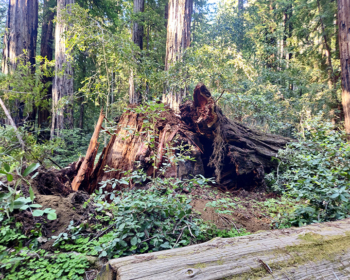
We didn’t expect to hear the groaning, cracking, and deep roar that followed. A thousand-year-old redwood—one of the elders of that forest—began to fall. We stood still, breath caught, as the ancient tree surrendered to gravity and centuries of standing strong. It collapsed with a thunder that rolled through the valley like the voice of God.

There was no panic in the moment. Just awe. Sadness, yes, and something like reverence. It felt like watching a great soul leave the earth—but also like being let in on a secret. A rare, sacred kind of transformation. We hadn’t come to witness anything that monumental, but sometimes the earth has its own plans.

As we approached the fallen redwood, we were struck not just by its size, but by its presence. Even fallen, it was not diminished. The tree, we knew, was not done with its work. Its life had changed form, not ended. Now it would become a home to insects and birds. It would hold moisture, enrich soil, and slowly feed the roots of new growth. Its service to the forest would continue—just in quieter, slower, more hidden ways. 

That moment lingered with us, especially considering the work that had brought us there. Veterans—the ones we train, work alongside, and learn from—often come home changed. Some carry the visible scars of their service; others bear the invisible ones. But many of them return not to rest, but to serve again—this time by growing food, stewarding land, and nurturing the very communities they once left to protect. 

Like the redwood, their fall from battle does not mark the end of their story. In fact, it begins a new chapter of service. One rooted not in combat, but in care. Not in defense, but in cultivation. 
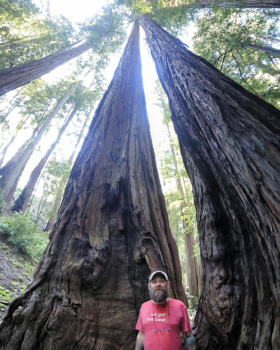
The redwood fell exactly where it had stood for over a thousand years—a reminder that there’s something sacred about place. That tree will now nurture the forest that once nurtured it. And that, too, is the story of many veterans who return to their communities, not only to heal themselves, but to heal the land and people around them. 

In our trainings, we see this time and again: veterans reconnecting with the soil, finding meaning in seeds, livestock, rain, and hard work. Farming offers more than a livelihood. It offers a sense of rootedness, of coming home in a deeper way. It’s not about escaping from the past but building the future—allowing one’s story to take new shape in familiar ground. 

The land doesn’t ask veterans to forget who they were. It invites them to become fully who they are now. 

As we looked around the grove, we noticed something else: no part of the tree would go to waste. The forest already knows how to receive it. Birds will perch on its limbs. Mushrooms will take root in its bark. Young trees will sprout in the softened soil beneath it. 

The forest never loses its own. 

That truth echoes in the way we view veterans in our work. Too often, society treats their transition as an ending—a closing of one chapter with no roadmap for what comes next. But in agrarian life, we see something different. We see a forest that welcomes them back. We see communities strengthened by their presence. We see the way they feed the ecosystem with their skills, their values, and their willingness to serve again—this time as cultivators of resilience, local knowledge, and hope. 

We like to imagine that life has chapters: childhood, youth, service, retirement. But that’s not how nature works. The redwood doesn’t retire. It simply moves from one mode of giving to another. The ecosystem doesn’t discard what falls; it transforms it into the conditions for life. 

Service isn’t a season. It’s a cycle. 
Veterans know this in their bones. They understand commitment, discipline, purpose—and many of them are now discovering how those same values apply not just in battle, but in fields, kitchens, farmers markets, and classrooms. They are becoming food producers, educators, mentors, and neighbors. They are learning to grow instead of defend—to restore rather than react. And in doing so, they help restore the places they love. 

Back in the forest, after the fall, the birds kept singing. Sunlight filtered down to the understory in a new way. And Eric and I stood there, not in grief, but in gratitude. We had witnessed something ancient and holy—a reminder that even the mightiest among us are still part of a much larger cycle. 

Maybe that’s what the redwood was trying to show us: that when we root ourselves in service to others and to the land, we never really stop growing. Even when we fall, we fall into the arms of something that knows exactly what to do with us. 

The forest never forgets. 

The land never wastes. 

And the work of service—real service—never ends. 
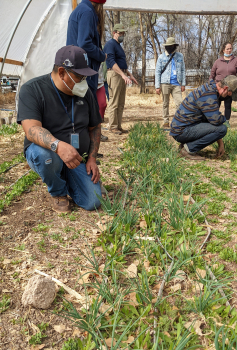
Ten years ago, Air Force veteran Sara Creech almost didn’t attend NCAT’s first week-long Armed to Farm, a sustainable agriculture education program for military veterans. After driving from Indiana to Arkansas for the training, anxiety told her to turn around and go home. Instead, she found the strength to stay.

“I went in there and had the most powerful week of my life,” Sara Creech said. “I really look at this life that I’ve built right now, and it all started with that Armed to Farm.” 

The National Center for Appropriate Technology today released its short film “Armed to Farm Stories: Sara Creech,” in which Creech, a former surgery and trauma nurse who served during the wars in Iraq and Afghanistan, shares her story of overcoming loss through organic farming. Attending NCAT’s Armed to Farm program in 2013 empowered Sara not only to pursue farming, but also to help other farmer veterans. 

In the film, we see the diversified vegetable, fruit, and livestock farm Sara has built over the past ten years and hear from members of the farmer veteran community who have benefited from Sara’s mentorship.

Many service members feel disconnected from their communities and former lives when they come home, Sara said. Organic and sustainable farming can help them feel connected and whole again.

“Armed to Farm offers practical information to help veterans get their farms started, or expand their operations,” said Margo Hale, Armed to Farm Program Director. “The classroom sessions, along with farm tours and hands-on activities, give them a strong foundation in sustainable agriculture. And the relationships they develop during the week of training—which often continue long after the week is over—are invaluable.” 

Armed to Farm participants learn from seasoned farmers and gain direct experience on livestock, vegetable, fruit, and agritourism operations. Since the week-long program began ten years ago, more than 1,000 veterans from 47 states have participated in the training. When surveyed one year after attending an Armed to Farm, 73 percent of participants indicated they continued farming, had started farming, or were in the process of starting a farm.

Sara credits farming with bringing peace to her life, as well as giving her purpose—caring for the land, feeding her community, and supporting other veterans who want to farm. And Sara is just one example of Armed to Farm alumni helping their fellow farmer veterans.

“Sara exemplifies what we hope to achieve through the Armed to Farm program,” said Hale. “Not only is she operating a successful diversified farm, but she has taken what she learned from us and amplified it so that many other veterans have access to that knowledge and support.” 

Watch the film, here: https://www.youtube.com/watch?v=HdsOjbc-GYY

To learn more about NCAT’s Armed to Farm program, visit ARMEDTOFARM.ORG.

“Learning to farm is more than a notion,” Armed to Farm alum and Montana farmer-veteran Lawrence Rhone recently told KRQE-TV. “It’s another language.” 

Rhone is among nearly 1,000 military veterans who’ve completed the hands-on, intensive Armed to Farm training program. First launched in 2013 through a cooperative agreement with USDA-Rural Development, Armed to Farm is funded in part by ATTRA. That same year, Rhone bought his farm in northeast Montana.  

Now, Rhone is a vocal advocate for the Armed to Farm program, and he has said that a unique value of the program is the lasting relationships that have formed among the network of alum. For new farmer veterans just getting started, he said there’s no other program like Armed to Farm. 

“Get to an Armed to Farm alumnus or contact NCAT because you have put together a tremendous program that helps you figure out how to break the ice.”  

The weeklong Armed to Farm training features farm tours and hands-on activities at a variety of successful farms. Participants learn from seasoned farmers and gain direct experience on livestock, vegetable, fruit, and agritourism operations. Farmer veterans learn how to create a business plan and market their products, access USDA programs, set business goals, and develop mentorships with seasoned farmers. 

“We don’t just have classroom time. We leave the classroom and go to farms of veterans who are walking the walk and that is powerful,” said Rhone. “When we went into the military, that’s the same way we did that type of training.” 

The National Center for Appropriate Technology (NCAT) is partnering with New Entry Sustainable Farming Project (NESFP) to bring NCAT’s free Armed to Farm training to the Bay State for the first time. Armed to Farm will take place July 24-28, 2023, in Danvers, MassFarmer-veterans will attend classroom sessions and travel to local farms for hands-on learning experiences. The deadline to apply is June 9.

Armed to Farm trainings include an engaging blend of farm tours, hands-on activities, and interactive classroom instruction. NCAT Sustainable Agriculture specialists will teach the training sessions, along with staff from USDA agencies and NESFP. Experienced crop and livestock producers will provide additional instruction. 

“We’re eager to bring Armed to Farm to Massachusetts,” said Andy Pressman, NCAT Sustainable Agriculture and Rural Communities Director. “Armed to Farm has served nearly 1,000 veterans in all corners of the country as they start or grow their own sustainable farm business.”   

Armed to Farm is a sustainable agriculture training program for military veterans. NCAT, a national nonprofit organization based in Butte, Montana, developed Armed to Farm in 2013 through a cooperative agreement with USDA-Rural Development. Farmer veterans learn how to make a business plan and market their products, how to access USDA programs, set business goals, and develop mentorships with seasoned farmers. 

“Armed to Farm was instrumental in helping us learn so much about how to begin our farm,” said program alum Lanette Lepper of Dudley, Massachusetts. From mistakes to avoid, what crops to grow (or not), and practicalities we never would have thought of ourselves, the experience was invaluable! Just six months after attending, Armstrong Acres was born!” 

This training is for military veterans in the Northwest, with selection priority given to Massachusetts residents. The number of participants will be limited. One spouse or farm partner is welcome to attend with a veteran but must submit a separate application. 

Applications are available here and are due by June 9, 2023. NCAT will notify selected participants by June 16. 

Armed to Farm Massachusetts is supported by USDA’s Office of Partnerships and Public Engagement. Successful applicants may also receive a travel stipend thanks to our partnership with California-based Ranchin’ Vets. 

Learn more about NCAT’s Armed to Farm and additional training series at ARMEDTOFARM.ORG.  

Dustin Cook left the U.S. Army in 2014 after a decade as an active-duty serviceman and later officer. He’s one of more than 350,000 veteran or active-duty service members involved in farming in the United States. He’s also among an elite group of about 900 farmer veterans who have completed the Armed to Farm training program first launched in 2013 through a cooperative agreement with USDA-Rural Development. Armed to Farm is funded in part by ATTRA.  

Now, Cook runs the Veteran’s Urban Farm in Columbia, Missouri. It’s part of a nonprofit organization called the Columbia Center for Urban Agriculture. In coordination with the Truman VA Hospital, the Veteran’s Urban Farm provides veterans with therapeutic, vocational, and recreational horticulture training and activities. Cook says veterans learn everything from starting seeds to managing a market stand. Everything the veterans grow at the 1.3-acre urban farm is harvested and donated to fellow vets once per week at the local VA.  

Cook describes struggling to transition from active-duty military life to finding his place in a civilian world, noting that sustainable agriculture was one piece that has given him a new mission and passion.  

“It’s given me a lot of drive to help other veterans dealing with those same transition struggles,” he says. “I have a real passion for helping other folks – they don’t have to muddle through by themselves – I can say I’ve been where you’re at.”  

Cook attended a week-long Armed to Farm training in Fayetteville, Arkansas, in 2021. Once he returned, he says he talks to any farmer-veteran looking for beginning farmer resources, encouraging them to turn to ATTRA and Armed to Farm.  

“The thing that really makes Armed to Farm better than the rest is that it’s the complete package. They do a really good job of presenting a lot of information and resources in a short amount of time while also creating interface time with local veteran farmers,” Cook explains. “The fact that all of that is provided free of charge is a huge benefit – there’s a barrier to entry in ag and finance is one of the biggest parts of that, so being able to go for free and learn as a veteran getting into agriculture – that’s just absolutely invaluable.” 

The National Center for Appropriate Technology (NCAT) is partnering with Alabama A&M University’s Small Farm Center and the Rural South Institute to bring the free Armed to Farm training to Alabama for the first time. Armed to Farm will take place October 31-November 4 in Huntsville. Farmer-veterans will attend classroom sessions and travel to local farms for hands-on learning experiences.

Armed to Farm trainings include an engaging blend of farm tours, hands-on activities, and interactive classroom instruction. NCAT Sustainable Agriculture specialists will lead the training sessions, along with staff from USDA agencies. Experienced crop and livestock producers will provide additional instruction.

“We’re eager to bring Armed to Farm to Alabama,” said Rockiell Woods, NCAT Gulf States Regional Director. “Armed to Farm has served more than 900 veterans in all corners of the country as they start or grow their own sustainable farm business, giving those farmers practical tools to continue serving their communities.”  

Armed to Farm is a sustainable agriculture training program for military veterans. NCAT, a national nonprofit organization based in Butte, Montana, developed Armed to Farm in 2013 through a cooperative agreement with USDA-Rural Development. Farmer veterans learn how to make a business plan and market their products, how to access USDA programs, set business goals, and develop mentorships with seasoned farmers.

“Alabama A&M University’s Small Farms Research Center is ecstatic to partner with NCAT again, and also welcome farmer veterans to ‘the Hill,’ said E’licia L. Chaverest, Assistant Director of Alabama A&M University’s Small Farms Research Center. “AAMU Small Farms Research Center has over 25 years of experience working with farmers, educating and empowering them in becoming more sustainable and profitable with their farm operations. We look forward to a successful program and interacting with farmer veterans and engaging with other great farmers in North Alabama.”

Armed to Farm’s Alabama training is supported by USDA’s Office of Partnerships and Public Engagement. Successful applicants may also receive a travel stipend thanks to our partnership with California-based Ranchin’ Vets.

Learn more about NCAT’s Armed to Farm and additional training series at ARMEDTOFARM.ORG.


-30-


THE NATIONAL CENTER FOR APPROPRIATE TECHNOLOGY has been helping people build resilient communities through local and sustainable solutions that reduce poverty, strengthen self-reliance, and protect natural resources since 1976. Headquartered in Butte, Montana, NCAT has field offices in Arkansas, California, Colorado, Idaho, Kentucky, Mississippi, Montana, New Hampshire, Pennsylvania, and Texas. Learn more and become a friend of NCAT at NCAT.ORG

A story about the Armed to Urban Farm program’s recent training has been featured on more than 40 television news stations around the country. The free training included two virtual sessions and three days of in-person sessions in Memphis, TN.

Armed to Urban Farm, presented in partnership with the U.S. Botanic Garden, is an outgrowth of NCAT’s Armed to Farm program. Since 2013, more than 900 farmer veterans have received sustainable agriculture training through Armed to Farm.

Armed to Urban Farm is unique in its focus on operating a farming business in the city. Attendees at the Memphis training learned about business planning, marketing, land access, and legal issues farmers can face. In addition, they spent time on urban farms in Memphis, learning from experienced urban farmers and building relationships with fellow farmer veterans.

“They’re here to learn and connect with each other and see what they might be able to take back to their own operations,” said U.S. Botanic Garden education specialist Emily Hestness.

Veterans who attend Armed to Urban Farm come to learn about vegetable, fruit, and flower production, with goals of feeding their families and communities. Many, such as Army veteran Charley Jordan, also have discovered therapeutic benefits from engaging in agriculture.

“It was helpful for me and I figured this must be helpful for other veterans…So, I’m slowly moving on to working more with veterans and mental health and using plants as healing.”

Whatever the farmer veterans’ goals may be, Armed to Urban Farm offers support and educational resources even after the training event ends. Farming is a challenging profession, as NCAT Sustainable Agriculture Specialist Mike Lewis points out, but farmer veterans are used to challenges from their time in military service.

“and we think that if you’ve already started the hardest job in the world, why can’t we transition you into the second?”

NCAT and the U.S. Botanic Garden have hosted Armed to Urban Farm training events in Washington, D.C., Cleveland, OH, and Baltimore, MD. For more information, visit ARMEDTOFARM.ORG.

Watch the full piece, here.

Randal Kelly and his dad started growing corn and squash on their family agriculture plot on the Navajo Nation back in 2019. Now in his fourth growing season, Kelly has added in more root vegetables, flowers, and herbs. At most, they’re growing on a one-acre section of their 10-acre plot. Kelly says this is just the start.  

“I would like to produce vegetables for the whole Navajo Nation, and the whole southwest,” he says. “We have the land and resources; they’re just not being worked.” 

Kelly was among a group of farmer veterans who gathered in New Mexico recently for a weeklong Armed to Farm training. He’s one of more than 350,000 veteran or active-duty service members involved in farming in the United States. Kelly is also now one of more than 900 farmer veterans who have completed the Armed to Farm training program first launched in 2013 through a cooperative agreement with USDA-Rural Development. Armed to Farm is funded in part by ATTRA.  

Kelly was in the U.S. Army from 2001 to 2006, but he’s deeply rooted in agriculture. He lives on the same land he was raised on, and as a kid was in 4-H and FFA. He learned about the free Armed to Farm training through the Navajo Nation Department of Agriculture, applied, and was selected.  

Randal Kelly New Mexico Armed to Farm“It was cool to see and hear stories about how farmers started similar to where I’m at right now and how they learned to use grants, have the drive, and make it a business,” he says. “I loved the training; it was amazing.”  

He adds the training was well planned, and the classroom sessions were paired with hands-on examples of the same topic. For Kelly, he says it was invaluable to see grant programs and sustainable agriculture methods at work. Plus, he says connecting with other like-minded farmers will continue to be a well of information.  

“My biggest thing right now is we’re a culture that grew vegetables and at some point, we lost that. I have black and white photos of my grandma standing next to 10-foot-high cornstalks – I want to be like that; that’s my goal. It’s part of our tradition that we’re losing.” 

Kelly says he took home ideas on how to mitigate erosion and conserve water, and on managed grazing techniques and cover cropping.  

“We are considered a food desert; we don’t have foods that are local,” Kelly says. “For me, it’s important that I provide better nutrition to my people. My mind is racing thinking about all the things I can do.” 

Mississippi farmer James Burch is among a growing network of farmers, ranchers, and land managers across the United States who are taking steps to catch and hold more water in the soil with the aim of regenerating the land and strengthening their businesses.  

More than 150 farms and ranches have joined the free and voluntary Soil for Water network, a regenerative agriculture project supported in part by NCAT and ATTRA. The project aims to include farmers and ranchers who discover and share land management practices that improve soil health, catch more water in soil, reduce erosion, sustain diverse plant and animal life, and filter out pollutants, all while improving the profitability of their businesses. 

Burch’s Mississippi farm has been in his family for a century. After a long military career, it’s only recently that he started putting the land back into production. He’s passionate about locally grown produce, grass-fed beef, and pasture-raised pigs. His main concern is mitigating erosion and ensuring that the soil on his land doesn’t wash away into nearby waterways. That’s why Burch joined the Soil for Water network. 

“It’s important to build the soil to the point that you’ve got some kind of cover on it, and any time you get these big rains, it doesn’t take your topsoil to another area,” said Burch. “The vision for my farm is big. I’m taking it one step at a time and using proven methodologies to grow healthy food above ground and maintain healthy soil below ground.”  

In addition to being an early Soil for Water network member, Burch is also an alum of NCAT and ATTRA’s Armed to Farm program.

The National Center for Appropriate Technology (NCAT) is teaming up with the Rocky Mountain Farmers Union to bring NCAT’s free Armed to Farm training to Colorado for the first time. Armed to Farm will take place August 29-September 2, 2022, in Boulder. Farmer-veterans will attend classroom sessions and travel to local farms for free hands-on learning experiences.

Armed to Farm trainings include an engaging blend of farm tours, hands-on activities, and interactive classroom instruction. NCAT Sustainable Agriculture specialists will lead the sessions. Staff from USDA agencies and experienced crop and livestock producers will provide additional instruction.

“We’re eager to bring Armed to Farm back to the West, and to train in Colorado for the first time,” said Armed to Farm Program Director Margo Hale. “Armed to Farm has served more than 900 veterans across the country as they start or grow their own sustainable farm business.”  

Armed to Farm is a sustainable agriculture training program for military veterans. NCAT, a national nonprofit organization based in Butte, Montana, developed Armed to Farm in 2013 through a cooperative agreement with USDA-Rural Development. Farmer veterans learn how to make a business plan and market their products, how to access USDA programs, set business goals, and develop mentorships with seasoned farmers.

Armed to Farm blew me away,” said Patrick Conrey, Armed to Farm alum and General Manager of the Oil Barn in Berthoud, Colorado. “Two years into my own agricultural business and I still reflect on the immersive experience as a highlight. The combination of in-field and in-class activities kept me engaged and paved the way. I would highly recommend the program to any veteran who is looking to turn their passion into a successful business.”

This training is for military veterans in the West. The number of participants will be limited. Spouses or farm partners are welcome to attend with a veteran but must submit a separate application.

Click HERE to apply by July 15. NCAT will notify selected participants by July 22.

NCAT and Rocky Mountain Farmers Union are partnering to host this Armed to Farm event. This work is supported by the USDA Natural Resources Conservations Service and the USDA Office of Partnerships and Public Engagement. Successful applicants may also receive a travel stipend thanks to our partnership with California-based Ranchin’ Vets.

Learn more about NCAT’s Armed to Farm and additional training series at ARMEDTOFARM.ORG.