January is Farmer Appreciation Month at NCAT, and some of the farmers and ranchers we especially value are those who make the effort to pass along their hard-won knowledge to beginners. NCAT Livestock Specialist Linda Coffey recently lost one of her farming mentors and took the opportunity to document how significantly this friend influenced her life.
By Linda Coffey
On December 21, 2024, family and friends gathered in Fayetteville, Arkansas, to celebrate the extraordinary life of Mrs. Janice Neighbor. Many people shared stories, and I loved hearing them all, but I couldn’t share mine then. I knew I would cry and stumble over words and not be able to adequately say what she has meant to me and my family for the past 25 years. But I would like to share here what Janice meant to me, in hopes that readers will be reminded of mentors in their own lives, and of people they could mentor, too, to help make the world a better place, as she did.
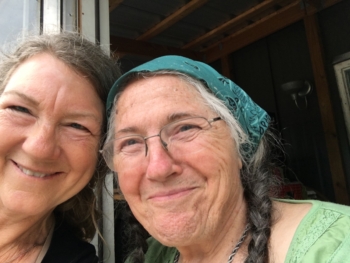
NCAT specialist Linda Coffey (left) and her friend and farming mentor Janice Neighbor (right). Photo: Linda Coffey, NCAT
My path crossed with Janice because of dairy goats. I had the idea that if we had a couple of dairy goats to milk, we would save money on our grocery bill. Our family of six drank a lot of milk. I mentioned this to a friend who replied that I ought to talk to Janice Neighbor, because her son was in his last year of 4-H and the family would be selling a lot of goats.
I found Janice at the kitchen cabin at Prairie Grove Battlefield State Park, where she was engaged in a reenactment. I was fascinated with the living history she was enacting, cooking with cast iron in the fireplace of the cabin, wearing period clothing, teaching people who came in about the Civil War era, and sharing delicious rolls that she had baked in a Dutch oven. We arranged to meet, and she began mentoring me about goats right from the start.
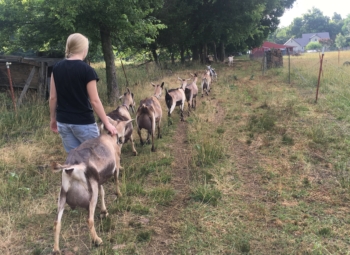
Hannah Coffey leads the family’s herd of milk goats to the barn for milking time. Photo: Linda Coffey, NCAT
She and her son had spent years breeding high-quality goats. She gave some to us with the stipulation that we must join 4-H and show the goats at the county fair. She promised to help with that by forming a dairy goat club for others who wanted to show, so we could learn together. That is how we met others who had similar interests. Janice was THE person responsible for connecting the Coffey family to the fair community. The last 25 years would have been so different if she hadn’t cared for and worked with us. I am so grateful!
Janice showed so much patience. We had so much to learn, and she guided us through joining the American Dairy Goat Association, getting papers transferred, applying for our farm name, applying for our herd tattoo, filling out registration papers, filling out fair entry forms, learning to fit and show and properly care for these beautiful, useful animals. She taught us what we needed to know, and we entered our first fair.
It is so much more fulfilling to be a participant than to be a spectator! And it was amazingly helpful having the pro introduce us to other experienced people in the dairy goat barn, having her encourage us each step of the way and cheer us on as the goats that originally were her son’s won more ribbons for our children and our farm. The fair that year, and every year that we participated, was my favorite week of the year, and Janice gave that to us. She helped us learn all about the Dairy Goat Barn customs, the premium sale, and the fun event where the goats and children dressed up and competed. And she was there, cheering us on and celebrating with us.
The joy of being part of this! It was great for me and for our kids, and we always did well, having started with really nice goats and taken Janice’s recommendations about where to acquire more breeding stock. It was satisfying and fun, and we would never have done it if she hadn’t put that requirement on us and then taught us how.
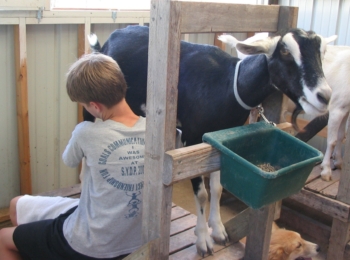
John Coffey takes a turn at milking one of the family’s milk goats. Photo: Linda Coffey, NCAT
The dairy goats brought other benefits to our family, beyond the fair. Our kids developed a solid work ethic with twice-a-day milking, and the milk itself fed our family, local customers, and the pigs, calves, and lambs we also raised. We learned to make cheese – she guided us there, too.
We took goats to Farm Friends, a fun event where over 1,000 school children attend, and there’s a free bean supper that evening for the community. Janice was always there, too, spinning all day with her guild and providing cornbread for the evening meal.
Janice also helped us with our sheep and got us involved in Sheep to Shawl. She got her entire spinners’ guild to spin our Gulf Coast wool for Sheep to Shawl, and I loved seeing what they created.
She was also such a good cook and gardener. She knew so much about culinary and medicinal herbs. She knew and grew at least ten basil varieties, for example, and the seed collection she and her husband developed is so impressive. She was a Master Naturalist as well as a Master Gardener, Master Canner, and knowledgeable in all the homesteading arts. I can’t capture everything that was special about her. I haven’t mentioned her humor, her colorful expressions, her vast knowledge of history, medicine, livestock, fiber arts, food preservation, indigenous knowledge, and more. I haven’t helped you picture her beautiful, kind smile, her enthusiasm for life and for people and for nature. You can’t see how she enjoyed all the good things, how she encouraged so many people every day, how she could be very blunt and straight-forward when the situation called for it, or how she’d lived so MUCH in her lifetime.
But her kindness and love for our family are what I will miss most. She got to know each of our children, celebrated our successes, and shared her teaching experience. She gave me great support and advice, even to the last time I saw her, literally on her deathbed, when she still cared and gave me words of wisdom.
I thought I had more time. I regret that I never took the time to just go hang out all day and learn. I would have had to go every day for a long time to just get the tip of the iceberg! I always thought I would do that “later.” My advice for you is this: if you know someone you admire and love, prioritize spending time with them, no matter how busy you are. If you have the chance to be a participant instead of a spectator, do it! It’s much more fun. If you have a mentor, thank them. If you are a mentor, I thank YOU: you are changing lives and making the world a better place, as my precious friend Janice did.
Beginning farmers often connect with mentors through formal mentorship programs like Marbleseed’s Farmer-to-Farmer Mentorship Program, Quivira Coalition’s New Agrarian Program, and Practical Farmers of Iowa’s Labor4Learning. Similarly, structured learning opportunities like the ones listed in ATTRA’s Internship Hub can help beginners connect with experienced agricultural practitioners.
This blog is produced by the National Center for Appropriate Technology through the ATTRA Sustainable Agriculture program, under a cooperative agreement with USDA Rural Development. ATTRA.NCAT.ORG.

The Weight of Water in Every Melon
By Darron Gaus, NCAT Agriculture Specialist
A Taste of July
When I was farming in San Antonio, Texas, one of my favorite crops to grow was watermelon. I would often stop during harvest to sit on the sun-warmed soil, cut open a 10-pound source of potassium-rich hydration, and chat with the crew while juice flowed down our chins. I even carried a shaker of pink Himalayan sea salt in my back pocket, ready for the quick draw when that moment came. (And if you’ve never salted your watermelon, give it a try. Just trust me on this.) Those were special moments that helped us all endure the arduous work of farming.
Over the course of nearly 20 seasons, I grew watermelons in almost every way imaginable and learned a lot about this unique cucurbit. I often pondered if the “water” in “watermelon” comes from the contents or its water-seeking abilities. Watermelon can congregate its fibrous root system to function like a central tap root. It does this in sandy soils with astounding efficiency, even potentially reaching down into the water table itself. I grew watermelons in modeling clay, the blackest of gumbos. After the first few seasons, I learned that I needed to play to the watermelon’s strengths. If I wanted the soil’s water to convert into hydration to enjoy during my future break times, I had to adapt my growing methods.
Learning from Failure and Abundance
I began conventionally, using industry-standard methods for growing watermelon at scale. My crew and I chisel plowed once a year and disk harrowed three times in every direction. Then we prepped the beds in one pass with the fine, almost desiccated clay shaped by a metal pan, covered with plastic mulch, and bisected by a single line of drip irrigation in the middle of each. After all that, I had to pump the water back in that I just helped evaporate into thin air. Three hundred thousand gallons of water for the five acres of soon-to-be-planted watermelons poured through pipes, hoses, and drip tape to ensure transplants or seeds had available moisture as soon as they dropped into their new home for the next 80 to 100 days.
Time-sensitive cultivation with 12-inch listers (arrow-shaped metal sweeps designed to move soil to either side of a center furrow) and hand-weeding the holes was the only thing left to do before harvest. Plant density was high in this system, and the yield was great, but keeping up with water demands in the high shrink-swell clay was a constant failure. The hardpan that formed from so many equipment passes was impenetrable, even for the well-adapted watermelon roots.
Farmworkers bringing in the watermelon harvest. Photo: USDA, Preston Keres.
After two seasons of conventional methods, I began implementing conservation practices that would increase organic matter, conserve soil moisture, and reduce my time on the tractor. Increasing organic matter in the heavy clay I farmed greatly increased porosity, water retention, living biology in the soil, and nutrient cycling. Cover crops, with a mix of at least three species, became my new obsession. Three quarters of the 105 acres were under cover crops designed for specific benefits: high biomass for weed suppression and organic matter, a brassica for insect trapping and greater soil porosity, and a legume for nitrogen fixation.
The cover crops provided one more critical benefit: they captured every rain drop that fell. I no longer had rill erosion in my furrows after a two-inch-per-hour rainfall. The large rills that once forced me to waste time sweeping beds back up were gone. Soil aggregation and tilth improved. Organic matter increased and the high pH came down. Watermelons grew like they were supposed to.
The first season of adopting this new farming approach came with its share of challenges. We had to develop innovative cultivation techniques to manage weed pressure and adjust our bed preparation methods to work with a high-residue topsoil layer. These adjustments initially led to a 20% drop in yields. However, after a season of learning and refining our practices, the results were remarkable—yields rebounded to impressive levels, all while requiring significantly less irrigation.
Pushing the Envelope
Watermelon interplanted with Sudan grass. Photo by Darron Gaus.
Once I started seeing the changes that the conservation practices were making, I wanted to add more. I wanted to try new things, so I pushed the envelope. I wanted those juice-covered-chin breaks in harvesting watermelon in November, not just July. The only thing standing in the way was overcoming the water demand of an August planting. August in San Antonio is usually 31 days of triple-digit temperatures and no rain in the forecast. Sudan grass grows tall quickly in these conditions, so I interplanted it with the watermelon. The idea was that the Sudan grass would provide wind breaks and shade to the seedlings, helping to conserve soil moisture. And it worked! We harvested watermelon in November that year, but it came with consequences. The harvest took place in nine-foot-tall grass-walled tunnels, which made passing the watermelons to the edges of the field for easy pick-up impossible. Every single watermelon (all undersized because of lack of sunlight during fruiting) had to be individually walked out of the field. Luckily, we had 200 volunteers from the Air Force on the day of harvest, and in spite of the tall grass, they still managed to pack out 12,000 pounds of three-to-five-pound fruits in just under two hours. That November was the only fall harvest of watermelon in my career; the price of labor was too steep. I pushed it too far, but I learned.
Water Rising to the Surface
Watermelons taught me many lessons, but none as important as water conservation. What began as a simple pursuit of sweetness transformed into a lesson about the lifeline that sustains these plants: water. Each watermelon I grew represented the delicate balance between abundance and scarcity. I learned how much water it takes to nurture just one fruit, and how easily that resource can be taken for granted.
Within the vibrant green rind and the refreshing red flesh is a story of soil, sun, and most critically, sustainability. In tending to the vines, I began to see the bigger picture. I saw how water connects everything: the land, the food we eat, and the future we hope to build. What started as farming became a quiet education in stewardship.
Watermelons, in their quiet way, reminded me that what’s beneath the surface often matters most—our water, our world, our shared responsibility.
Come back for Part Two of the sweetest story ever told. It involves compost, city citations, crowded cover crops, and conservation dryland farming.
True Love, Tomatoes, and Trouble: Managing Heat Stress in Tomato Production
By Andy Pressman, NCAT Sustainable Agriculture Program Director
“Homegrown tomatoes, homegrown tomatoes,
What’d life be without homegrown tomatoes?
Only two things that money can’t buy
And that’s true love and homegrown tomatoes.”
– Guy Clark, Homegrown Tomatoes
Listen to a clip of “Homegrown Tomatoes” by Guy Clark
The author’s daughter enjoying a homegrown tomato.
It sure is hard to imagine life without homegrown tomatoes. For some, like American folk singer Guy Clark, it is well worth the wait over the winter months for a sun-ripened tomato fresh off the vine, and for the experience of first biting into one and feeling that rush of flavor as it explodes in your mouth. This moment of joy is not limited to gardeners—anyone can seek out these precious, homegrown flavors from farmers who grow tomatoes skillfully and with great care.
Tomatoes are a staple summer crop for many diversified farms: high-value, in-demand, and, when conditions are right, highly productive. But as summers grow hotter and more unpredictable, even this dependable crop can show signs of stress. Blossom drop, sunscald, delayed or uneven ripening, and declines in yield are symptoms caused by intense heat.
Whether you’re selling at farmers markets, through CSA shares, or to wholesale accounts, heat stress in tomato production can quickly translate into lost income. With the right strategies, you can mitigate heat-related issues and maintain healthy, productive plants, even at the height of summer. Read on for common heat-related issues and how to solve them.
Fruit Set and Blossom Drop
Heat can impede fruit set when daytime highs are consistently over 90°F and nighttime temperatures stay above 70°F. Blossoms can drop and pollen can become less viable as the plant shifts from reproductive to survival mode. Choosing heat-tolerant varieties and staggering plantings to avoid peak summer stress, including planting early in high tunnels, can reduce blossom drop. Using hoops and shade cloth in the field can reduce the sun’s intensity. Managing soil temperature and moisture by utilizing practices such as drip irrigation and mulching can also help retain flowers.
Close-up of a tomato blossom. Photo credit: Nina Prater.
Pollination
Fruit deformities can result from a lack of pollination. Planting pollinator habitats in and around tomato plantings can increase pollination from native pollinators. It’s also a good idea to limit insecticide use (even organic-approved insecticides) during bloom periods. Hand-pollinating plants can improve pollination rates, especially in high tunnels. Applying a kelp or seaweed fertilizer as a foliar spray during early flowering also helps mitigate heat-related stress that impacts pollination and causes misshapen fruits.
Sunscald
Sunscald on tomatoes occurs when the fruit is exposed to intense sun, especially after the plants are pruned and leaf cover is reduced. Sunscald causes the fruit to develop leathery white or gray patches on the skin that make it unmarketable. Maintaining leaf canopy during periods of extreme heat by limiting pruning and sucker removal can reduce sunscald. Trellising can assist in providing more leaf canopy, while also assisting with airflow. And, as with blossom drop, utilizing shade techniques in high tunnels or in the field can reduce the risk of sunscald during periods of intense heat.
Ripening Issues and Yellow Shouldering
Extended periods of high temperatures can cause uneven or delayed ripening, and can also cause the fruit to exhibit green or yellow tops, known as yellow shouldering. Managing potassium availability in the soil can help prevent these issues. Use soil tests to determine potassium levels and apply amendments, such as kelp meal, as needed. Adding too much nitrogen, especially late in the season, can prolong vegetative growth, which slows fruit ripening. If daytime heat is affecting the color or appearance of the fruit, consider harvesting early and ripening indoors.
Blossom-End Rot
Another disorder caused by heat stress is blossom-end rot. While tied to inadequate amounts of calcium, blossom-end rot is more associated with a lack of water. The hotter the temperature, the more water is lost to transpiration from the tomato plants. This increase in water loss causes small lesions on the blossom end of the fruit that gradually spread and turn the area into a brownish or tan color. Timely irrigation and maintaining proper pH and calcium levels in the soil can prevent blossom-end rot.
White Core
Variety of beautiful heirloom tomatoes. Photo credit: USDA Lance Cheung.
Internally, tomatoes can develop a hard white core from excessive heat and inadequate fertility. In moderate cases, white core can occur just beneath the flower-shaped leaf, or calyx, on the top of the fruit. In more extreme cases, you may see white core extend through the entire fruit. Having adequate foliage cover and potassium levels can prevent white core. Additionally, older varieties are more susceptible to white core, while newer varieties are less prone to this issue. Therefore, variety selection can again help mitigate this disorder.
Fruit Cracking
Mid- to late-summer tomato harvests often occur during dry periods. However, an afternoon shower can cause the fruit to swell faster than the skin can stretch, resulting in fruit cracking. Fruit cracking can also occur through sudden irrigation during a dry spell. Cracking can be managed by reducing moisture fluctuations, and through the consistent use of drip irrigation. Mulching conserves soil moisture and reduces the risk of temperature swings. If a sudden rain shower is in the forecast after a dry spell, harvesting tomatoes at first blush or the breaker stage (a slight change in color from green to no more than 10% pink, red, orange, or yellow) and ripening indoors will keep the fruit from cracking. Research shows that ripening in a protected structure at temperatures between 55° F and 65° F is equal to ripening on the vine, while ripening at 68° F increases the sweetness and overall flavor of the tomato.
Tomatoes may love the heat, but even they have their limits. By observing your plants closely, using techniques to mitigate heat stress, choosing the right varieties, and managing soil and water strategically, you can protect your crops and enjoy a fruitful harvest. And, while the summer heat may test your patience and your plants, there’s still something magic about harvesting a perfect slicer in the middle of July—enough to make you hum a little of Guy Clark’s tune on your way back from the field.
Read more on tomato production in our ATTRA publication, Organic Tomato Production.
The Full Circle of Local Food Systems
By Maura Henn, NCAT Local Food Systems Specialist
What do farmers markets, locally owned grocery stores, and community compost centers have in common?
If you answered they are all part of a functioning local food system, you would be right. If you had asked me that question six years ago, I may have been able to make the connection that they had something to do with food, but my answer would have ended there! Even though I had managed a farmers market, worked at cooperative grocery store, and regularly sought out and enjoyed locally produced food, it wasn’t until I started working at NCAT that I realized that I had been participating in local food systems my entire life.
A local food system refers to the network that connects local producers and consumers, promoting the consumption of locally-grown food. A local food system includes the overlap and collaboration of five key sectors: production, processing, distribution, consumption, and waste management and food recovery. Though there is not a federally established definition of local food, it is generally accepted that local food is food that travels the entire supply chain, from production to waste management in the same locality.
Buying local foods strengthens local economies and helps keep family farmers farming. It also creates a connection between consumers and local farmers that enhances both individual and community health. Efforts such as urban farms, community gardens, farmers markets, locally-owned small grocers, and composting programs all contribute to local food systems.
Here is a breakdown of what makes up the local food system:
Of all the processes of local food systems, food recovery is the one I think has the most opportunity for expansion within communities, which can help deliver safe and edible food to people who need it. Gleaning programs allow for unsold food to be donated to food pantries, food access programs such as community fridges, or even directly to consumers. When I was a full-time college student who also needed to work full time to cover rent and living expenses, I relied heavily on the “red tagged” food that was made available to staff at the local food cooperative where I was employed. The red tagged food was available to take home free of charge because it had met its sell-by date. I look back now and realize I had been a recipient of a gleaning program. Without that supplemental source of food I would have had a hard time managing all that was required in both schoolwork and my job.
As with all aspects of local food systems, one vital ingredient is present in each sector: people. Without people growing, preparing, selling, eating, and mindfully disposing of food byproducts, local food systems would not exist. Some are called to the profession of farming and ranching and choose to market their products locally—a vital part of the local food system. Those of us who aren’t farmers or ranchers still have essential roles to play in the system. We all participate in our local food system in one way or another. Those of us who are able can choose to invest in these local systems by supporting local farmers, sharing our garden yields with neighbors, installing a compost system in our backyard, or countless other actions we can take as members of a local food community. Local food systems are for everyone, and everyone has a place within them.
ATTRA Resources:
Episode 376: Talking ‘Health in the Hood’ with Asha Walker – ATTRA – Sustainable Agriculture
Episode 337. ATTRA and SARE: Building Local Food Systems in Montana – ATTRA – Sustainable Agriculture
Start a Farm in the City – ATTRA – Sustainable Agriculture
Composting: The Basics – ATTRA – Sustainable Agriculture
NCAT Marketing Tip Sheet Series – ATTRA – Sustainable Agriculture
Additional Resources:
Local and Regional Food Systems Resource Guide | Agricultural Marketing Service
National Gleaning Project
The Conservation Equation: Water, Wildlife, and Working Lands
By Darron Gaus, NCAT Sustainable Agriculture Specialist
Across the arid West, the choices producers make about how they graze, plant, and manage their soil ripple far beyond (and below) the fence line. When producers choose to implement water conservation practices, they are choosing to not just sustain agriculture, but also to protect wildlife, support habitats, and recharge aquifers that serve millions.
The Ogallala Aquifer in particular is a vital source of water for drinking and irrigation across eight states, and it is under stress. But with thoughtful land stewardship, it is possible to slow depletion and even allow aquifer recharge. The best news is that the conservation practices that recharge the aquifer also improve soil health, increase drought resilience, improve profitability, and create habitat for species like pollinators, songbirds, and even the lesser prairie chicken.
Conserving a Lifeline: The Ogallala Aquifer
The Ogallala Aquifer lies beneath the vast grasslands of the Southern Great Plains. This geological reservoir of groundwater has quietly powered the region’s agriculture and rural communities for generations. But that lifeline is shrinking. Decades of pumping, often faster than natural recharge can occur, has led to widespread depletion in many areas.
Fortunately, regenerative conservation practices offer a way forward. Practices such as managing for deep-rooted perennial grasses, rotating livestock to avoid overgrazing, reducing tillage, and increasing ground cover all help slow runoff and encourage water infiltration.
These practices are proactive rather than reactive. Building the conditions for aquifer recharge and for drought resilience requires conservation planning, instead of just reacting to weather extremes as they happen. The aquifer level responds to these long-term decisions. Managing diverse perennial cover and maximizing ground cover to minimize bare soil helps create conditions that soak in every drop of rain to sustain crops, livestock, and wildlife even through dry spells.
Working Lands, Living Landscapes
Across the Southern Great Plains, a growing number of farmers and ranchers are discovering that what’s good for water is good for the land, what’s good for the bird is good for the herd, and all of it is great for the bottom line. Adaptive grazing strategies that mimic historic bison movement patterns are helping keep grasses vigorous and resilient. Cover cropping and minimal tillage are building organic matter and protecting soil from erosion and drought. Where invasive woody species have crowded out native grasses, prescribed fire and mechanical removal are bringing back the open structure grasslands need to thrive. This isn’t about bringing back a single species, it’s about reweaving the fabric of the prairie, one pasture at a time.
This holistic approach builds a landscape that holds onto its water, supports wildlife, and weathers droughts more effectively. In the long term, it also reduces input costs, improves forage production, and helps producers manage risk. The environmental and economic benefits come hand-in-hand.
A Prairie Bird, a Bigger Picture
One species that benefits greatly from these regenerative practices is the lesser prairie chicken. Though it is federally listed and often surrounded by political debate, it stands for a much broader truth: the conditions that support its survival also support thriving grassland systems. Native grasses, forb diversity, insect abundance, and managed disturbance like fire and grazing are as important for bird broods as they are for forage and aquifer recharge. It’s all part of a holistic approach where habitat for birds, forage for cattle, and recharging aquifers are not competing interests, but complementary outcomes.
The Abundant Ogallala Project: Turning Principles into Practice
Recognizing these overlapping benefits and interwoven challenges, NCAT launched the Abundant Ogallala Project, which supports producers in adopting regenerative practices that restore prairie health and support groundwater sustainability. Whether the focus is improving pasture health, building drought resilience, or restoring habitat for species like the lesser prairie chicken, Abundant Ogallala is about supporting real, on-the-ground solutions.
This summer, the project will also host a free webinar series called From Scarcity to Sustainability: A Vision for the Southern Great Plains. Ranchers, researchers, and conservationists, who are finding common ground through stewardship, will come together to share stories and strategies about building resilience from the ground up—literally.
You can learn more about signing up for a free conservation plan and register for the series by visiting the Abundant Ogallala Project page or emailing us at AbundantOgallala@ncat.org.
A Season of Hope
Whether you’re raising cattle, growing cover crops, or restoring native range, your land can be more than a production space. It can be a refuge. A reservoir. A place where soil, water, and wildlife work together in balance. As spring unfolds, we’re reminded that every decision we make matters on our land, under our feet, and for the generations to come. It reminds us that the decisions we make on the land echo far beyond this season. It also reminds us that nature is resilient. That a rancher’s grazing plan, a patch of native wildflowers, or a single decision to leave a little more cover can make all the difference. As we walk through this season, we invite you to see your land not just as a production ground, but as a habitat. As a sponge for rain, a filter for nutrients, and a canvas for renewal. When we farm and ranch with intention, the prairie answers back. It blooms. It sings. And sometimes, if we’re consistent, it rewards us with more than mere beauty. It provides income and a quality of life we all dream of.
When Giants Fall: A Story of Service, Soil, and the Long Arc of Belonging
By Mike Lewis, NCAT Senior Manager and Farmer Veteran
It was quiet when it happened. Not the kind of quiet that feels empty, but the kind that wraps around you like the stillness before a summer storm. A couple of weeks ago, my coworker Eric and I spent a day wandering through Armstrong Redwoods State Natural Reserve in Sonoma, California. We had come to the region for a year-end celebration hosted by Ranchin’ Vets, one of our Armed to Farm partners. But that day, we were just two friends walking through a forest of giants.
We didn’t expect to hear the groaning, cracking, and deep roar that followed. A thousand-year-old redwood—one of the elders of that forest—began to fall. We stood still, breath caught, as the ancient tree surrendered to gravity and centuries of standing strong. It collapsed with a thunder that rolled through the valley like the voice of God.
There was no panic in the moment. Just awe. Sadness, yes, and something like reverence. It felt like watching a great soul leave the earth—but also like being let in on a secret. A rare, sacred kind of transformation. We hadn’t come to witness anything that monumental, but sometimes the earth has its own plans.
As we approached the fallen redwood, we were struck not just by its size, but by its presence. Even fallen, it was not diminished. The tree, we knew, was not done with its work. Its life had changed form, not ended. Now it would become a home to insects and birds. It would hold moisture, enrich soil, and slowly feed the roots of new growth. Its service to the forest would continue—just in quieter, slower, more hidden ways.
That moment lingered with us, especially considering the work that had brought us there. Veterans—the ones we train, work alongside, and learn from—often come home changed. Some carry the visible scars of their service; others bear the invisible ones. But many of them return not to rest, but to serve again—this time by growing food, stewarding land, and nurturing the very communities they once left to protect.
Like the redwood, their fall from battle does not mark the end of their story. In fact, it begins a new chapter of service. One rooted not in combat, but in care. Not in defense, but in cultivation.
In our trainings, we see this time and again: veterans reconnecting with the soil, finding meaning in seeds, livestock, rain, and hard work. Farming offers more than a livelihood. It offers a sense of rootedness, of coming home in a deeper way. It’s not about escaping from the past but building the future—allowing one’s story to take new shape in familiar ground.
The land doesn’t ask veterans to forget who they were. It invites them to become fully who they are now.
As we looked around the grove, we noticed something else: no part of the tree would go to waste. The forest already knows how to receive it. Birds will perch on its limbs. Mushrooms will take root in its bark. Young trees will sprout in the softened soil beneath it.
The forest never loses its own.
That truth echoes in the way we view veterans in our work. Too often, society treats their transition as an ending—a closing of one chapter with no roadmap for what comes next. But in agrarian life, we see something different. We see a forest that welcomes them back. We see communities strengthened by their presence. We see the way they feed the ecosystem with their skills, their values, and their willingness to serve again—this time as cultivators of resilience, local knowledge, and hope.
We like to imagine that life has chapters: childhood, youth, service, retirement. But that’s not how nature works. The redwood doesn’t retire. It simply moves from one mode of giving to another. The ecosystem doesn’t discard what falls; it transforms it into the conditions for life.
Service isn’t a season. It’s a cycle.
Back in the forest, after the fall, the birds kept singing. Sunlight filtered down to the understory in a new way. And Eric and I stood there, not in grief, but in gratitude. We had witnessed something ancient and holy—a reminder that even the mightiest among us are still part of a much larger cycle.
Maybe that’s what the redwood was trying to show us: that when we root ourselves in service to others and to the land, we never really stop growing. Even when we fall, we fall into the arms of something that knows exactly what to do with us.
The forest never forgets.
The land never wastes.
And the work of service—real service—never ends.
Cozy Up with Wool
By NCAT Conservation Planner Cody Brown and NCAT Senior Conservation Planner Alisha Horak
If the word ‘wool’ conjures up memories of itchy socks and the scratchy blankets your grandparents would pull out when it got cold, it’s time to modernize your view on this warm, soft, functional fiber! Wool has come a long way in recent years. The wool industry has improved processing methods to increase wool’s versatility and comfort, and consumers are loving it, driving the demand for sustainable fibers. In response, the global woolen textiles market, which was valued at 190.4 billion dollars in 2023, is expected to grow almost eight percent every year between now and 2030.
Wool is a timeless, sustainable fiber that can be used to make comfortable, functional clothes.
The fibers that make up your wardrobe may all make comfortable, useful clothes, but there are growing concerns about a wide range of environmental impacts these different fibers can have. Synthetic fiber’s elasticity, comfort, and cheap cost of production have made it a fierce competitor with natural fibers since the invention of nylon in the 1930s. However, synthetic textiles can lead to microplastic pollution, among other environmental costs. These concerns are starting an industry-wide shift to seek natural fiber sources with verified benefits to land and climate.
The prevalence of synthetics has led to a decline in the American wool industry and the domestic wool processing infrastructure that supported American wool in the past. This caused wool growers to have an increased dependency on volatile international wool markets. To be more profitable, wool producers and domestic wool processors can work together to serve the market of sustainability-interested consumers.
Wool insulation is a sustainable alternative to synthetic insulations and a potential market for coarse wool fibers.
Wool isn’t just for clothes, either. The fashion industry and the fine wool producers that support them are seeing an increase in demand for fine wool (i.e., the softest types of wool with the smallest fiber diameter), but medium and coarse wool producers also have opportunities to serve the sustainable fiber market. Medium and coarse wool can be turned into carpets and insulation, replacing synthetic fibers in our homes.
The best part is, when sheep producers use managed grazing techniques, they can actually build soil health and improve the health of the landscape. NCAT has a wide variety of resources available to help farmers and ranchers produce wool in sustainable, ethical ways, so together we can rebuild the American wool market from the soil up.
Producers and consumers both win with wool. It’s a sustainable material for clothing and other products. Wool’s durability, breathability, and insulative properties make it an easy choice when prioritizing the quality of materials. With a growing demand for sustainability across the nation, NCAT aims to empower wool producers through ATTRA’s sustainable agriculture information service, cost-share incentives, conservation plans, and access to new verified fiber markets that benefit the land, producers, and consumers.
Additional Resources:
Climate Beneficial Fiber Project
Tips for Marketing Sheep and Goat Products: Fiber
Building the Market for Climate-Beneficial Wool
Climate Beneficial Fiber Partnership: Introduction for Producers
Voices from the Field Podcast Episode 355. Soil-to-Skin: Rebecca Burgess of Fibershed on Building Community
The Case for Tractor Farming
By Audrey Kolde, NCAT Sustainable Agriculture Specialist
My experience in farming started at the hand-tool scale. I enjoy the physical labor, that tangible connection to the land. But years of repetitive movement have started to catch up with me. My love of farming hasn’t changed as the aches and pains have increased—in fact, it has grown. I want to produce even more food to feed my community. I want to grow crops that are calorie- and nutrient-dense, and store well, like beans, winter squash, sweet potatoes, and dent corn—but these require a lot of land. They are cornerstones of the American diet that small-scale gardens often can’t keep up with.
With these crops in mind, my farming partner and I have started the journey to transition part of our land to tractor farming. It is a work in progress. As two women running a farm, we started to think more about why more women aren’t transitioning from small- to mid-scale operations. Women represent 9% of primary farmers in small-scale farms ($100,000-$350,000) and 5% of primary farmers in mid-scale operations ($350,000-$1,000,000). Women have continued farming in small-scale and traditional systems that involve a lot of manual labor and require physical strength. However, mechanization and technology like tractors offer women the chance to broaden their opportunities in agriculture.
Increase Productivity
One major reason to adopt tractor farming is that it makes it possible to cultivate larger areas in less time, with less hired help, and less backbreaking work. Mechanizing tasks like bed shaping, planting, and cultivation is game-changing. Using tractors increases productivity and efficiency, leading to bigger harvests, better quality produce, and access to lucrative markets that require a larger volume of products.
Improve Profitability
Tractors can make it easier for women to grow their businesses and achieve financial independence, helping to close the gender gap in agricultural productivity and land ownership. According to the 2012 Farm Census, female farmers in the United States earn about 40% less than male farmers. As women earn more, they can reinvest in their businesses by buying more equipment, diversifying their crops, or improving how they market their products. This economic freedom allows women to become successful agricultural entrepreneurs.
Improve Farmer Health
One of the biggest benefits of using a tractor for me is that it reduces the need for so much heavy (and expensive, if hired out) manual labor. I am all too aware of the back pain that planting, weeding, and harvesting crops can lead to. By using tractors, women can better manage their health while increasing their farm’s productivity. Tasks you wouldn’t immediately think of, like moving tarps and weights, are much easier with tractors. I once even moved a walk-behind tractor with a riding tractor.
Improve Conservation Practices
As an added bonus, tractors have so many attachments that can help with conservation practices. Proper tilling and cultivation help with pest management. No-till drills and roller crimpers make cover cropping easier. And the world of precision farming methods, like GPS and sensors, save water, use fewer chemicals, and enhance crop yields with less environmental harm.
Barriers
Unlike seed packets and wheel hoes, financing tractors costs more than a pretty penny. Tractors require capital to purchase, rent, or borrow. Women will likely need to find financial help through affordable loans from institutions such as the U.S. Department of Agriculture’s (USDA) Farm Service Agency, Women’s Business Center, or the Small Business Administration, or grants through organizations like USDA Rural Development, National Women’s Business Council, RAFI, and American Farmland Trust’s Brighter Future Fund.
Another barrier is knowledge. Tractor operation is a skill that can be intimidating to learn. Organizations like NCAT and Extension Services are trying to overcome this barrier by training new farmers on how to operate tractors, maintain equipment, and use sustainable practices. Experienced farmers are also an invaluable source of knowledge, and now is the time for those skilled in using tractors to pass their knowledge on to the next generation. The generational transition in farming is coming, and our ability to maintain a steady food supply will require a smooth transition, passing the torch to well-trained hands.
Conclusion
Tractors, used responsibly, can turn more acres into productive, sustainable land, reducing food insecurity and improving the local economy in communities. By overcoming a few barriers, women farmers can improve their profitability and increase their chances of long-term health and success.
ATTRA Resources
Maintaining Your Tractor – Building Your Toolbox
Scaling Up Your Vegetable Farm for Regional Markets
Equipment and Tools for Small-Scale Intensive Crop Production
NCAT Highlights Safety Resources During Farm Safety and Health Week
Other Resources
American Farmland Trust’s Research into Women in Agriculture
The State of Gender Equity in U.S. Agriculture (pdf)
Sources
Dentzman, K. and Lewin, P. (2024), A Fair Comparison: Women’s and Men’s Farms at Seven Scales in the United States. Rural Sociology, 89: 3-39. https://doi.org/10.1111/ruso.12512https://doi.org/10.1111/ruso.12512
Schmidt, C., Goetz, S. J., & Tian, Z. (2021). Female farmers in the United States: Research needs and policy questions. Food Policy, 102039. https://doi.org/10.1016/j.foodpol.2021.102039
The Legacy and Future of Small Farms
By Mike Lewis, NCAT Senior Manager, Southeast and Appalachia Region
In the past century, the number of farmers in the U.S. has declined dramatically. Small farms, once the heart and soul of rural America, have been squeezed out by a system that prioritizes economies of scale over community well-being. Consolidation of land and resources has made it nearly impossible for smaller operations to compete. The result has been more than a loss of livelihoods; it has been a profound loss of identity for countless communities across the country.
This loss runs deeper than economics. For generations, small farms were not just places of work—they were centers of life. They anchored rural towns, fostered innovation, and built tight-knit networks of support and resilience. Farmers leaned on one another, sharing tools, wisdom, and stories passed down through the ages. In many ways, these farms were the lifeblood of rural culture, a thread connecting people to one another and to the land itself. Their decline has left more than empty barns and overgrown fields; it has unraveled the social fabric of communities, leaving schools closed, main streets empty, and once-thriving towns struggling to survive.
The impact on community well-being is stark and far-reaching. The loss of small farms means the loss of shared traditions—harvest festivals, barn raisings, and local markets where neighbors gathered not just to trade goods, but to build relationships. These were places where stories were told, problems were solved, and hope was renewed. Without them, rural communities have seen an increase in isolation, the erosion of mutual support, and the hollowing out of institutions that once brought people together.
Equally devastating is the fading connection between people and the land. Small farms represented more than just a way to earn a living; they embodied a way of life that valued stewardship, humility, and a deep respect for the natural world. This relationship, cultivated over generations, has been lost for many, replaced by a sense of disconnection from the land that once fed, healed, and sustained entire communities.
But this story is not over. Beneath the surface of these struggles lies a quiet determination. Rural people understand what’s at stake—their heritage, their livelihoods, and their future. And amidst the hardships, there are glimmers of hope: farmers working together to reclaim their role as stewards of the land, young people returning to agriculture with a vision of sustainability, and communities fighting to preserve what remains of their unique way of life.
By supporting small-scale farmers, whether they’ve been farming for generations, or whether they are new to the profession, we can honor the legacy of small farmers, protect the land, and rebuild the resilience of rural communities. Every purchase at a local farmers market, every voice raised for fair agricultural policies, and every effort to connect with the origins of our food helps ensure a future where small farms thrive once again.
The time to act is now. The values of small farms—stewardship, care, and community—are not just relics of the past but guiding lights for a sustainable future. Together, we can cultivate a world where rural communities flourish, the land is cherished, and every field tells a story of hope and renewal. Let us choose to support the farmers who are working to build this better tomorrow, one seed, one harvest, and one community at a time.
Farmer Appreciation: A Tribute to Janice Neighbor
January is Farmer Appreciation Month at NCAT, and some of the farmers and ranchers we especially value are those who make the effort to pass along their hard-won knowledge to beginners. NCAT Livestock Specialist Linda Coffey recently lost one of her farming mentors and took the opportunity to document how significantly this friend influenced her life.
By Linda Coffey
On December 21, 2024, family and friends gathered in Fayetteville, Arkansas, to celebrate the extraordinary life of Mrs. Janice Neighbor. Many people shared stories, and I loved hearing them all, but I couldn’t share mine then. I knew I would cry and stumble over words and not be able to adequately say what she has meant to me and my family for the past 25 years. But I would like to share here what Janice meant to me, in hopes that readers will be reminded of mentors in their own lives, and of people they could mentor, too, to help make the world a better place, as she did.
NCAT specialist Linda Coffey (left) and her friend and farming mentor Janice Neighbor (right). Photo: Linda Coffey, NCAT
My path crossed with Janice because of dairy goats. I had the idea that if we had a couple of dairy goats to milk, we would save money on our grocery bill. Our family of six drank a lot of milk. I mentioned this to a friend who replied that I ought to talk to Janice Neighbor, because her son was in his last year of 4-H and the family would be selling a lot of goats.
I found Janice at the kitchen cabin at Prairie Grove Battlefield State Park, where she was engaged in a reenactment. I was fascinated with the living history she was enacting, cooking with cast iron in the fireplace of the cabin, wearing period clothing, teaching people who came in about the Civil War era, and sharing delicious rolls that she had baked in a Dutch oven. We arranged to meet, and she began mentoring me about goats right from the start.
Hannah Coffey leads the family’s herd of milk goats to the barn for milking time. Photo: Linda Coffey, NCAT
She and her son had spent years breeding high-quality goats. She gave some to us with the stipulation that we must join 4-H and show the goats at the county fair. She promised to help with that by forming a dairy goat club for others who wanted to show, so we could learn together. That is how we met others who had similar interests. Janice was THE person responsible for connecting the Coffey family to the fair community. The last 25 years would have been so different if she hadn’t cared for and worked with us. I am so grateful!
Janice showed so much patience. We had so much to learn, and she guided us through joining the American Dairy Goat Association, getting papers transferred, applying for our farm name, applying for our herd tattoo, filling out registration papers, filling out fair entry forms, learning to fit and show and properly care for these beautiful, useful animals. She taught us what we needed to know, and we entered our first fair.
It is so much more fulfilling to be a participant than to be a spectator! And it was amazingly helpful having the pro introduce us to other experienced people in the dairy goat barn, having her encourage us each step of the way and cheer us on as the goats that originally were her son’s won more ribbons for our children and our farm. The fair that year, and every year that we participated, was my favorite week of the year, and Janice gave that to us. She helped us learn all about the Dairy Goat Barn customs, the premium sale, and the fun event where the goats and children dressed up and competed. And she was there, cheering us on and celebrating with us.
The joy of being part of this! It was great for me and for our kids, and we always did well, having started with really nice goats and taken Janice’s recommendations about where to acquire more breeding stock. It was satisfying and fun, and we would never have done it if she hadn’t put that requirement on us and then taught us how.
John Coffey takes a turn at milking one of the family’s milk goats. Photo: Linda Coffey, NCAT
The dairy goats brought other benefits to our family, beyond the fair. Our kids developed a solid work ethic with twice-a-day milking, and the milk itself fed our family, local customers, and the pigs, calves, and lambs we also raised. We learned to make cheese – she guided us there, too.
We took goats to Farm Friends, a fun event where over 1,000 school children attend, and there’s a free bean supper that evening for the community. Janice was always there, too, spinning all day with her guild and providing cornbread for the evening meal.
Janice also helped us with our sheep and got us involved in Sheep to Shawl. She got her entire spinners’ guild to spin our Gulf Coast wool for Sheep to Shawl, and I loved seeing what they created.
She was also such a good cook and gardener. She knew so much about culinary and medicinal herbs. She knew and grew at least ten basil varieties, for example, and the seed collection she and her husband developed is so impressive. She was a Master Naturalist as well as a Master Gardener, Master Canner, and knowledgeable in all the homesteading arts. I can’t capture everything that was special about her. I haven’t mentioned her humor, her colorful expressions, her vast knowledge of history, medicine, livestock, fiber arts, food preservation, indigenous knowledge, and more. I haven’t helped you picture her beautiful, kind smile, her enthusiasm for life and for people and for nature. You can’t see how she enjoyed all the good things, how she encouraged so many people every day, how she could be very blunt and straight-forward when the situation called for it, or how she’d lived so MUCH in her lifetime.
But her kindness and love for our family are what I will miss most. She got to know each of our children, celebrated our successes, and shared her teaching experience. She gave me great support and advice, even to the last time I saw her, literally on her deathbed, when she still cared and gave me words of wisdom.
I thought I had more time. I regret that I never took the time to just go hang out all day and learn. I would have had to go every day for a long time to just get the tip of the iceberg! I always thought I would do that “later.” My advice for you is this: if you know someone you admire and love, prioritize spending time with them, no matter how busy you are. If you have the chance to be a participant instead of a spectator, do it! It’s much more fun. If you have a mentor, thank them. If you are a mentor, I thank YOU: you are changing lives and making the world a better place, as my precious friend Janice did.
This blog is produced by the National Center for Appropriate Technology through the ATTRA Sustainable Agriculture program, under a cooperative agreement with USDA Rural Development. ATTRA.NCAT.ORG.
Ag solutions company sparks biomass innovation and remarkable success
The fertile farm country of eastern Washington’s Palouse prairie region hosts millions of acres of grains, fruits, vegetables, forage, and forests that support its economy. And one Cheney-based company is increasing the economic value of these crops by turning their organic waste into a valuable soil amendment called biochar.
Mike Werner, CEO of Qualterra, a Washington-based agricultural technology solutions firm focused on sustainability, says his company’s mission is to deliver innovative solutions to farmers. One of Qualterra’s flagship technologies is a biomass processing technology that produces biochar, a charcoal-like material made from organic materials that are processed through Qualterra’s Biomass Processing Units (BPU) at high temperatures in a low combustion environment that locks in and sequesters carbon to form biochar. When added to soils, biochar can improve key factors like pH, aeration, drainage, nutrient availability, microbial makeup, and water absorption.
Werner says Qualterra is trying to strike a balance between the viability of food systems and the economics of what farmers need. “By adding in biochar, we’ve seen some very positive outcomes for our growers,” he said. “At the end of the day, it helps their crops grow better while improving their soil for the next generation. This is an important aspect of food security.”
The Qualterra brand is only a couple of years old, but the history of their technologies spans the last decade. They spawned out of two different companies that did biomass processing, plant propagation, and molecular diagnostic testing. The two companies had a distinct overlap with soil improvement goals, which fostered a circular economy around “better plants, better soils, better world.”
Thriving in drought
Qualterra’s 75-acre farm in Cheney, Washington, just outside Spokane, is the main campus for biomass processing and commercial biochar production. It is also home to a laboratory, greenhouse, and Agricultural Regeneration Center (ARC) on over 50 acres of farmland used to conduct research.
“We’ve successfully processed wheat straw, nut shells, hops, thistle, and rice husks to make high quality and consistent biochars through pyrolysis within our BPUs,” said Werner. “But we know one size doesn’t fit all, so we are constantly pushing our boundaries, asking questions, and researching: What’s the right biomass? How much to use? What are the right soils? Where’s the benefit?”
One real-world success came when Qualterra partnered with a local farm and applied biochar in the soil with new start apple trees. “Within a month, the grower called us back and said, ‘I think there’s a difference–you gotta come out and see it,’” Werner said. “After 3 months, we kept seeing bigger, denser, and greener trees. Trees planted in biochar-amended soils within five months had a canopy 20-25% greater than the rest of the orchard, even in the hottest part of the year.”
Qualterra’s biochar product has succeeded with plants during climate stress and drought. The biochar improves soil water absorption and holding capacity, allowing growers to reduce watering in controlled environments by about 25%.
“We can work very closely with growers based on our team’s scientific experiences to support the evidence-based application of biochar in different cropping systems,” Werner said. “Summers are getting hotter, and water restrictions are a reality. Biochar can help soils function more effectively during those stressful times.”
Qualterra’s ARC facility, located in Cheney, Washington, was intentionally chosen as a demonstration facility for agricultural sustainability and housing its technologies in one location. The biomass processing units produce biochar that customers can purchase. Qualterra is also continuing its research and can scientifically test the agricultural benefits of its biochar at its on-site R&D greenhouse.
Added energy benefit
Qualterra has just begun harnessing the green renewable energy from the units to offset its energy footprint. Its life cycle analysis of its biomass processing units showed that after running for just 1.36 months, the technology was carbon-negative. The units have been running on site for 10-15,000 hours and can process 450 tons of biomass a year without even running at full capacity. They run on 3-5 kWh but produce 80-90 kWh of renewable energy, producing a net surplus.
In Werner’s estimation, “the value proposition of responsible elimination of waste, biomass processing, biochar production, and renewable energy capture is compelling and important. That’s the last big piece for our organization and our team.”
What’s next
Qualterra conducts biochar studies with 27 research partners, testing various applications in 13 different cropping systems across three states. It is also exploring applications for decarbonizing industries and helping them reduce their carbon footprint.
There is also a need to expand federally funded research to close critical knowledge gaps on biochar. The Senate version of the 2025 USDA appropriations bill includes $2.5 million in new funding for biochar research. The research would inform farmers, ranchers, foresters and businesses on which type of biochar will have positive results in their area. It would help companies like Qualterra do even more to maximize the many benefits of biochar.
Werner says young people are interested in the environmental impacts of biochar. Local schools bring kids out to tour Qualterra’s facilities because they want to understand biochar and sustainability in agriculture systems. “We are trying to build a company,” he said, “but also build a knowledge base for future generations.”