Tag Archive for: Soil Health

By Darron Gaus, NCAT Agriculture Specialist 

A Taste of July 

When I was farming in San Antonio, Texas, one of my favorite crops to grow was watermelon. I would often stop during harvest to sit on the sun-warmed soil, cut open a 10-pound source of potassium-rich hydration, and chat with the crew while juice flowed down our chins. I even carried a shaker of pink Himalayan sea salt in my back pocket, ready for the quick draw when that moment came. (And if you’ve never salted your watermelon, give it a try. Just trust me on this.) Those were special moments that helped us all endure the arduous work of farming. 

Over the course of nearly 20 seasons, I grew watermelons in almost every way imaginable and learned a lot about this unique cucurbit. I often pondered if the “water” in “watermelon” comes from the contents or its water-seeking abilities. Watermelon can congregate its fibrous root system to function like a central tap root. It does this in sandy soils with astounding efficiency, even potentially reaching down into the water table itself. I grew watermelons in modeling clay, the blackest of gumbos. After the first few seasons, I learned that I needed to play to the watermelon’s strengths. If I wanted the soil’s water to convert into hydration to enjoy during my future break times, I had to adapt my growing methods. 

Learning from Failure and Abundance 

I began conventionally, using industry-standard methods for growing watermelon at scale. My crew and I chisel plowed once a year and disk harrowed three times in every direction. Then we prepped the beds in one pass with the fine, almost desiccated clay shaped by a metal pan, covered with plastic mulch, and bisected by a single line of drip irrigation in the middle of each. After all that, I had to pump the water back in that I just helped evaporate into thin air. Three hundred thousand gallons of water for the five acres of soon-to-be-planted watermelons poured through pipes, hoses, and drip tape to ensure transplants or seeds had available moisture as soon as they dropped into their new home for the next 80 to 100 days.  

Time-sensitive cultivation with 12-inch listers (arrow-shaped metal sweeps designed to move soil to either side of a center furrow) and hand-weeding the holes was the only thing left to do before harvest. Plant density was high in this system, and the yield was great, but keeping up with water demands in the high shrink-swell clay was a constant failure. The hardpan that formed from so many equipment passes was impenetrable, even for the well-adapted watermelon roots. 
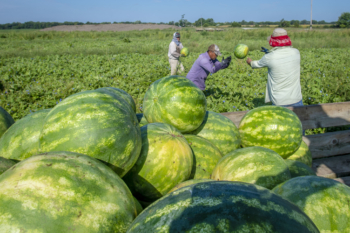
Farmworkers bringing in the watermelon harvest. Photo: USDA, Preston Keres.

After two seasons of conventional methods, I began implementing conservation practices that would increase organic matter, conserve soil moisture, and reduce my time on the tractor. Increasing organic matter in the heavy clay I farmed greatly increased porosity, water retention, living biology in the soil, and nutrient cycling. Cover crops, with a mix of at least three species, became my new obsession. Three quarters of the 105 acres were under cover crops designed for specific benefits: high biomass for weed suppression and organic matter, a brassica for insect trapping and greater soil porosity, and a legume for nitrogen fixation.  

The cover crops provided one more critical benefit: they captured every rain drop that fell. I no longer had rill erosion in my furrows after a two-inch-per-hour rainfall. The large rills that once forced me to waste time sweeping beds back up were gone. Soil aggregation and tilth improved. Organic matter increased and the high pH came down. Watermelons grew like they were supposed to.  

The first season of adopting this new farming approach came with its share of challenges. We had to develop innovative cultivation techniques to manage weed pressure and adjust our bed preparation methods to work with a high-residue topsoil layer. These adjustments initially led to a 20% drop in yields. However, after a season of learning and refining our practices, the results were remarkable—yields rebounded to impressive levels, all while requiring significantly less irrigation. 

Pushing the Envelope
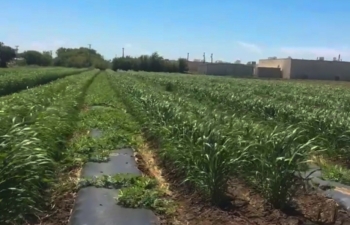
Watermelon interplanted with Sudan grass. Photo by Darron Gaus.

Once I started seeing the changes that the conservation practices were making, I wanted to add more. I wanted to try new things, so I pushed the envelope. I wanted those juice-covered-chin breaks in harvesting watermelon in November, not just July. The only thing standing in the way was overcoming the water demand of an August planting. August in San Antonio is usually 31 days of triple-digit temperatures and no rain in the forecast. Sudan grass grows tall quickly in these conditions, so I interplanted it with the watermelon. The idea was that the Sudan grass would provide wind breaks and shade to the seedlings, helping to conserve soil moisture. And it worked! We harvested watermelon in November that year, but it came with consequences. The harvest took place in nine-foot-tall grass-walled tunnels, which made passing the watermelons to the edges of the field for easy pick-up impossible. Every single watermelon (all undersized because of lack of sunlight during fruiting) had to be individually walked out of the field. Luckily, we had 200 volunteers from the Air Force on the day of harvest, and in spite of the tall grass, they still managed to pack out 12,000 pounds of three-to-five-pound fruits in just under two hours. That November was the only fall harvest of watermelon in my career; the price of labor was too steep. I pushed it too far, but I learned. 

Water Rising to the Surface 

Watermelons taught me many lessons, but none as important as water conservation. What began as a simple pursuit of sweetness transformed into a lesson about the lifeline that sustains these plants: water. Each watermelon I grew represented the delicate balance between abundance and scarcity. I learned how much water it takes to nurture just one fruit, and how easily that resource can be taken for granted.  

Within the vibrant green rind and the refreshing red flesh is a story of soil, sun, and most critically, sustainability. In tending to the vines, I began to see the bigger picture. I saw how water connects everything: the land, the food we eat, and the future we hope to build. What started as farming became a quiet education in stewardship.  

Watermelons, in their quiet way, reminded me that what’s beneath the surface often matters most—our water, our world, our shared responsibility.  

Come back for Part Two of the sweetest story ever told. It involves compost, city citations, crowded cover crops, and conservation dryland farming. 

By Darron Gaus, NCAT Sustainable Agriculture Specialist 

Across the arid West, the choices producers make about how they graze, plant, and manage their soil ripple far beyond (and below) the fence line. When producers choose to implement water conservation practices, they are choosing to not just sustain agriculture, but also to protect wildlife, support habitats, and recharge aquifers that serve millions.

The Ogallala Aquifer in particular is a vital source of water for drinking and irrigation across eight states, and it is under stress. But with thoughtful land stewardship, it is possible to slow depletion and even allow aquifer recharge. The best news is that the conservation practices that recharge the aquifer also improve soil health, increase drought resilience, improve profitability, and create habitat for species like pollinators, songbirds, and even the lesser prairie chicken.

Conserving a Lifeline: The Ogallala Aquifer

The Ogallala Aquifer lies beneath the vast grasslands of the Southern Great Plains. This geological reservoir of groundwater has quietly powered the region’s agriculture and rural communities for generations. But that lifeline is shrinking. Decades of pumping, often faster than natural recharge can occur, has led to widespread depletion in many areas.

Fortunately, regenerative conservation practices offer a way forward. Practices such as managing for deep-rooted perennial grasses, rotating livestock to avoid overgrazing, reducing tillage, and increasing ground cover all help slow runoff and encourage water infiltration.

These practices are proactive rather than reactive. Building the conditions for aquifer recharge and for drought resilience requires conservation planning, instead of just reacting to weather extremes as they happen. The aquifer level responds to these long-term decisions. Managing diverse perennial cover and maximizing ground cover to minimize bare soil helps create conditions that soak in every drop of rain to sustain crops, livestock, and wildlife even through dry spells.

Working Lands, Living Landscapes

Across the Southern Great Plains, a growing number of farmers and ranchers are discovering that what’s good for water is good for the land, what’s good for the bird is good for the herd, and all of it is great for the bottom line. Adaptive grazing strategies that mimic historic bison movement patterns are helping keep grasses vigorous and resilient. Cover cropping and minimal tillage are building organic matter and protecting soil from erosion and drought. Where invasive woody species have crowded out native grasses, prescribed fire and mechanical removal are bringing back the open structure grasslands need to thrive. This isn’t about bringing back a single species, it’s about reweaving the fabric of the prairie, one pasture at a time.

This holistic approach builds a landscape that holds onto its water, supports wildlife, and weathers droughts more effectively. In the long term, it also reduces input costs, improves forage production, and helps producers manage risk. The environmental and economic benefits come hand-in-hand.

A Prairie Bird, a Bigger Picture

One species that benefits greatly from these regenerative practices is the lesser prairie chicken. Though it is federally listed and often surrounded by political debate, it stands for a much broader truth: the conditions that support its survival also support thriving grassland systems. Native grasses, forb diversity, insect abundance, and managed disturbance like fire and grazing are as important for bird broods as they are for forage and aquifer recharge. It’s all part of a holistic approach where habitat for birds, forage for cattle, and recharging aquifers are not competing interests, but complementary outcomes.

The Abundant Ogallala Project: Turning Principles into Practice

Recognizing these overlapping benefits and interwoven challenges, NCAT launched the Abundant Ogallala Project, which supports producers in adopting regenerative practices that restore prairie health and support groundwater sustainability. Whether the focus is improving pasture health, building drought resilience, or restoring habitat for species like the lesser prairie chicken, Abundant Ogallala is about supporting real, on-the-ground solutions.

This summer, the project will also host a free webinar series called From Scarcity to Sustainability: A Vision for the Southern Great Plains. Ranchers, researchers, and conservationists, who are finding common ground through stewardship, will come together to share stories and strategies about building resilience from the ground up—literally.

You can learn more about signing up for a free conservation plan and register for the series by visiting the Abundant Ogallala Project page or emailing us at AbundantOgallala@ncat.org.

A Season of Hope

Whether you’re raising cattle, growing cover crops, or restoring native range, your land can be more than a production space. It can be a refuge. A reservoir. A place where soil, water, and wildlife work together in balance. As spring unfolds, we’re reminded that every decision we make matters on our land, under our feet, and for the generations to come. It reminds us that the decisions we make on the land echo far beyond this season. It also reminds us that nature is resilient. That a rancher’s grazing plan, a patch of native wildflowers, or a single decision to leave a little more cover can make all the difference. As we walk through this season, we invite you to see your land not just as a production ground, but as a habitat. As a sponge for rain, a filter for nutrients, and a canvas for renewal. When we farm and ranch with intention, the prairie answers back. It blooms. It sings. And sometimes, if we’re consistent, it rewards us with more than mere beauty. It provides income and a quality of life we all dream of.

In a new video series: Soil Health 101: Principles for Livestock Production, NCAT Sustainable Agriculture Specialist Nina Prater makes the case for modeling soil health strategies after nature’s blueprint that produced that situation in the first place.

We all know the basic story. Plants photosynthesize sunlight and make sugars. They use the sugars to build leaves and stems and roots and seeds – pretty much everything that makes a plant a plant.

But at the same time, they share the wealth by exuding sugars from the roots to feed a “community” of soil microbes and fungi that in turn help keep the soil healthy for the plant.

A classic win-win situation.

“This layer of productive soil on top of the bedrock that we all have to work with is this vibrant living thing that has a community of life within it,” Nina says. “You have to treat it like a living thing because it is.”

And just like any living thing, there are practices that can keep it healthy and practices that can cause it harm.

Nina and other NCAT staffers produced a three-part webinar series – Soil Health 101 – through the ATTRA sustainable agriculture program, along with support from the USDA National Institute of Food and Agriculture (NIFA) and the Southern Sustainable Agriculture Research and Education program (Southern SARE).

You can watch the webinars here:

The series has a particular focus on the role livestock can play in soil health, but its strategies for keeping soil healthy is good information for any producer.

Those strategies are often described as the principles of soil health. Nina breaks it down to five.

  • Minimize disturbance to the soil
  • Maximize biodiversity on the land
  • Keep the soil covered at all times
  • Keep living roots growing in the soil during as much of the year as possible
  • Incorporate animals and use regenerative grazing practices

Nature provides models for how to put those principles of soil health into place, Nina says, and the webinar is full of practical examples of just that.

“To build soil health on our farm, we have to look to nature to figure out how to do that. Nature built all of these soils in the first place,” she explains. “The planet wasn’t created with all these, you know, lush terrains and prairie and everything. All that evolved over time. And it evolved with these ecosystem that built soil.”

To learn even more about the importance of soil health, and to connect with farmers, ranchers, and land managers taking steps to regenerate their soils, visit SOILFORWATER.ORG.

As a camera soars over an impressive piece of Rocky Mountain ranch land, the narrator says, “The soil that covers U.S. farm and ranch land holds a remarkable story. It’s a tale of success and setbacks. At its best, the soil beneath our feet is the source of life, food, and economic security.”

The National Center for Appropriate Technology (NCAT) has released its short film, Soil for Water, to highlight a growing network of farmers, ranchers, and land managers across the United States who are taking steps to catch and hold more water in the soil.

“Your soil health is going to keep you in business,” Texas rancher Tina Weldon says in the film. “If you take care of your soil, the land will give back to you in terms of your productivity.”

More than 120 farms and ranches in 20 states have already joined the free and voluntary Soil for Water network. The project aims to include farmers and ranchers who discover and share land management practices that improve soil health, catch more water in soil, reduce erosion, sustain diverse plant and animal life, and filter out pollutants, all while improving the profitability of their businesses.

“If we’re going to be successful ranching in the long-term, we need to do a better job working together with other ranchers and learn how to do things regeneratively and profitably,” Montana rancher Dusty Emond explains in the short film.

The Soil for Water project is about implementing practical, cost-effective, and lasting ways to regenerate our soil — making farms, ranches, and communities more resilient in the face of climate disruption.

Unhealthy soil doesn’t absorb much water. Healthy soil acts like a sponge, capable of holding hundreds of thousands of gallons of water in an acre. Climate trends across much of the U.S. indicate longer, hotter drought periods punctuated by storms that often are more severe, according to a 2021 USDA report. Regenerative farming practices enable the soil to capture rainfall that otherwise might disappear as runoff. Economically, these practices can increase crop and forage production, drought resilience, access to lucrative new markets, and therefore profitability. Environmentally, they can improve soil health and biodiversity.

The expanded Soil for Water project encourages the adoption of regenerative land management practices through an interactive website, peer-to-peer forum, in-person and online networking opportunities, and the ability to connect with experts and land managers who are finding success with varied practices.

To learn more about the newly expanded Soil for Water project visit SOILFORWATER.ORG.

The National Center for Appropriate Technology has opened registration for its Soil Health Innovations Conference: Soil for Water, March 15 and 16.

The two-day conference will convene online, and the highly interactive format will connect agricultural producers and educators in a critical conversation about soil health. As was the first conference, it will be an in-depth exploration of agriculture’s sustainable future: on-farm practices, soil biology, carbon markets, and public policy. This year’s conference will focus on farm and ranch strategies to catch and hold more water in the soil.

“The inaugural Soil Health Innovations Conference last spring really exceeded our expectations,” said NCAT Executive Director Steve Thompson. “We were especially struck by the engagement of the participants, both during the conference and afterward through NCAT’s ATTRA sustainable agriculture program. It goes to show that we live in a time when producers and food companies, as well as policy makers, realize how important healthy soils are as we design practical approaches for supporting resilient regenerative agriculture.”

The conference will bring together leading experts and innovative farmers from around the U.S. to share the latest in soil science, best practices in soil management, opportunities for policy change, and the emerging technologies that will drive the future of sustainable and regenerative agriculture. Two sessions will focus on the potential to reduce downstream flooding through watershed-scale soil health practices. Keynote speakers will include University of Washington and Dig2Grow’s David Montgomery and regenerative rancher Alejandro Carrillo.

This year’s theme, Soil for Water, expands on NCAT’s nationwide effort of the same name to connect a growing network of regenerative farmers, ranchers, and land managers who are taking steps to catch and hold more water in the soil.

In addition, since one of the best parts of any conference is the chance to greet old friends and make new acquaintances, the conference will have virtual networking tables that allow participants to get together with each other, speakers, and NCAT staff.

There also will be virtual halls where participants can connect with exhibitors and conference sponsors.

Don’t miss this chance to examine current practices as well as the concepts, techniques, and practical applications that may be available in the future. Register to attend the conference, exhibit or sponsor the event at SOILINNOVATIONS.NCAT.ORG.

Keynote Speaker: March 15

David R. Montgomery, University of Washington and Dig2Grow.com

Growing a Revolution: Bringing Our Soil Back to Life

“Soil may be the least sexy resource upon which civilization depends, yet soil erosion and degradation have plagued societies in the past and pose challenges for feeding the future. Growing a Revolution relates visits to farmers around the world at the heart of a brewing soil health revolution that cuts through standard debates about conventional and organic farming.”

See David Montgomery’s biography.


Keynote Speaker: March 16

Alejandro Raul CarrilloAlejandro Raul Carrillo, Las Damas Cattle Ranch

Regenerative Grazing to Reverse Desertification

Using regenerative grazing techniques over the past several years, Alejandro dramatically increased the water filtration of his ranch in the Chihuahuan Desert 250 miles south of El Paso, Texas.

See Alejandro Carrillo’s biography


Registration is now open for the National Center for Appropriate Technology’s Soil Health Innovations Conference: Soil for Water, March 15 and 16.

This two-day virtual conference will be highly interactive, offering producers and educators from around the country the chance to participate in a critical conversation about soil health.

Speakers will include David Montgomery of Dig2Grow, Alejandro Carrillo of UnderstandingAg, and agroforestry expert Dr. Hannah Hemmelgarn. Find the full conference agenda, here.

Emerging technologies and innovative practices are shining a light on the importance of healthy soils for the future of regenerative agriculture. These promising approaches are coming at a time when there is a growing commitment among producers, food companies, and policy makers to improve the resilience of healthy food systems at their very roots.

The conference will bring together leading experts and innovative farmers from around the U.S. to share the latest in soil science, best practices in soil management, opportunities for policy change, and the emerging technologies that will drive the future of sustainable and regenerative agriculture.

Don’t miss this chance to examine current practices as well as the concepts, techniques, and practical applications that may be available in the future.

Details and Registration

When: March 15-16, 2022

Where: Online

Registration: SOILINNOVATIONS.NCAT.ORG

Organizations, agencies, and individuals who would like to sponsor the conference can find sponsorship information here.

Exhibitor and vendor information is available here.

For more information, contact Rex Dufour at rexd@ncat.org or Sandra Booth at sandrab@ncat.org or call 406-494-4572.

Farmers, ranchers, and land managers across the United States who are taking steps to catch and hold more water in the soil are invited to join the National Center for Appropriate Technology’s Soil for Water project. Building on an expanding peer-to-peer network of ranchers in Arkansas, California, Colorado, Montana, Mississippi, New Mexico, Texas, and Virginia, NCAT has opened the program to crop farmers, ranchers, and land managers in all 50 states who are learning together how to catch and hold more water in the soil.

“The Soil for Water project is about implementing practical, cost-effective, and lasting ways to regenerate our soil — making farms, ranches, and communities more resilient in the face of climate disruption,” said NCAT Executive Director Steve Thompson. “We need to start thinking about healthy soil as permanent infrastructure that stores water to better withstand the impacts of droughts and floods. By connecting innovative farmers and ranchers, and tapping into their know-how, we see Soil for Water becoming a key player in regenerating and improving farmland across America. We welcome and encourage farmers and ranchers everywhere to join this free network at SOILFORWATER.ORG.”

To date, more than 90 farms and ranches have joined the free and voluntary Soil for Water network. The project aims to include hundreds of farmers and ranchers who discover and share land management practices that improve soil health, catch more water in soil, reduce erosion, sustain diverse plant and animal life, and filter out pollutants, all while improving the profitability of their businesses.

James Burch’s Mississippi farm has been in his family for a century. After a long military career, it’s only recently that he started putting the land back into production. He’s passionate about locally grown produce, grass-fed beef and pasture-raised pigs. His main concern is mitigating erosion and making sure the soil on his land doesn’t wash away into nearby waterways. That’s why Burch joined the Soil for Water network.

“It’s important to build the soil to the point that you’ve got some kind of cover on it, and any time you get these big rains, it doesn’t take your topsoil to another area,” said Burch. “The vision for my farm is big. I’m taking it one step at a time and using proven methodologies to grow healthy food above ground and maintain healthy soil below ground.”

Unhealthy soil doesn’t absorb much water. Healthy soil acts like a sponge, capable of holding hundreds of thousands of gallons of water in an acre. Climate trends across much of the U.S. indicate longer, hotter drought periods punctuated by storms that often are more severe, according to a 2021 USDA report. Regenerative farming practices enable the soil to capture rainfall that otherwise might disappear as runoff. Economically, these practices can increase crop and forage production, drought resilience, access to lucrative new markets, and therefore profitability. Environmentally, they can improve soil health and biodiversity.

The expanded Soil for Water project encourages the adoption of regenerative land management practices through an interactive website, peer-to-peer forum, in-person and online networking opportunities, and the ability to connect with experts and land managers who are finding success with varied practices.

The Soil for Water project launched in 2015 with support from the Dixon Water Foundation and the Meadows Foundation. Project investors include grants from the National Resources Conservation Service (NRCS), $980,000; The Jacob and Terese Hershey Foundation, $50,000; the Southern Sustainable Agriculture Research and Education (SARE) program, $1 million; and the Kathleen Hadley Innovation Fund, $20,000.

To learn more about the newly expanded Soil for Water project, and to join the free network, visit SOILFORWATER.ORG.

Mark your calendars for NCAT’s second Soil Health Innovations Conference: Soil for Water, set for Tuesday and Wednesday, March 15 and 16, 2022. This will be a virtual conference offering plenty of networking opportunities with presenters and fellow attendees.

Join us to hear from presenters such as David Montgomery of the University of Washington and Dig2Grow, Alejandro Carillo of UnderstandingAg, and agroforestry expert Dr. Hannah Hemmelgarn.

Watch our conference website, SOILINNOVATIONS.NCAT.ORG, for a complete agenda and registration information.

We look forward to seeing you in March for this important event.

There’s nothing like a summer of vicious heat, drought, and grasshoppers to focus minds on the vital importance of healthy soil. Soil scientist Wallace Fuller said in 1975, “A cloak of loose, soft material, held to the Earth’s hard surface by gravity, is all that lies between life and lifelessness.”

Across Montana, the summer of 2021 proved again just how crucial — and how vulnerable — that thin cloak of soil can be. Soil health is foundational to the resilience of land, and thus also to food systems, human health, and ecosystem function. In light of current weather, financial and societal disruptions, what challenges do Montana ag producers face in building soil health and resilience?

Through July 2022, the Montana Association of Conservation Districts, Montana Watershed Coordination Council and partners, including the National Center for Appropriate Technology (NCAT) are reaching out across the state to ask: What more might be done to better support farmers and ranchers in managing soils in Montana?

We want to hear from you! Help us understand ag needs and opportunities by completing a confidential online survey. Complete one or both surveys there: a five-minute version to capture key thoughts plus a detailed version to provide more context and depth to your responses.

We know you’re busy, so we’re offering several options to better fit your time and level of interest. In addition to the surveys, we’ll also be reaching out via regional listening sessions, one-on-one contacts, and presentations at various conferences, including the Montana Organic Conference in Bozeman, December 2-4.

In August of 2022 we will produce and share a report on what was learned along with recommendations shaped by your responses.. Our purpose is to help increase the pace and scale at which land stewards implement voluntary practices and systems to maintain and improve soils, and to strengthen the economic and ecological vitality of agriculture in Montana.

If this topic is a big one for you, we welcome your participation in our periodic planning meetings. These discussions are held virtually and are facilitated by Cole Mannix. To sign up or for more information, you can reach Cole at exploringsoil@macdnet.org. We hope you’ll join us in this important effort.

The National Center for Appropriate Technology has released a series of 19 videos from its inaugural Soil Health Innovations Conference. The presentations feature nationally recognized experts and innovative farmers from around the U.S. who share the latest in soil science, best practices in soil management, and the emerging technologies that will drive the future of sustainable and regenerative agriculture.

“The Soil Health Innovations Conference occupies the cutting edge of soil health across the country – on-farm practices, soil biology, carbon markets, and public policy,” said Steve Thompson, NCAT executive director. “This set of videos adds to NCAT’s trusted knowledgebase and provides a free resource to any producer or land manager working to improve soil conditions.”

The keynote presentation by Dr. Fred Provenza, one of the country’s leading ecologists, is a highlight of the conference videos. He discusses the link between the health of soils and plants with the health of livestock and the people who eat these foods.

Dr. Robin “Buz” Kloot, a soil health research professor in the Environmental Health Sciences Department at University of South Carolina’s Arnold School of Public Health, spoke about helping farmers find their way forward using new soil testing techniques.

Other acclaimed speakers featured in these conference videos are Rick Clark of Farm Green, Dorn Cox of OpenTEAM, Dan Kittredge of Bionutrient Food Association, Aria McLauchlan of Land Core, Dr. Bianca Moebius-Clune of American Farmland Trust, and Arohi Sharma of the Natural Resources Defense Council. Presentations from innovative farmers and ranchers included rice, corn, soybean and cotton farmer Adam Chappell from Arkansas, organic walnut grower Russ Lester from California, and beef producer Cooper Hibbard from Montana.

An audience favorite at the conference was the Indigenous and Traditional Soil Health Practices presentation featuring speakers Mila Berhane, Greenland Nursery; Kelsey Ducheneaux-Scott, Intertribal Agriculture Council; Earcine Evans, Francis Flowers and Herbs Farm, and Twila Cassadore, Traditional Western Apache Diet Project.

These videos are free and available on YouTube, ATTRA.NCAT.ORG and SOILINNOVATIONS.NCAT.ORG.

As emerging technologies and innovative practices have made clear, healthy soil will play a foundational role in the future of sustainable, climate-smart agriculture. These innovations come at a time when there is a growing commitment among producers, food companies, policy makers, and consumers to improve the resilience of healthy food systems at their very roots. NCAT’s conference was a unique opportunity for these groups to come together for important conversation.