
By Andy Pressman, NCAT Sustainable Agriculture Program Director
“Homegrown tomatoes, homegrown tomatoes,
What’d life be without homegrown tomatoes?
Only two things that money can’t buy
And that’s true love and homegrown tomatoes.”
– Guy Clark, Homegrown Tomatoes
Listen to a clip of “Homegrown Tomatoes” by Guy Clark

The author’s daughter enjoying a homegrown tomato.
It sure is hard to imagine life without homegrown tomatoes. For some, like American folk singer Guy Clark, it is well worth the wait over the winter months for a sun-ripened tomato fresh off the vine, and for the experience of first biting into one and feeling that rush of flavor as it explodes in your mouth. This moment of joy is not limited to gardeners—anyone can seek out these precious, homegrown flavors from farmers who grow tomatoes skillfully and with great care.
Tomatoes are a staple summer crop for many diversified farms: high-value, in-demand, and, when conditions are right, highly productive. But as summers grow hotter and more unpredictable, even this dependable crop can show signs of stress. Blossom drop, sunscald, delayed or uneven ripening, and declines in yield are symptoms caused by intense heat.
Whether you’re selling at farmers markets, through CSA shares, or to wholesale accounts, heat stress in tomato production can quickly translate into lost income. With the right strategies, you can mitigate heat-related issues and maintain healthy, productive plants, even at the height of summer. Read on for common heat-related issues and how to solve them.
Fruit Set and Blossom Drop
Heat can impede fruit set when daytime highs are consistently over 90°F and nighttime temperatures stay above 70°F. Blossoms can drop and pollen can become less viable as the plant shifts from reproductive to survival mode. Choosing heat-tolerant varieties and staggering plantings to avoid peak summer stress, including planting early in high tunnels, can reduce blossom drop. Using hoops and shade cloth in the field can reduce the sun’s intensity. Managing soil temperature and moisture by utilizing practices such as drip irrigation and mulching can also help retain flowers.
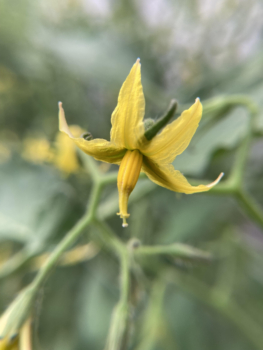
Close-up of a tomato blossom. Photo credit: Nina Prater.
Pollination
Fruit deformities can result from a lack of pollination. Planting pollinator habitats in and around tomato plantings can increase pollination from native pollinators. It’s also a good idea to limit insecticide use (even organic-approved insecticides) during bloom periods. Hand-pollinating plants can improve pollination rates, especially in high tunnels. Applying a kelp or seaweed fertilizer as a foliar spray during early flowering also helps mitigate heat-related stress that impacts pollination and causes misshapen fruits.
Sunscald
Sunscald on tomatoes occurs when the fruit is exposed to intense sun, especially after the plants are pruned and leaf cover is reduced. Sunscald causes the fruit to develop leathery white or gray patches on the skin that make it unmarketable. Maintaining leaf canopy during periods of extreme heat by limiting pruning and sucker removal can reduce sunscald. Trellising can assist in providing more leaf canopy, while also assisting with airflow. And, as with blossom drop, utilizing shade techniques in high tunnels or in the field can reduce the risk of sunscald during periods of intense heat.
Ripening Issues and Yellow Shouldering
Extended periods of high temperatures can cause uneven or delayed ripening, and can also cause the fruit to exhibit green or yellow tops, known as yellow shouldering. Managing potassium availability in the soil can help prevent these issues. Use soil tests to determine potassium levels and apply amendments, such as kelp meal, as needed. Adding too much nitrogen, especially late in the season, can prolong vegetative growth, which slows fruit ripening. If daytime heat is affecting the color or appearance of the fruit, consider harvesting early and ripening indoors.
Blossom-End Rot
Another disorder caused by heat stress is blossom-end rot. While tied to inadequate amounts of calcium, blossom-end rot is more associated with a lack of water. The hotter the temperature, the more water is lost to transpiration from the tomato plants. This increase in water loss causes small lesions on the blossom end of the fruit that gradually spread and turn the area into a brownish or tan color. Timely irrigation and maintaining proper pH and calcium levels in the soil can prevent blossom-end rot.
White Core
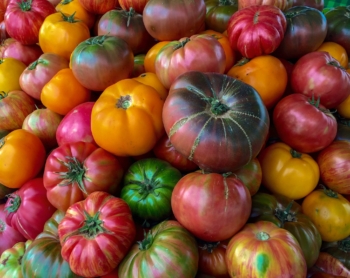
Variety of beautiful heirloom tomatoes. Photo credit: USDA Lance Cheung.
Internally, tomatoes can develop a hard white core from excessive heat and inadequate fertility. In moderate cases, white core can occur just beneath the flower-shaped leaf, or calyx, on the top of the fruit. In more extreme cases, you may see white core extend through the entire fruit. Having adequate foliage cover and potassium levels can prevent white core. Additionally, older varieties are more susceptible to white core, while newer varieties are less prone to this issue. Therefore, variety selection can again help mitigate this disorder.
Fruit Cracking
Mid- to late-summer tomato harvests often occur during dry periods. However, an afternoon shower can cause the fruit to swell faster than the skin can stretch, resulting in fruit cracking. Fruit cracking can also occur through sudden irrigation during a dry spell. Cracking can be managed by reducing moisture fluctuations, and through the consistent use of drip irrigation. Mulching conserves soil moisture and reduces the risk of temperature swings. If a sudden rain shower is in the forecast after a dry spell, harvesting tomatoes at first blush or the breaker stage (a slight change in color from green to no more than 10% pink, red, orange, or yellow) and ripening indoors will keep the fruit from cracking. Research shows that ripening in a protected structure at temperatures between 55° F and 65° F is equal to ripening on the vine, while ripening at 68° F increases the sweetness and overall flavor of the tomato.
Tomatoes may love the heat, but even they have their limits. By observing your plants closely, using techniques to mitigate heat stress, choosing the right varieties, and managing soil and water strategically, you can protect your crops and enjoy a fruitful harvest. And, while the summer heat may test your patience and your plants, there’s still something magic about harvesting a perfect slicer in the middle of July—enough to make you hum a little of Guy Clark’s tune on your way back from the field.
Read more on tomato production in our ATTRA publication, Organic Tomato Production.