By Margo Hale, NCAT Southeast Regional Director, Armed to Farm Program Director, and Agriculture Specialist
My day begins with a hot cup of coffee and a quick check of our farm. What a thrill to find a new baby calf from our Belted Galloways, to watch the antics of our pig, to have my girls gather farm-fresh eggs, and to watch the goats grazing. Livestock bring life to the farm!
Then again, livestock can bring difficulty. The bull escaped; we need to return him to the pasture and fix the fence. The processor doesn’t have a slot for the pig, the price of chicken feed rises, and the goats get into mischief.
While I can’t imagine life without livestock, I recognize that they don’t fit on every farm or for every farm family. Let’s consider the benefits and some of the challenges of living with livestock.
Benefits of Livestock
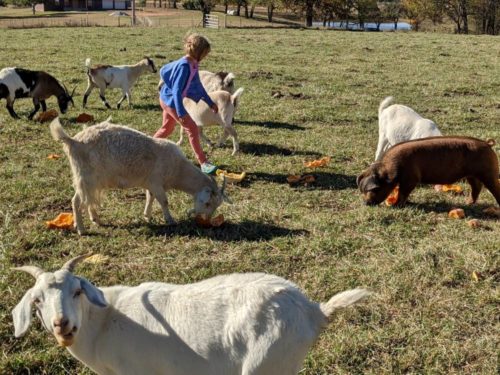
Livestock can turn your over-ripe or excess vegetables into meat. On the Hale farm, goats and pigs take care of the discarded Halloween pumpkins. Photo: Margo Hale, NCAT.
On our farm, and yours, livestock turn pasture and browse into healthy meat. Pasture-raised hogs and poultry need other feed as well, but the meat and eggs produced on pasture are healthier for our family and community. Those grazing animals improve the fertility of our land and boost soil health. And during the garden season our livestock “recycle” excess or over-ripe vegetables, turning waste into meat or eggs. Farms that already have a customer base will find that adding farm-raised meat or eggs can really boost sales and bring in new customers.
There are also many intangible, but real, benefits, as we have learned. Livestock are fun to watch and interesting to raise. They’re valuable for teaching children to be responsible, observant, and curious. They teach kids how science and nature work and how food is grown. These life-long lessons were given to me as a child, and it is satisfying to pass them on to my children, as well.
Assessing Resources
For our family, livestock are a perfect fit. Are they for you?
Before getting started with any enterprise, it is important to consider the goals you have for your farm, family, and lifestyle. How will livestock help you meet your farm goals? Your farm goals, including financial goals, will impact the livestock species you choose, your scale of production, and marketing streams.
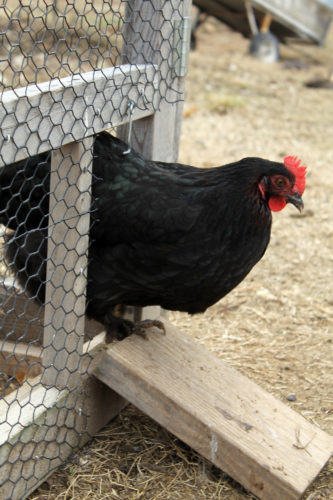
Chickens are easier to contain and need much less space than cattle, so they can be a good fit on small acreage. Photo: Robyn Metzger, NCAT.
Next, what are your available resources? Consider land, money, infrastructure, and time. Some enterprises lend themselves best to smaller acreages: poultry, rabbits, and bees take little space. Grazing livestock need more area so that you can protect soil and pastures and keep livestock healthy. If you have sufficient acreage to raise larger livestock, then the type of forages may influence your decisions. Woodlots are a good fit for hogs and goats, whereas farms with mostly grass pastures best suit sheep and cattle.
Another factor that influences your choice of enterprise is the money you have available to invest in livestock and infrastructure. You can start small with any enterprise, but some are easier and cheaper to contain, such as poultry and rabbits. Grazing livestock need a larger enclosure and are therefore more expensive to start. If there is existing infrastructure, that is very helpful. If not, you will need to budget funds for fence, water, and needed equipment. These up-front costs can be significant, but they are vital. You don’t want an angry phone call from your neighbor about your goats killing their fruit trees!
Having a way to deliver adequate quantities of water to your livestock is also imperative and can be tricky to figure out. In addition, livestock usually need supplementary feed. Poultry, rabbits, and hogs need grain, while grazing animals need hay in winter. Where can you source feed, for what price? Where can you store feed to keep it dry and protected from livestock and rodents? Feed goes into the budget, as all feed costs are paid before you get meat to sell.
Shelter may be an issue. In our moderate climate and with our choice of hardy cattle and goats, we rarely need shelter. However, baby goats born in a cold rain will suffer. If they get too chilled to nurse, they will die. Therefore, we need a plan for circumstances where the livestock do need shelter.
Local markets and processing may also influence your choice. Pasture-raised eggs are always popular, but what is the selling price for a dozen in your area? Can you make money selling at that price, given your feed cost? Similarly, meat enterprises may be feasible or not, depending on the local prices, processing, and feed costs. You will need to do some homework, investigating the local situation and plugging the numbers into a budget to see if the enterprise makes sense. The sample budgets in ATTRA’s Small Scale Livestock Production publication can serve as a starting point. Also see publications on the ATTRA livestock page about whatever enterprise you are considering. Know before you begin what you can produce and for what cost—this knowledge can help guide your choice of livestock enterprise and save your family from a costly mistake.
Time is a precious resource and your farm setup and the enterprises you choose must take this into consideration. Our family includes two children and two full-time, off-farm jobs; therefore, one of our goals is to have easy-to-manage enterprises that don’t take much time. That is important when we need to leave the farm; also, our farm sitter needs the chores to be low-stress and easy to complete. We accomplish that by being intentional in our enterprise selection, infrastructure setup, and our management. Don’t set yourself up for disappointment by taking on more than you can easily manage in the time you have available.
In next week’s blog, I will share some of the strategies and infrastructure we use on our farm to save time and money. Stay tuned!
Learning More
No matter what livestock you choose, it is best to start small. Learn with a few animals so your mistakes—and you will make mistakes—won’t be as costly. Continuously monitor your enterprise and adjust as needed. Remember to keep your farm and family or lifestyle goals in mind. Is this livestock enterprise helping you meet those goals? For example, while our sheep were profitable, we found that we didn’t enjoy raising them and they took too much time. In contrast, my coworker, NCAT Livestock Specialist Linda Coffey, found that sheep worked better than meat goats on their farm. Their customers wanted lamb and the sheep made best use of the pastures. We sold our sheep, and Linda sold the meat goats. Both of us are happier.
There is much to learn about raising and marketing livestock. I would suggest finding a mentor who you can learn from and lean on for advice. Connecting with local producer or grazing groups is a great way to find a mentor. ATTRA has many resources (linked below), and our Livestock Specialists are available to answer questions and talk with you about these considerations. Linda and I will be discussing species specific considerations in an upcoming podcast. Send your questions to us at margoh@ncat.org and lindac@ncat.org.
ATTRA Resources
Getting Started with Livestock Podcast
Small Scale Livestock Production
ATTRA Livestock and Pasture resources
Livestock as a Tool: Improving Soil Health, Boosting Crops
Integrating Livestock and Crops
Managed Grazing Tutorial
Healthy Animals, Happy Farm
Working With Your Meat Processor

Big Sky Senior Living
A lighting-upgrade project is saving a senior living center in Butte significant lighting energy costs, while providing higher-quality lighting for its residents, staff, and visitors.
The Big Sky Senior Living complex consists of one main building and 12 cottages. The main building contains common areas, apartments, offices, kitchens, dining rooms, maintenance areas, parking garages, a memory care unit, a hairdressing shop, and a physical therapy center.
The Montana Resource Efficiency Program (MREP) performed a detailed energy audit for Big Sky Senior Living, selected the LED lighting, facilitated both the purchase of the lighting and the utility rebate process. Lighting at the complex ranged from metal halide bulbs in parking garage and exterior fixtures, to incandescent, halogen, and fluorescent lights in the interior fixtures. The new LED lighting is more energy-efficient and will provide a better quality of light, with a longer service life.
Prior to the lighting conversion, Big Sky Senior Living used 731,612 kWh annually at a cost of $73,808, and 13,118 therms of natural gas annually at a cost of $9,038. As a day of service, a group of 15 Energy Corps volunteers and MREP engineers performed the complex-wide light bulb change-out and assisted in packing the 4,300 bulbs for recycling.
Future energy-efficiency potential at the complex includes boiler and hot-water pipe insulation; installing variable frequency drives (VFD) on fan motors of air-handling units, rooftop units, energy-recovery units, make-up air units, condensers, unit heaters, and AC units; installing variable frequency drives (VFD) on the pumps in the hydronic heating systems; installing energy-efficient air-conditioning units; and installing an energy-efficient air-condensing unit for the walk-in cooler and freezer.
LED Conversion per Fixture Type
Best Western Heritage Inn
The Best Western Heritage Inn in Great Falls, Montana, is one of the city’s largest hotels. Built in 1972, the hotel is two stories tall with 230 guest rooms, including four two-room suites and five one-room suites. The building also houses a steakhouse, casino, pool, hot tub, bar, fitness center, and 12 large conference rooms in a convention center.
LED Lighting Conversion
Lighting at the Heritage Inn included metal halide bulbs in the parking lot and incandescent, CFL, and fluorescent lights throughout the interior. Based upon the information in the audit, MREP facilitated an LED conversion project. This project had a less than one year payback:
Additional Recommendations in the MREP Audit Report
In addition to the LED conversion, MREP also recommended occupancy sensors for guest rooms and public areas, such as the fitness center, business center, and offices. These sensors could help save as much as 40% more energy by turning lights off in unoccupied spaces. Several occupancy sensor options are available for hotels, including a technology that involves sensors in the key readers. A standard sensor wall switch can cost as little as $10.00 per switch.
Interior Room Heating
The 76 interior rooms and hallways have 10 dedicated electric roof-top ventilators. These ventilators are direct expansion (DX) cooling only, with no heat. Each room is equipped with its own thermostat tied to a duct-mounted electric heater. This allows each guest to adjust the temperature according to their comfort levels. The supply air to these heaters is not preheated and it takes a large amount of energy to heat air when there is a large temperature difference. It would be beneficial to replace the current roof-top units with a gas-fired model. MREP recommended this upgrade only if and when the current roof-top units are replaced or upgraded. The gas-fired roof top units will preheat the air and use a less-expensive fuel. They will also lower the electricity required by the smaller duct-mounted heaters.
Hot Water Heating
Hot water for the entire building, including the pool and hot tub, is heated by three gas water heaters. The main hot water heater for the guest rooms operates at 79% efficiency. By installing a new high-efficiency hot water heater Heritage Inn would save 5,000 therms of energy or $3,500 per year. The cost of a new high-efficiency water heater ranges between $1,500 to $3,000, resulting in a simple payback for this energy conservation measure of three to five years.
Farm Equipment and Infrastructure
By Margo Hale, NCAT Southeast Regional Director, Armed to Farm Program Director, and Agriculture Specialist
Last week, I shared a few thoughts about getting started with livestock.
In the Getting Started with Livestock Podcast, NCAT Livestock Specialist Linda Coffey and I discussed our farm goals, how our livestock enterprises help us meet those goals, and how the goals influence our livestock management. On my family’s farm, we want our livestock to make money, so we are always looking for cost-saving ideas. We also want our livestock enterprises to be easily managed without too much labor. We are a busy family and have focused on time- and money-saving systems.
I want to share with you a few pieces of infrastructure and equipment we have on our farm, why they work for us, and ways they don’t work. I always find it helpful to see how other farmers feed and water their animals. Maybe you will get ideas that you can implement on your farm—or you can send me ideas for improvement.
Watering Systems
As Linda and I discussed in the podcast, providing water is one of the first things you must figure out. On our farm we have a pond, a well, and county water. We also collect rainwater from our barn and sheds. We use all these resources to water our animals on different parts of our farm, depending on how we have our pastures divided and animals separated.
We try to find cost-effective ways to do most everything on our farm, so we like to use recycled materials and captured rainwater as much as possible. In one of our pastures, we have gutters on part of a shed and small shelter that empty into a tub. One of our friends had new gutters installed on her house and gave us the old gutters to use around the farm.
We did have a regular stock tank here, but it was too tall for our young goats to reach. We had an old IBC tote that we weren’t using, so we cut it in half to use as a waterer. This works great for the goats, but when cows are in this pasture, they tend to stand in these low totes, dirtying the water. It doesn’t take much rainfall to fill this water tub. We do have a water hydrant nearby that we can use to fill the tubs if there hasn’t been enough rainfall.
We have a small pasture next to our barn that we use when we have pigs and when our goats are kidding. Our free-range laying hens like to hang out in the barn, so they use this waterer, too. There is a 55-gallon barrel that captures rainwater and fills the bowl waterer, pictured above. The gravity-fed bowl is mounted over a small concrete pad, so the animals (pigs especially) don’t make a muddy mess around the waterer. We don’t often graze our cows in this small pasture, but when we do, this waterer doesn’t work too well. Several cows can empty that 55-gallon barrel quickly!
We use a similar set-up at our chicken coop (pictured above right). We have a coop with nest boxes and an enclosed run built on the back side of our shop. The hens have free range of our pastures, but we shut them in the coop at night. Once again, we use gutters on their coop roof, draining in to an elevated 55-gallon barrel. There is a hose from the barrel to a water bowl with a float. Our winters are fairly mild so we can use this system year-round. On occasion, the bowl and hose freeze and we have to carry water to the chickens. We have used this for our flock of about 20 chickens for about seven years, and I’ve only had to put water in the barrel a couple of times.
Hay-feeding Systems
We are in hay-feeding season on our farm, so I will share with you the equipment we use to feed hay.
We use a hay ring (above) to feed our cows, but this is problematic if you have goats or sheep. We have a few young goats with our cows right now to keep them away from our billy. They prefer to eat standing on top of the hay, soiling the hay and causing a lot of waste.
We have an elevated, round bale feeder that we use for our goats. This keeps the hay off of the ground and the goats cannot get on top of it. The cows are able to easily eat out of it, too. This reduces the amount of hay they waste.
We also have an elevated square bale feeder. We don’t feed many square bales (remember we want low labor), but do use them when we have goats in a small pasture right after they have kidded or are just feeding a few goats. Once again, keeping the hay off of the ground reduces waste.
We move the hay feeders to a different spot each time we feed a bale, typically feeding on an area that needs some extra fertility. There are many different ways to feed hay, but this is what works for us on our farm. Unrolling round bales is a great practice, but we don’t have enough animals for that to be efficient. They would waste too much before eating the majority of the bale. We have rolled out smaller portions of a round bale, but that was time-consuming.
Learning More
There is always trial and error before you figure out what systems work on your farm. I hope this virtual tour of our farm’s watering and hay-feeding systems will help you find what will fit your situation.
The ATTRA Sustainable Agriculture publications linked below have information about infrastructure and equipment for different livestock enterprises. As always, our NCAT Livestock Specialists are available to answer your questions and provide you with additional resources. Please email or call us at askanag@ncat.org or 800-346-9140.
ATTRA Resources
Small-Scale Livestock Production
Sheep and Goats: Frequently Asked Questions
An Illustrated Guide to Sheep and Goat Production
Hogs: Pastured and Forested Production
Hooped Shelters for Hogs
Poultry: Equipment for Alternative Production
Intensive Grazing: One Farms Setup (video series: Nine Chapters)
Managed Grazing Tutorial
Photos by Margo Hale
Getting Started with Livestock
By Margo Hale, NCAT Southeast Regional Director, Armed to Farm Program Director, and Agriculture Specialist
My day begins with a hot cup of coffee and a quick check of our farm. What a thrill to find a new baby calf from our Belted Galloways, to watch the antics of our pig, to have my girls gather farm-fresh eggs, and to watch the goats grazing. Livestock bring life to the farm!
Then again, livestock can bring difficulty. The bull escaped; we need to return him to the pasture and fix the fence. The processor doesn’t have a slot for the pig, the price of chicken feed rises, and the goats get into mischief.
While I can’t imagine life without livestock, I recognize that they don’t fit on every farm or for every farm family. Let’s consider the benefits and some of the challenges of living with livestock.
Benefits of Livestock
Livestock can turn your over-ripe or excess vegetables into meat. On the Hale farm, goats and pigs take care of the discarded Halloween pumpkins. Photo: Margo Hale, NCAT.
On our farm, and yours, livestock turn pasture and browse into healthy meat. Pasture-raised hogs and poultry need other feed as well, but the meat and eggs produced on pasture are healthier for our family and community. Those grazing animals improve the fertility of our land and boost soil health. And during the garden season our livestock “recycle” excess or over-ripe vegetables, turning waste into meat or eggs. Farms that already have a customer base will find that adding farm-raised meat or eggs can really boost sales and bring in new customers.
There are also many intangible, but real, benefits, as we have learned. Livestock are fun to watch and interesting to raise. They’re valuable for teaching children to be responsible, observant, and curious. They teach kids how science and nature work and how food is grown. These life-long lessons were given to me as a child, and it is satisfying to pass them on to my children, as well.
Assessing Resources
For our family, livestock are a perfect fit. Are they for you?
Before getting started with any enterprise, it is important to consider the goals you have for your farm, family, and lifestyle. How will livestock help you meet your farm goals? Your farm goals, including financial goals, will impact the livestock species you choose, your scale of production, and marketing streams.
Chickens are easier to contain and need much less space than cattle, so they can be a good fit on small acreage. Photo: Robyn Metzger, NCAT.
Next, what are your available resources? Consider land, money, infrastructure, and time. Some enterprises lend themselves best to smaller acreages: poultry, rabbits, and bees take little space. Grazing livestock need more area so that you can protect soil and pastures and keep livestock healthy. If you have sufficient acreage to raise larger livestock, then the type of forages may influence your decisions. Woodlots are a good fit for hogs and goats, whereas farms with mostly grass pastures best suit sheep and cattle.
Another factor that influences your choice of enterprise is the money you have available to invest in livestock and infrastructure. You can start small with any enterprise, but some are easier and cheaper to contain, such as poultry and rabbits. Grazing livestock need a larger enclosure and are therefore more expensive to start. If there is existing infrastructure, that is very helpful. If not, you will need to budget funds for fence, water, and needed equipment. These up-front costs can be significant, but they are vital. You don’t want an angry phone call from your neighbor about your goats killing their fruit trees!
Having a way to deliver adequate quantities of water to your livestock is also imperative and can be tricky to figure out. In addition, livestock usually need supplementary feed. Poultry, rabbits, and hogs need grain, while grazing animals need hay in winter. Where can you source feed, for what price? Where can you store feed to keep it dry and protected from livestock and rodents? Feed goes into the budget, as all feed costs are paid before you get meat to sell.
Shelter may be an issue. In our moderate climate and with our choice of hardy cattle and goats, we rarely need shelter. However, baby goats born in a cold rain will suffer. If they get too chilled to nurse, they will die. Therefore, we need a plan for circumstances where the livestock do need shelter.
Local markets and processing may also influence your choice. Pasture-raised eggs are always popular, but what is the selling price for a dozen in your area? Can you make money selling at that price, given your feed cost? Similarly, meat enterprises may be feasible or not, depending on the local prices, processing, and feed costs. You will need to do some homework, investigating the local situation and plugging the numbers into a budget to see if the enterprise makes sense. The sample budgets in ATTRA’s Small Scale Livestock Production publication can serve as a starting point. Also see publications on the ATTRA livestock page about whatever enterprise you are considering. Know before you begin what you can produce and for what cost—this knowledge can help guide your choice of livestock enterprise and save your family from a costly mistake.
Time is a precious resource and your farm setup and the enterprises you choose must take this into consideration. Our family includes two children and two full-time, off-farm jobs; therefore, one of our goals is to have easy-to-manage enterprises that don’t take much time. That is important when we need to leave the farm; also, our farm sitter needs the chores to be low-stress and easy to complete. We accomplish that by being intentional in our enterprise selection, infrastructure setup, and our management. Don’t set yourself up for disappointment by taking on more than you can easily manage in the time you have available.
In next week’s blog, I will share some of the strategies and infrastructure we use on our farm to save time and money. Stay tuned!
Learning More
No matter what livestock you choose, it is best to start small. Learn with a few animals so your mistakes—and you will make mistakes—won’t be as costly. Continuously monitor your enterprise and adjust as needed. Remember to keep your farm and family or lifestyle goals in mind. Is this livestock enterprise helping you meet those goals? For example, while our sheep were profitable, we found that we didn’t enjoy raising them and they took too much time. In contrast, my coworker, NCAT Livestock Specialist Linda Coffey, found that sheep worked better than meat goats on their farm. Their customers wanted lamb and the sheep made best use of the pastures. We sold our sheep, and Linda sold the meat goats. Both of us are happier.
There is much to learn about raising and marketing livestock. I would suggest finding a mentor who you can learn from and lean on for advice. Connecting with local producer or grazing groups is a great way to find a mentor. ATTRA has many resources (linked below), and our Livestock Specialists are available to answer questions and talk with you about these considerations. Linda and I will be discussing species specific considerations in an upcoming podcast. Send your questions to us at margoh@ncat.org and lindac@ncat.org.
ATTRA Resources
Getting Started with Livestock Podcast
Small Scale Livestock Production
ATTRA Livestock and Pasture resources
Livestock as a Tool: Improving Soil Health, Boosting Crops
Integrating Livestock and Crops
Managed Grazing Tutorial
Healthy Animals, Happy Farm
Working With Your Meat Processor
Project Promotes Solar Energy for Ag Land
The National Center for Appropriate Technology (NCAT) will launch an online information clearinghouse in 2021 to promote solar-energy development on agricultural lands while protecting — and even improving — those lands’ agricultural capacity.
NCAT was selected for a $1.6 million cooperative agreement from the U.S. Department of Energy to develop the Agri-Solar Clearinghouse (ASC), a national information hub and professional network that connects researchers, technology companies, solar developers, landowners, farmers and consumers.
“Federal energy planners estimate that utility-scale solar installations could cover almost 2 million acres of land in the United States by 2030,” said Stacie Peterson, Ph.D., director of NCAT’s energy programs.
“Under traditional solar development, these lands could be taken over for energy-only production and this could lead to negative impacts on food production,” Peterson said. “However, there is tremendous opportunity for low-impact solar development that is complementary with sustainable agriculture, increasing pollinator habitat, improving soil health, and promoting native species, all while diversifying revenue streams for both agricultural and solar operations.”
“NCAT’s decades of experience in sustainable energy and agriculture will enable the group to work as an honest broker of co-location information,” said Peterson.
“Together, with our incredible network of partners, we hope to help promote the co-location of solar and agriculture in a way that is beneficial to both throughout the United States and territories.”
National Renewable Energy Laboratory researchers Jordan Macknick and Paul Torcelini along with UMass professor Stephen Herbert survey the test plot at the UMass Crop Animal Research and Education Center in South Deerfield, MA.
— Photo by Dennis Schroeder, NREL 53126
ASC will showcase and develop practical, affordable solar-energy solutions through research, success stories, case studies, and multi-media outreach. The project will also connect participants through an online forum, mailing list, workshops and farm tours to facilitate peer-to-peer exchanges and mentoring.
ASC also will have databases that help locate financial and technical assistance, as well as identify best practices, explain regulatory issues and provide policy information.
The Solar Energy Technologies Office (SETO) of the U.S. Department of Energy will provide a three-year, $1.6 million cooperative agreement to help fund the project. The total budget of the project for three years is $2,030,000.
NCAT has a number of partners in the project, including Argonne National Laboratory, Bozeman Green Build, Breezy Point Energy, Center for Rural Affairs, Fresh Energy Center for Pollinators in Energy, George Washington University, Helical Solar Solutions, Montana Renewable Energy Association, Oak Ridge National Laboratory, Renewable Northwest, Ridge to Reefs, Seeta Sistla, Smithsonian Conservation Biology Institute, Virginia Working Landscapes, and Wexus Technologies.
ASC is expected go live in the summer of 2021.
The SETO program provided a total of $130 million in fiscal year 2020 for projects that improve the affordability, reliability, and value of solar technologies on the U.S. power grid.
NCAT’s project is one of four that focus on siting solar-energy systems in agricultural settings. The four projects were funded at a total of $7 million. Their aim is to help farmers, ranchers, and other agricultural enterprises gain value from solar technologies while keeping land available for agricultural purposes.
NCAT is a national nonprofit, founded in 1976, with a mission of helping people build resilient communities through local and sustainable solutions that reduce poverty, strengthen self-reliance, and protect natural resources.
It is headquartered in Butte, Mont., and has five regional offices around the country.
NCAT’s team of 35 sustainable agriculture specialists and energy engineers, along with its partners, will develop the clearinghouse. NCAT will develop alternate funding streams to ensure ASC will continue after the three-year funding period.
Exploring the Garden for Beneficial Insects!
By Jamie Fanous, Sustainable Agriculture Specialist
Like many, during these challenging times, I’ve turned to home gardening! I’ve used gardening as an opportunity to reconnect with nature and clear my head, all while staying close to home during the quarantine.
Interested in home gardening? Need to build a raised garden bed frame? Check out this amazing video on the NCAT Youtube page with Jeremy Prater!
I’ve also maintained a variety of beautiful native plants such as ceanothus or California Lilacs, which serve as a valuable habitat for beneficial insects! Having various native plants, flowers, and herbs has been instrumental for the garden particularly for pest suppression and pollination. Insects like native bees, honeybees, butterflies, ladybird beetles, lacewings, and spiders are vibrant additions to the garden which have encouraged the fruits and vegetables to flourish and reduce pressure from damaging pests like aphids.
Interested in more information on Beneficial Insects? See this ATTRA Publication: A Pictorial Guide to Hedgerow Plants for Beneficial Insects
It has been an exciting journey tending to the garden and I look forward to continuing it. The fall is just around the corner which means new vegetables to grow and new beneficial insects to discover!
Relevant Resources:
Build a Basic Wooden Raised-Garden Bed Frame – https://www.youtube.com/watch?v=ScuK2Ktp2FA
A Pictorial Guide to Hedgerow Plants for Beneficial Insects – https://attra.ncat.org/product/a-pictorial-guide-to-hedgerow-plants-for-beneficial-insects/
Beneficial Insects You Want in your Garden – California Gardening https://www.youtube.com/watch?v=YkMaZqfHMHc
CNN Article about Mental Health & Gardening – https://www.cnn.com/2020/05/03/health/how-to-start-gardening-coronavirus-wellness/index.html
Apples and Pears: How to Tell When They’re Ripe
By Guy K. Ames, NCAT Horticulture Specialist
It’s the time of year when apple and pear growers are watching their trees like hawks. . .because the crows are watching the trees, too—like, well, crows.
Ripening fruit becomes attractive to crows and many other critters. The fruit sugars are just too much to resist. And beating the other critters to the fruit is one of the reasons you need to know when to pick. This is not always as clear as you’d think because, when it comes to apples and pears, there is ripe and there is “ripe.”
Ripe for the Picking
Pome fruits, apples, pears and quince, are “physiologically ripe” (the seeds are mature) sometime before they are their sweetest and before they begin falling from their parent trees. This is important because as soon as they are physiologically ripe they can be picked and expected to finish ripening off the tree! Fruit left on the tree past this first stage of ripening will continue to sweeten and change color and texture. There is nothing wrong with letting an apple reach peak sweetness on the tree. But doing so could compromise its firmness and storability. . .and it remains on the tree for the crows to find.
Pears, at least the European types, are a somewhat different story. European-type pears—like the familiar Bartlett and Comice—ripen best off the tree. This is not true for Asian pears, which ripen fine on the tree. If left to ripen on the tree, European pears generally start ripening from the inside out and can be grainy or mushy. These pears are best picked just shy of full ripe (but physiologically ripe) then chilled and “cured.”
Curing is simply a matter of allowing the pear to reach perfection at room temperature on your kitchen counter or table. If you’re in a hurry you can put the pears in a paper bag. Bag with a banana to further hasten the process. To check for perfect ripeness, hold the pear in your hand and push on the fruit near the stem area with your thumb. When the pear gives just a little to your thumb pressure it is ready to eat.
Follow the Signs to Ripe Fruit
But back to physiological ripeness and other indicators of ripeness. Here are some important indicators:
Storing Apples and Pears
If your intent is to store your apples or pears, then catching them right when they are first physiologically ripe will allow you to take these fruit while still firm and store them. Sometimes they will last for months depending on what you might have to keep them cool.
Interestingly, it could be argued that pome fruits are still very much alive after picking. They are still respiring (exchanging gases like oxygen and ethylene) and starches are continuing to convert to sugars. We’ve already mentioned that European pears reach their highest flavors after storage and curing. Similarly, many apple varieties don’t achieve their finest, most complex flavors until they’ve been stored for a while.
Happy eating!
Additional Information on Apples and Pears
For more on apple and pear production, see the ATTRA Sustainable Agriculture publications Apples: Organic Production Guide and Pears: Organic Production. You’ll find many other resources on fruit production on the ATTRA website’s Fruits page, including publications, podcasts, and videos.
Guy has written several blog posts on the joys and challenges of fruit production. His previous posts include Pear Trees Exemplify Resilience, Restorative Pruning, Dwarfing Apple Rootstocks: Pros and Cons, Fall Planting Fruit Trees, and Battling Borers in Organic Apple Production.
You can contact Guy or other NCAT agriculture specialists by email at askanag@ncat.org or 800-346-9140.
Ready for Anything: Preparing for the Unexpected and the Inevitable
By Ann Baier, NCAT Sustainable Agriculture Specialist
Foreword: After the recent passing of her mother, Ann reflects on some valuable lessons and preparations, especially relevant in the time of a pandemic.
Building resilience in agriculture and communities is at the heart of our work at the National Center for Appropriate Technology (NCAT). For over 40 years and continuing in this time of the pandemic, we persist in agricultural endeavors that support just and ecological food and farming systems in the midst of racial and economic inequalities and the public health implications of COVID-19.
Unexpected things happen all the time, in food and farming businesses, and in life. For a farm business to be resilient amid the unpredictable, we develop risk management plans and integrated pest management strategies to minimize loss and weather adversity. We create standard operating procedures, food safety plans, quality control measures. We analyze hazards and address critical control points and develop recall plans. We buy insurance. We set emergency preparedness plans in place, considering regional probabilities of a wildfire, flood, earthquake, hurricane or tornado, illness, or death.
Each of us has some capacity to prepare, prevent, or mitigate unpredictable events that may or may not happen in life and business. We also need to prepare for the inevitable (death)—that which will happen; we just don’t know how or when. During a pandemic, we are slightly more aware of our mortality, that any one of us could suddenly reach the end of our life. Our lives, no matter how long they may be, are finite. Even though talking about death may seem difficult at first, preparing for its eventuality won’t cause it!
Last year, my women’s group began discussing aging. (We are all aging, no matter how old we are!) We committed to meeting regularly to support and inspire each other to prepare for life’s eventual end. Each month we address a topic, such as Health and Medical Care, Legal Arrangements, Information for Survivors, Legacy / Succession, and Death Cleaning. We share meaningful reflections, practical help, and even laughter as we work toward clarity and organization. Our experience may be helpful to others.
The best time to make emergency preparedness plans is before the emergency begins. I’ll gather my important papers, map out an escape route, decide on an out-of-state contact and a family gathering place before a disaster looms and communications are lost. The best time to prepare to die is while we are healthy and of sound mind. When the possibility of illness and the eventuality of death seem far-off in the future rather than imminent, I can work with a clearer mind, and ground my decisions in carefully considered and dearly held values. It is quite all right to set arrangements in writing and not need them; it is more costly, legally complex, and emotionally exhausting to need, and not have them. Putting my affairs in order can give me peace of mind while I’m alive, especially understanding how I can minimize the legal, financial and emotional burdens on my loved ones–or business partners–when I cross life’s finish line.
Part I: Health and Medical Care: Advance Health Care Directives
My Mom used to joke, “None of us is going to get out of here alive!” Indeed, she made a timely exit from her life’s journey earlier this year. Her passing was peaceful and consistent with her values, thanks to her preparations. Mom completed both an Advance Health Care Directive (AHCD) and Physicians Orders on Life-Sustaining Treatment (POLST) form, I had copies, and both documents were on file with her health care system. Mindful that someday she would take “that journey that needs no baggage,” my Mom had put her wishes in writing years prior when thoughts of physical frailty or mental incompetence were merely hypothetical.
No matter my age or current health status, I can consider various scenarios and write down my wishes. What if I get into an accident or fall suddenly ill, get a brain tumor, or lose my memory? There are times when discussing the real possibility–or probability– of disability or death might feel like taking away someone’s hope. It is best to prepare now, while I can still reason clearly and speak for myself. Knowing I have discussed my values and criteria for decision-making with my family and my doctor and filed my advance health care directive with my health care system, I can be at ease.
My Mom had a fall. At age 95, it was not her first, but this one was different. The doctor who assessed her condition asked if we wanted to honor my mother’s POLST. “Yes,” I said, knowing we’d had the necessary conversations ahead of time. “Then we are providing comfort measures.” I clarified, “This may lead to the end of her life?” “Yes.” Having Mom’s wishes in writing gave me peace of mind. I did not need to second-guess, or worry that a family member would question her end-of-life care. It also allowed her a natural death, free of invasive medical interventions. She was able to die as simply as she lived, with modest use of finite medical resources.
Advance Health Care Directive templates are easy to find; many health care systems provide them. Physicians Orders on Life-Sustaining Treatment, or POLST, is described in https://polst.org/: “All adults should have an advance directive to help identify a surrogate decision-maker and provide information about what treatments they want for an unknown medical emergency. A POLST form is for when you become seriously ill or frail and toward the end of life. A POLST form does not replace an advance directive — they work together.” The POLST form has three sections with checkboxes to express your wishes with respect to: A) Resuscitation (Attempt or Not); B) Medical Interventions (Full, Selective or Comfort-Focused Care); C) Artificially Administered Nutrition (Long-term, Trial or None), followed by D) Information and Signatures—yours and your doctor’s. That’s all. Together, the AHCD and POLST can save costly confusion for family members and care providers when life hangs in the balance. It is reassuring to have written guidance about when to try what kinds of interventions, and when to accept death when it is time.
Part II: Legal Affairs
Making legal arrangements, appropriate to one’s family composition and farm business, is a worthy investment of time and money. Get reliable legal advice! Key documents often include a Will, General Durable Power of Attorney, and a Living or Revocable Trust. A Trust complements the Will, and allows the property to be transferred to beneficiaries without the expense and delay of probate court proceedings. A Trust is “funded” by titling items of value (such as bank accounts and real property) in the name of the Trust, and recording deeds with the county.
A Trust names beneficiaries and Successor and/or Co-Trustees. “We wouldn’t want to declare you incompetent!” explained my Mom’s estate attorney, as she drew up the Trust. And explained the key distinction between Co-Trustee and Successor Trustee. Being named Co-Trustee gave me the legal authority to take care of Mom’s affairs as her energy waned, her eyesight faded, and her hand grew increasingly unsteady over several years. The latter would have allowed me to act only if and when the primary Trustee was declared physically or mentally incapable by a medical professional. Because life provides no guarantees about a person’s longevity or the order of death (one of my mom’s children died before she did), it is good to name more than one Co-Trustee, and the order in which they would serve.
Making necessary legal arrangements does not mean giving up or losing hope. It’s simply a good idea. At any moment, I may find myself needing to act, in some legal capacity, on behalf of my spouse, sibling or business partner—or one of them for me! Some people lose capacity gradually, with age or dementia; others more suddenly, due to an accident, stroke, heart attack, or some rapidly progressing illness. Human beings may find it increasingly embarrassing, frightening, or uncomfortable to speak of getting one’s affairs in order when failing health or death become real possibilities. Anyone’s judgment can be clouded by emotion, fear, or stress when the balance of life itself or the future of business seem to hang on some critical decision. Why not set things in order now?
Further Reading:
Incubator Farm Project in its Second Season
By Luke Freeman, NCAT Horticulture Specialist
We are excited to announce that we have two new incubator farmers participating in the Woolsey Incubator Farm program in Fayetteville, AR! Their names are Lucy Capelle and Sandra Wesson, and they have both begun work on their quarter-acre farm plots.
We had a slow start to the season with disruptions from COVID-19 and Cobblestone Farms hiring a new farm manager. However, we have been able to onboard our new farmers in time for them to plant their fall-season crops.
Incubator farmer Lucy Capelle, at right, with friend Shailer Balton and their little farm helpers.
Lucy Capelle is a gardener who works in Northwest Arkansas’s Marshallese community to encourage health and wellness through gardening, good nutrition, and active lifestyles. She wants to develop her farm business to serve the Marshallese community. She hopes they can buy fresh fruits and vegetables from their own local farmers and revive traditional farming practices from the Marshall Islands.
Lucy grew up helping her father on their coconut, banana, and pumpkin plantations on the Marshall Islands. She helped plant and harvest their crops and also tended to the chickens and pigs they raised.
Lucy has already started her late-season summer crops and fall-season crops in the greenhouse. She will be growing corn, okra, squash, pumpkins, broccoli, cabbage, and fall root crops this year.
Sandra Wesson also has a background in gardening. She is interested in growing her skills to supply organic produce to local restaurants and farmers markets in Northwest Arkansas. She is from Central Arkansas, but recently moved to Fayetteville for work and to be close to her grandchild. In Central Arkansas she was close to market farmers Mary and Rickey Bone of Lighthouse Farms and was inspired by their successful farm business.
Incubator farmer Sandra Wesson preps her plot for fall crops.
Sandra is currently working on preparing her plot for planting, removing the plastic mulch and crop residues from last year.
Events this Fall
We have plans to host two more workshops at Cobblestone on organic vegetable production. We also plan to have project partners lead field trips to the farm this fall. However, our staff are monitoring the COVID-19 situation to determine the most responsible way to use the incubator farm as an educational resource. At this point we are considering the option of allowing farmers to participate in the workshops remotely through video, but we have yet to make the call.
Lucy’s farm plot, getting ready for planting.
Stay tuned on our Facebook page to find out when our workshops will take place and how you can participate.
Project Background and Overview
The Woolsey Incubator Farm Project is complex and ambitious. It wouldn’t be possible without our great partners and supportive community. Our mission is to educate K-12 students and adults of all ages in Northwest Arkansas about sustainable agriculture and environmental conservation. We want to demonstrate how local food systems affect the environment. We also want to highlight the role that sustainable agriculture can play in environmental stewardship. Following is a list of goals we hope to accomplish with the help of our partners.
Creating an incubator farm is key to accomplishing our goals. It will be the home base for our educational activities. We are working closely with the City of Fayetteville to prepare the city-owned historic Woolsey Farm site to house the incubator farm. Once it’s established, we expect the Woolsey Incubator Farm to educate hundreds of farmers, students, and adults for years to come. Cobblestone Farms generously provided plots for our first incubator farmers until the Woolsey Farm property is ready. For more on our activities for this project, see our previous blog post Incubator Farm Project Cultivates Farmers and Community.
More Information
Whether you’re a beginning farmer or have years of experience, check out the ATTRA Sustainable Agriculture website! There are hundreds of resources on sustainable agriculture topics, including publications, videos, online courses, webinars, podcasts, and more. And if you’d like an agriculture specialist to provide a one-on-one consultation, call 1-800-346-9140 or email your questions to askanag@ncat.org.
Need for Energy Assistance Programs During a Pandemic
By Victorian Tilley, Energy Programs Assistant
The COVID-19 pandemic has had deep impacts upon Americans. Mandatory closures and physical distancing put many people out of work and required them to stay home. The bills do not stop coming in though. And in the case of energy bills, staying home means using more energy, which results in higher bills. Because many Americans were furloughed or terminated from their jobs, paying those bills became a challenge, if not impossible. In some areas, threats of shutoffs were looming over many families, as well. This created an urgent need for assistance.
Two important sources of such assistance stood ready to help: the Low-Income Home Energy Assistance Program (LIHEAP) and the National Energy Assistance Referral (NEAR) service, which connects people to their local LIHEAP office. The program experienced a massive influx of assistance requests since the pandemic began.
In April, NEAR received a total of 173,829 assistance requests, a 72.4% increase over the same month in 2019. The LIHEAP Clearinghouse website saw an astounding 651.9% increase in site users from April of 2019 and another 458% increase from May of 2019.
LIHEAP is a federal program that offers energy assistance to households in every state and in most tribal reservations and territories by assisting households with heating and cooling needs. Those in need of assistance may dial the NEAR hotline and receive information on their state’s available programs. The LIHEAP Clearinghouse website also serves as a network of information and resources on low-income energy issues and delivers this information to grantees, which are the state-specific programs that operate under the block grant, subgrantees like local government and community action agencies, and energy service organizations.
NCAT has operated the LIHEAP Clearinghouse and NEAR for some 30 years, assisting 703,241 households and providing referrals to over 1.2 million visitors of the NEAR directory. The common annual trend is that directory contact volume usually increases in the peak seasons, since some need heating assistance in cold climates and others need cooling assistance in warm climates. Since transition between seasons brings milder weather and subsequent reduction in energy bill costs, the first week of April is typically when calls begin to decrease. This year, the program experienced something quite different.
Specialists at NCAT are responsible for taking calls from the NEAR hotline and referring households from all over the country to their respective state programs. One of our specialists reports that many of the calls right now are coming from residents in the southern states, potentially in response to increased cooling needs, but can also be related to socioeconomic factors. Researchers have monitored trends between low-income households and high energy burden, stating that “[e]nergy burden for low-income households is not declining, and it remains persistently high, particularly in the South, in rural America, among minority households, and those with children and elderly residents” (Brown, et al., 2020). Currently, those seeking assistance are seeking relief for accounts currently in arrears and at risk for shut-off, as many still owe on bills from before the extended utility relief provided under the Corona Virus Aid, Relief, and Economic Security Act (CARES) Act.
Under the CARES Act, put in place to address the economic emergency the pandemic brought on, LIHEAP was provided with $900 million in additional funding that will extend the assistance season through August 2020. States now have more resources and a broader scope of how they can assist people. Those seeking assistance can do so quicker and easier than in previous years that had not seen a pandemic. Additionally, utility companies have put moratoriums on disconnections in place, so that a household’s utilities will not be shut off for overdue bills. However, even though their service cannot be shut off, the residents’ accounts are still accruing charges. When the moratoriums eventually end, the program predicts another spike in calls once households are hit with cumulative bills for all their heating or cooling usage.
Visit the LIHEAP Clearinghouse website to learn more about its focus and goals. LIHEAP’s programming operates on a state-by-state basis in order to be specific and uniquely responsive to the needs in each state. Visit the state snapshots to learn more about specific programming. Additionally, you can view the research on trends of low-income energy affordability and opportunities for future policy and programming.
Reference:
Brown, Marilyn Ann, Anmol Soni, Melissa Voss Lapsa, and Katie Southworth. 2020. Low-Income Energy Affordability: Conclusions From A Literature Review. Oak Ridge National Laboratory. Report No. ORNL/TM-2019/1150. March 31. https://www.osti.gov/servlets/purl/1607178.