By Mike Lewis, NCAT Agriculture Specialist 

The forest is not merely a backdrop for raising pigs in silvopasture. The forest is a living partner in the cycle of growth and renewal. When pigs are raised thoughtfully among the trees, they become agents of fertility and soil health, creating a balance that benefits the animals, the trees, and the land. This balance isn’t a given, though – it requires intention, observation, and a gentle hand to maintain.  

Pigs should ideally be moved every three to seven days to prevent over-disturbance that can cause soil erosion, compaction, and overgrazing. Fencing is one of the most important tools required for this practice. Portable electric fencing—made of polywire or mesh netting, supported by step-in posts—allows farmers to move pigs quickly and safely. A well-maintained fence that delivers a reliable charge of 6 Joules or more encourages pigs to respect boundaries, keeping them within the paddock and protecting sensitive areas.  

Moving pigs from one paddock to the next isn’t as hard as it might seem at first. Leaving paths or corridors between paddocks helps reduce stress and builds trust in animals during moves. A simple trick is to carry the feed bucket when moving pigs—this familiar sound will encourage them to follow calmly. 

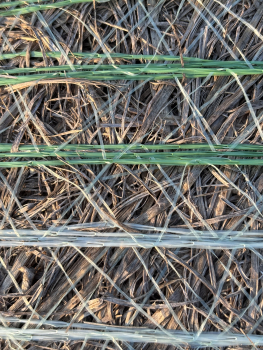
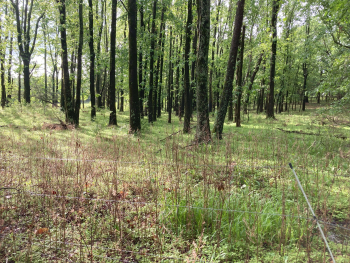
Electric fence in the foreground in front of a grassy forest floor.

Forest where pigs have grazed that has been allowed to rest and recover. Photo: Nina Prater, NCAT

Rest periods for paddocks, typically between 30 and 90 days to allow forages to fully recover, allow the forest floor to regenerate. Wetter or more fragile soils may require longer rest periods. Walking the paddock before turning pigs in provides valuable insight into whether the ground is ready or needs more time.  

Appropriate stocking rates will help maintain a balanced silvopasture system. A general guideline is to stock between 10 and 20 pigs per acre in a rotation system, but this varies based on tree density, soil type, and forage availability. Observing the ground after a rotation will allow you to assess if the stocking density is appropriate; if leaf litter remains intact and fungi are still visible, the pressure on the land is likely well-managed.  

It is best to err on the side of understocking, as it is easier to build up a system than to repair overused ground. It is also important to avoid farrowing pigs in the rotation paddocks, as sows and piglets need stable, sheltered areas with minimal disturbance.  

Protecting the trees themselves is vital. Young saplings are especially vulnerable and will benefit from wire mesh guards or rigid tree protectors to prevent pigs from chewing on bark or rubbing against the trunks. A single pig can uproot a small oak sapling in minutes, so take measures to protect your future forest. Also take care to avoid compaction around tree roots, especially after rain. Rotating pigs away from these sensitive areas during wet conditions preserves root health and prevents long-term damage.  

Timing moves to suit soil conditions is a practice rooted in respect and care for the land. Wet or saturated soil is very soft, and grazing pigs on it can lead to soil compaction and erosion, damaging both pasture and the forest understory. When the soil dries and firms, pigs can safely root and disturb the leaf litter, helping to clear invasive plants and cycle nutrients back into the soil without causing lasting harm. 

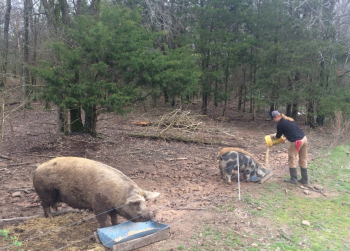
One pig eats from a blue trough in the foreground, and a farmer pours feed to two more pigs in a second trough in the midground, with a forest in the background.

Feeding pigs in portable troughs helps reduce excessive soil disturbance. Photo: Nina Prater, NCAT

Feeding management supports both pig health and land stewardship. While pigs will forage widely on acorns, roots, and greens, supplemental feed is necessary to reach market weight efficiently. Feed balanced rations, including grains or fermented feeds, in a way that encourages natural behavior and spreads manure evenly. Using portable feeders will allow you to move feeding sites around the paddock, which help limit the creation of wallows or overly concentrated manure piles. Seasonal mast like acorns and hickories offer rich forage, but it is important to limit pig time in these areas after the pigs have feasted to allow trees to recover from trampling. Monitoring the pigs’ body condition throughout the rotation is key. Pasture-raised pigs may grow more slowly than confined animals, but their meat often develops a richer flavor and firmer texture.  

Above all, raising pigs in silvopasture is a practice of attentive observation and adaptability. No single plan fits all seasons or sites. Successful farmers walk their land daily, watching rooting patterns, monitoring tree health, and noting soil recovery. Keeping a simple journal with observations and adjustments helps build a deeper understanding over time. Managing a regenerative pig enterprise in the forest is not about control, but cooperation. It’s a dialogue between steward and land, where both pig and tree flourish.  

In the end, silvopasture invites the producer to foster an approach of patience and respect. When managed with care, pigs do more than grow; they become part of the story of soil and tree, of land renewed and bounty shared. Through this work, farmers honor not only the meat they harvest but the living, breathing landscape that sustains them.  

ATTRA Resources:

By Eric Fuchs-Stengel, NCAT Agriculture Specialist

Back in the olden times, hardscrabble beekeepers worked their hives in the hot sun with no suits or gloves. They would puff on cigars, blowing smoke up around their faces, filling the air underneath their wide-brimmed bee veils. This smoke would keep bees, either defensive or curious, away from their upturned mustaches, long beards, and sunbaked faces. Meanwhile, these old-timers would work methodically, gently squeezing the bellows of their copper smokers, floating a thick gray smoke, often a mix of burning pine needles and wood chips, into their Langstroth beehives.

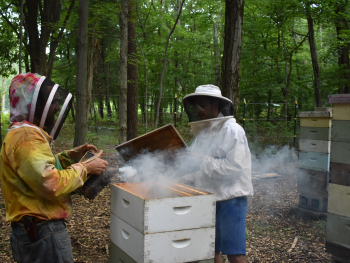
Two people stand on either side of a Langstroth beehive, one of them holding the lid while the other applies smoke to the hive.

Two beekeepers applying smoke to a Langstroth hive. Photo: Eric Fuchs-Stengel

The smoke served (and continues to serve) many functions: it distracts the bees, confuses their olfaction system (smell and pheromone communication), and signifies the potential of an incoming forest fire. The simple practice of using a smoker goes all the way back to ancient times and is still a cornerstone of modern-day beekeeping. Modern beekeepers may have lost the cigars and the outlandish facial hair, but the smoker remains in both copper, stainless steel, and aluminum forms and is a symbol of sustainable, productive, and successful beekeeping.

When I was a brand-new beekeeper, my local bee club partnered with a remarkable bee mentor who rarely used a bee smoker. She was extraordinarily successful with her hives, stewarding many through Varroa mite infestations and cold winters. She prioritized moving slowly and thoughtfully, with movements that were not jarring or alarming to bees. I have not seen this slow and steady “Tai Chi” style of beekeeping replicated anywhere else in the beekeeping world. She would on occasion use smoke, but it was rarely needed when she worked her mature, well-aged, well-mannered, and “spiritually connected,” hives in her home apiary. On a beautiful, sunny, summer day, I would watch my mentor slowly opening, inspecting, and working the hives with her bare hands—no smoker lit, no fear at all, and no defensive hives stinging and buzzing her in the face. Truly, a sight to behold.

As an inexperienced beekeeper, I thought this was the way I should begin raising my bees, which brings us to our story. For several years I kept my colonies on a horse farm. My mentor would visit me and wear a bee suit with no gloves so that she could feel what was happening in the hives and to what extent she was jostling the frames around. The bees were calm and peaceful around her. She was a master of this practice. I, on the other hand, was extremely nervous. I wore a full bee suit, thick leather gloves, and sweated profusely every time I worked my hives in the sun. The smell of my stress radiated outward, and my sweat soaked into the suit, which I did not really wash. In an attempt to imitate my mentor, I did not use a smoker. I would try to be gentle. Slow. Steady. But the fully aware, undistracted-by-smoke, energetic bees would BUZZ LOUDLY and swarm around my face covered by my bee veil. This would lead to me crushing bees under my fingers with the thick leather gloves, jarring and jolting frames as I removed them from the colony.

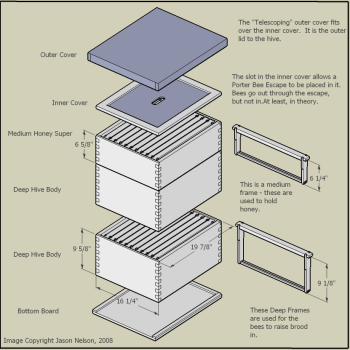
Diagram of the parts of a Langstroth hive, showing from top to bottom the outer cover, inner cover, medium honey super, deep hive body, and bottom board.

Basic anatomy of a Langstroth hive. Source: Jason Nelson, 2008.

In the heat of summer, I would struggle lifting off the heavy honey super, then the top deep, to do a full inspection on the bottom deep—as I had interpreted that to be standard practice—at least once a month. (In actuality, I was over-inspecting my colony due to my inexperience. A skilled beekeeper can read the comb in a hive to determine its health and would need to dive deep into the brood chamber much less frequently.) The bees would buzz, cluster on top of the deep frames, and bubble over the sides of the hive box like lava.


In short, my bees were angry. My leather gloves were covered in stingers. The edges of the hives were full of dead bees crushed between the deeps and supers. My suit was smelly with the stench of nervous sweat. Every time I went to the hives I was scared and worked faster to try to avoid the eruption of bees out of the colony, which only made things worse.

Toward the end of July, I found one of my hives densely packed and sealed tight with propolis, which made it difficult to open. Every time I freed the inner cover, prying it apart with my hive tool, a loud crack would sound, and the sweet smell of bananas would flow out into the air. That banana smell is the alarm pheromone released by the bees’ Koschevnikov gland, which contains isoamyl acetate (the same compound that naturally occurs in bananas). The bees would produce this pheromone upon my arrival and fan it throughout the hive. As I lifted the lid off the hive, the bees buzzed and flew into my veil aggressively, then shot out into the surrounding area, stinging farm visitors, and harassing workers.

For the seasoned beekeepers reading this, it already sounds like a nightmare scenario. But to top it all off, something else had also been occurring that I had not realized would be an issue. About fifteen feet in front of the hive was the farm’s horse-washing station. Every day, several horses would be brought out of the stalls and sprayed down, soaped up, and washed—in the flight path of the forager bees. The animal smell and dust would waft into the hive entrances, further agitating hives already on edge from my nervous management practices.

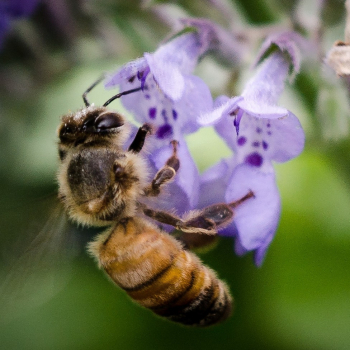
Close-up of a honeybee perched on a purple flower.

Honeybees are excellent at mapping and remembering where to find nectar. Photo: Lance Cheung, USDA

Honeybees have a great memory when it comes to smells. Their brain is tiny but contains up to one million neurons and is organized into clusters called “lobes.” Each lobe controls distinct functions or activities, and one particularly important lobe is called, the “mushroom body.” This lobe is enlarged in honeybees and takes up to 20% of their brain. Its purpose is to receive sensory information like smell and taste, learn about that information, and remember it for the future. This is what allows the bee’s brain to recall certain flowers that are good nectar sources. Likewise, they can also recall the smells of threats like horses, or a scared beekeeper like me.

As the season progressed, I started to receive calls about honeybees stinging visitors as they got out of their cars. Farm staff could be on the other side of the farm working when all a sudden a stray honeybee would fly in their face, get stuck in their hair, and sting them. My colony had become chronically on-edge, and something needed to be done. First, I tried to re-queen the colony. I bought a gentle, healthy, and highly regarded Carniolan queen from a local queen breeder and put it in the hive. This did change the hive temperament a little bit, but I still had stinging issues and excess defensiveness from the colony. When winter arrived, I decided to move the colony to a new location. It took me years to fully understand all the factors that led to turning this hive—which had initially been calm and peaceful—into the volcano of overflowing guard bees that it became. Here are some key lessons I learned:

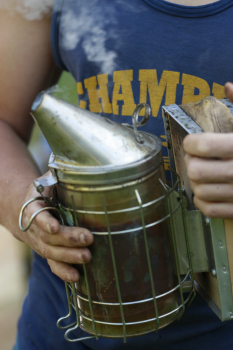
Close-up photo of a person holding a metal smoker used in beekeeping.

One common model of smoker used in beekeeping to keep the hives calm. Photo: Eric Fuchs-Stengel

  • Use a smoker. As a new beekeeper you can’t avoid crushing and killing bees and one of the absolute best tools to avoid prevent stress on bees is a smoker. Today, I usually light my smoker with a tiny bit of dry cardboard. Then I pile it up slowly with pine needles and woodchips. I top it off with a layer of wet mugwort weeds, green grassy material, or other green vegetative material growing around the farm. This green layer will cool the smoke as it leaves the smoker, ensuring the smoke is not so hot it would burn the bee wings or spread hot ash into the hive. I use mugwort as my first choice because the bees appear to like the smell.
  • Observe your site. Scope out your potential apiary location before you place hives there. What animals live in the area? What type of weather patterns impact it? Is there a strong wind? Lots of shade? Too much sun? Will weeds impact the hive entrance?
  • Be careful about smells! Wash your bee suit and gloves monthly. Try your best to visit your hives after a shower when your personal pheromones are at a minimum. Try to stay less sweaty when you work your hives by buying a ventilated bee suit and dressing lightly under it.
  • Don’t stress over applying smoke at the beginning. If you want to be “Zen” with your bees, that can happen over time. Master the basics first and then you can experiment with no gloves, no suit, or no smoke.
  • Use equipment that works for you: Thick leather gloves with no dexterity will kill bees if you aren’t careful. If you are feeling brave and comfortable with your hives, try thinner gloves that fit tighter to the hand or nitrile exam gloves (which the bees can sting through) so you can have dexterity without leaving skin exposed.

I hope you can benefit from the mistakes I made as a new beekeeper, so you’ll be able to start your beekeeping career off a little less painfully than I did. Please feel free to reach out to me with questions, or to let me know if there is other beekeeping information you need from us at ATTRA!

Sources:

Paoli, M. and Galizia, G. 2021. Olfactory coding in honeybees, Cell & Tissue Research 383, pp. 35–58.

Conrad, R. 2017. Natural Beekeeping, Revised and Expended ed. From Chapter 2, Working With The Hive / Attitude. Chelsea Green Publishing, White River Junction, VT. pp. 30–31.

ATTRA Resources:

Podcast episode: Beekeeping Basics with Eric Fuchs-Stengel


By NCAT Conservation Planner Cody Brown and NCAT Senior Conservation Planner Alisha Horak

If the word ‘wool’ conjures up memories of itchy socks and the scratchy blankets your grandparents would pull out when it got cold, it’s time to modernize your view on this warm, soft, functional fiber! Wool has come a long way in recent years. The wool industry has improved processing methods to increase wool’s versatility and comfort, and consumers are loving it, driving the demand for sustainable fibers. In response, the global woolen textiles market, which was valued at 190.4 billion dollars in 2023, is expected to grow almost eight percent every year between now and 2030.

Close-up photo of medium-gray wool sweater.

Wool is a timeless, sustainable fiber that can be used to make comfortable, functional clothes.

The fibers that make up your wardrobe may all make comfortable, useful clothes, but there are growing concerns about a wide range of environmental impacts these different fibers can have. Synthetic fiber’s elasticity, comfort, and cheap cost of production have made it a fierce competitor with natural fibers since the invention of nylon in the 1930s. However, synthetic textiles can lead to microplastic pollution, among other environmental costs. These concerns are starting an industry-wide shift to seek natural fiber sources with verified benefits to land and climate.

The prevalence of synthetics has led to a decline in the American wool industry and the domestic wool processing infrastructure that supported American wool in the past. This caused wool growers to have an increased dependency on volatile international wool markets. To be more profitable, wool producers and domestic wool processors can work together to serve the market of sustainability-interested consumers.

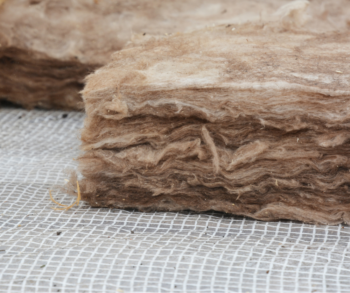
Close-up photo of a cross-section of wool insulation.

Wool insulation is a sustainable alternative to synthetic insulations and a potential market for coarse wool fibers.

Wool isn’t just for clothes, either. The fashion industry and the fine wool producers that support them are seeing an increase in demand for fine wool (i.e., the softest types of wool with the smallest fiber diameter), but medium and coarse wool producers also have opportunities to serve the sustainable fiber market. Medium and coarse wool can be turned into carpets and insulation, replacing synthetic fibers in our homes.

The best part is, when sheep producers use managed grazing techniques, they can actually build soil health and improve the health of the landscape. NCAT has a wide variety of resources available to help farmers and ranchers produce wool in sustainable, ethical ways, so together we can rebuild the American wool market from the soil up.

Producers and consumers both win with wool. It’s a sustainable material for clothing and other products. Wool’s durability, breathability, and insulative properties make it an easy choice when prioritizing the quality of materials. With a growing demand for sustainability across the nation, NCAT aims to empower wool producers through ATTRA’s sustainable agriculture information service, cost-share incentives, conservation plans, and access to new verified fiber markets that benefit the land, producers, and consumers. 

Additional Resources: 

Climate Beneficial Fiber Project

Tips for Marketing Sheep and Goat Products: Fiber

Building the Market for Climate-Beneficial Wool

Climate Beneficial Fiber Partnership: Introduction for Producers

Voices from the Field Podcast Episode 355. Soil-to-Skin: Rebecca Burgess of Fibershed on Building Community

January is Farmer Appreciation Month at NCAT, and some of the farmers and ranchers we especially value are those who make the effort to pass along their hard-won knowledge to beginners. NCAT Livestock Specialist Linda Coffey recently lost one of her farming mentors and took the opportunity to document how significantly this friend influenced her life.

By Linda Coffey

On December 21, 2024, family and friends gathered in Fayetteville, Arkansas, to celebrate the extraordinary life of Mrs. Janice Neighbor. Many people shared stories, and I loved hearing them all, but I couldn’t share mine then. I knew I would cry and stumble over words and not be able to adequately say what she has meant to me and my family for the past 25 years. But I would like to share here what Janice meant to me, in hopes that readers will be reminded of mentors in their own lives, and of people they could mentor, too, to help make the world a better place, as she did.

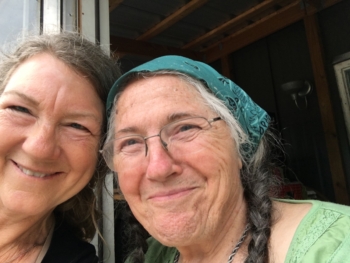
Two women taking a selfie, looking at the camera smiling.

NCAT specialist Linda Coffey (left) and her friend and farming mentor Janice Neighbor (right). Photo: Linda Coffey, NCAT

My path crossed with Janice because of dairy goats. I had the idea that if we had a couple of dairy goats to milk, we would save money on our grocery bill. Our family of six drank a lot of milk. I mentioned this to a friend who replied that I ought to talk to Janice Neighbor, because her son was in his last year of 4-H and the family would be selling a lot of goats.

I found Janice at the kitchen cabin at Prairie Grove Battlefield State Park, where she was engaged in a reenactment. I was fascinated with the living history she was enacting, cooking with cast iron in the fireplace of the cabin, wearing period clothing, teaching people who came in about the Civil War era, and sharing delicious rolls that she had baked in a Dutch oven. We arranged to meet, and she began mentoring me about goats right from the start.

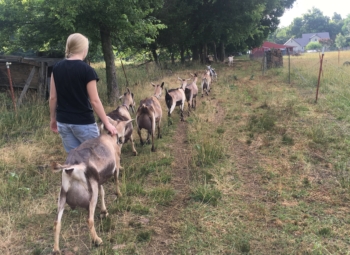
Hannah Coffey on left leading a string of milk goats down a grassy path to the barn for milking time.

Hannah Coffey leads the family’s herd of milk goats to the barn for milking time. Photo: Linda Coffey, NCAT

She and her son had spent years breeding high-quality goats. She gave some to us with the stipulation that we must join 4-H and show the goats at the county fair. She promised to help with that by forming a dairy goat club for others who wanted to show, so we could learn together. That is how we met others who had similar interests. Janice was THE person responsible for connecting the Coffey family to the fair community. The last 25 years would have been so different if she hadn’t cared for and worked with us. I am so grateful!

Janice showed so much patience. We had so much to learn, and she guided us through joining the American Dairy Goat Association, getting papers transferred, applying for our farm name, applying for our herd tattoo, filling out registration papers, filling out fair entry forms, learning to fit and show and properly care for these beautiful, useful animals. She taught us what we needed to know, and we entered our first fair.

It is so much more fulfilling to be a participant than to be a spectator! And it was amazingly helpful having the pro introduce us to other experienced people in the dairy goat barn, having her encourage us each step of the way and cheer us on as the goats that originally were her son’s won more ribbons for our children and our farm. The fair that year, and every year that we participated, was my favorite week of the year, and Janice gave that to us. She helped us learn all about the Dairy Goat Barn customs, the premium sale, and the fun event where the goats and children dressed up and competed.  And she was there, cheering us on and celebrating with us.

The joy of being part of this! It was great for me and for our kids, and we always did well, having started with really nice goats and taken Janice’s recommendations about where to acquire more breeding stock. It was satisfying and fun, and we would never have done it if she hadn’t put that requirement on us and then taught us how.

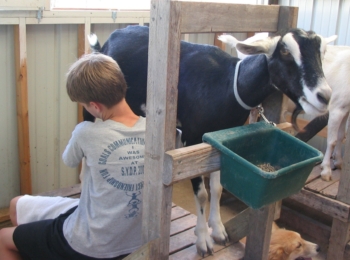
John Coffey with his back to the camera hand-milking a black goat, who is standing on a wooden milk stand facing the camera.

John Coffey takes a turn at milking one of the family’s milk goats. Photo: Linda Coffey, NCAT

The dairy goats brought other benefits to our family, beyond the fair. Our kids developed a solid work ethic with twice-a-day milking, and the milk itself fed our family, local customers, and the pigs, calves, and lambs we also raised. We learned to make cheese – she guided us there, too.

We took goats to Farm Friends, a fun event where over 1,000 school children attend, and there’s a free bean supper that evening for the community. Janice was always there, too, spinning all day with her guild and providing cornbread for the evening meal.

Janice also helped us with our sheep and got us involved in Sheep to Shawl. She got her entire spinners’ guild to spin our Gulf Coast wool for Sheep to Shawl, and I loved seeing what they created.

She was also such a good cook and gardener. She knew so much about culinary and medicinal herbs. She knew and grew at least ten basil varieties, for example, and the seed collection she and her husband developed is so impressive. She was a Master Naturalist as well as a Master Gardener, Master Canner, and knowledgeable in all the homesteading arts. I can’t capture everything that was special about her. I haven’t mentioned her humor, her colorful expressions, her vast knowledge of history, medicine, livestock, fiber arts, food preservation, indigenous knowledge, and more. I haven’t helped you picture her beautiful, kind smile, her enthusiasm for life and for people and for nature. You can’t see how she enjoyed all the good things, how she encouraged so many people every day, how she could be very blunt and straight-forward when the situation called for it, or how she’d lived so MUCH in her lifetime.

But her kindness and love for our family are what I will miss most. She got to know each of our children, celebrated our successes, and shared her teaching experience. She gave me great support and advice, even to the last time I saw her, literally on her deathbed, when she still cared and gave me words of wisdom.

I thought I had more time. I regret that I never took the time to just go hang out all day and learn. I would have had to go every day for a long time to just get the tip of the iceberg! I always thought I would do that “later.”  My advice for you is this: if you know someone you admire and love, prioritize spending time with them, no matter how busy you are. If you have the chance to be a participant instead of a spectator, do it! It’s much more fun. If you have a mentor, thank them. If you are a mentor, I thank YOU: you are changing lives and making the world a better place, as my precious friend Janice did.

Beginning farmers often connect with mentors through formal mentorship programs like Marbleseed’s Farmer-to-Farmer Mentorship Program, Quivira Coalition’s New Agrarian Program, and Practical Farmers of Iowa’s Labor4Learning. Similarly, structured learning opportunities like the ones listed in ATTRA’s Internship Hub can help beginners connect with experienced agricultural practitioners.

This blog is produced by the National Center for Appropriate Technology through the ATTRA Sustainable Agriculture program, under a cooperative agreement with USDA Rural Development. ATTRA.NCAT.ORG.

By Chris Lent, NCAT Agriculture Specialist

Finding ways to turn “waste materials” into useful resources on the farm has always fascinated me. On my farm, I tried to reuse and recycle resources as much as possible to close the off-farm input loop. I think farms can become more resilient as they rely on fewer off farm inputs. So, when I heard of the mid-scale anaerobic digester being installed at Dickenson College Organic Farm as a demonstration of how small dairy farms can utilize manure and other waste streams to produce on farm energy, I was eager for the opportunity to visit the farm and help spread the word to other farms.

In November 2023, NCAT Agriculture Specialist Eric Fuchs-Stengel and I had that opportunity. We traveled to Dickenson College Organic Farm in Carlisle, PA to visit Matt Steiman, Farm Energy and Livestock Manager at the farm. The farm is a beautiful certified organic working farm situated on 90 acres in the south-central part of the state where they grow vegetables and raise beef, lamb, and layers. Eric and I were there to shoot a video tour of the newly installed, mid-scale anaerobic biodigester that transforms manure from a neighboring dairy, as well as food waste from the college dining hall and local restaurants, into natural gas that can be used to generate heat and electricity.

This biodigester project comes after years of biofuel research and experimentation by Steiman at the college. The idea of using waste products from the farm and local area to produce fuel and power greatly intrigued Steiman, so he started making biodiesel that converted waste cooking oil into fuel to run equipment on the farm. Since the glycerin byproduct from biodiesel production can be useful in anaerobic digestion of organic matter that produces natural gas, he started experimenting in 2010 with small anaerobic digester systems to utilize glycerin, leading to a series of larger systems and culminating with the latest farm-scale biodigester.

The process of anaerobic digestion for production of natural gas is straightforward. A sealed tank creates an anaerobic, or oxygen-free, environment where a slurry of organic matter can be “eaten” or digested by microbes that thrive at certain temperatures in low-oxygen conditions. The methane gas given off from the microbes in this process rises to the top of the tank to an outlet tube where it can be collected and used as a fuel source for heat or electric production. The leftover digestate, which contains all the nutrients from the original waste material, is collected and spread on farm fields.

The size and cost of this new biodigester project required very specific design considerations to ensure that it was sized properly to match the expected waste flow and operate as intended. The digester tank is a 10-foot tall, 115,000-gallon, 50-foot-diameter cement tank buried 8 feet in the ground and sealed with a heavy-duty rubber covering. In the tank are heater pipes and an agitator to mix the slurry. A free-style barn was built next to the tank to house the dairy cows and heifers. At one end of the barn are three in-ground cement tanks that make up the waste-collection system for the digester. One tank is for daily manure collection, the second is for food waste collection (up to 3 tons per day), and the third is for collecting the digestate material remaining after the digestion process. The digestate goes through a liquid removal process and can then be used for bedding in the barn. The liquid portion of the digestate is staged to be used as a nutrient source for the farm’s crop fields and compost piles.

This digester is sized to produce enough gas to match a 50-kilowatt (kW) combined heat and power (CHP) engine. An engine from the European company TEDOM adapted to biogas was chosen for the job. The power produced will first be used to supply the power needs of the farm and the biodigester itself with excess electric production being sold back to the local utility company. This unique 150-cow-scale digester is small compared to other on farm digesters in the United States.

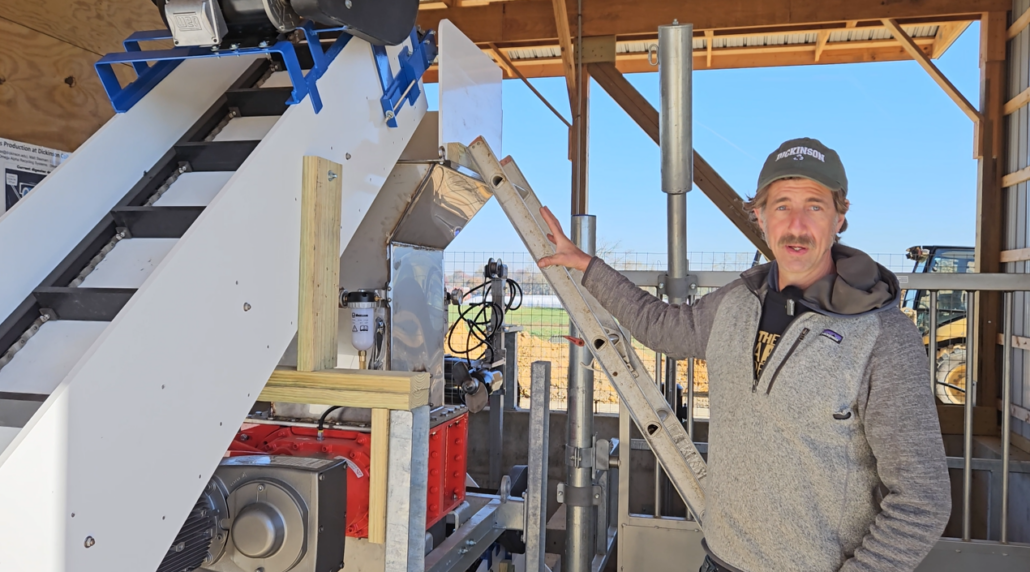
Matt Steiman explaining how an industrial grinder works to break down up to 3 tons of food waste a day so it can be pumped to the digester tank

Matt Steiman explaining how an industrial grinder works to break down up to 3 tons of food waste a day so it can be pumped to the digester tank. Photo: NCAT

Funding for this project was secured from multiple sources, including NRCS’s Environmental Quality Incentives Program (EQIP). For farmers looking for biodigester funding, Steinman had several suggestions. First, he said, talk to your Natural Resources Conservation Service (NRCS) county office. In addition, the Rural Energy for America Program (REAP) is a grant program administered through USDA’s Rural Development office. Through REAP, farmers and rural businesses who meet grant criteria can apply for grant funding up to 50% of the cost of an on-farm alternative energy project, including anaerobic biodigesters. Steiman also suggested talking to your state Department of Agriculture and Department of Environmental Management or Protection as funding sources. It is also worth investigating local conservation districts and utility companies that may offer funding for on-farm alternative energy projects.

With this new biodigester, Steiman and Dickenson College are using farm and food-waste streams to generate renewable energy right on the farm and reduce greenhouse gas emissions. With nearly 5,000 dairy farms in Pennsylvania alone with an average herd size of 100 cows, this project is intended to showcase how biogas production can work for mid-sized farms across the state and the country. The college is partnering with Penn State University and agriculture producer groups like PASA Sustainable Agriculture to use this project as an on-the-ground demonstration of properly sized biodigester design and implementation and to educate farmers on the benefits of biogas production at this scale.

Related ATTRA Resources:

Episode 350. Mid-Scale Biodigester with Matt Steiman of Dickinson College

Biodiesel Use, Handling, and Fuel Quality 

Micro-Scale Biogas Production: A Beginners Guide 

Anaerobic Digestion of Animal Wastes: Factors to Consider

Other Resources:

Biogas – Dickinson College Organic Farm 

Organic Farm Dickinson College – YouTube 

Rural Energy for America Program Renewable Energy Systems & Energy Efficiency Improvement Guaranteed Loans & Grants 

On-Farm Energy Initiative, NRCS 

This blog is produced by the National Center for Appropriate Technology through the ATTRA Sustainable Agriculture program, under a cooperative agreement with USDA Rural Development. ATTRA.NCAT.ORG.