By Danielle Duni, NCAT Agriculture Specialist
Whether you have ten sheep or one thousand, proper preparation, handling, and storage of wool can significantly improve the value of your wool clip. When you take steps to produce clean wool, you open the door to better pricing and more opportunities for processing into finished products.
One of the biggest factors affecting wool quality is contamination, which can come from livestock paint, feed, grass seed, baling twine, net wrap, and many other sources. The good news is that there are several steps you can take long before shearing day to reduce contamination and protect your wool quality. You should start making plans for your next clean wool clip shortly after your previous shearing is complete. Keep reading for ways to keep your wool clean from a range of contaminants.
Sheep Paint
Many operations shear their sheep before lambing to create a cleaner environment for the birth and to make it easier for lambs to latch onto the ewe. Larger operations often use paint brands to be able to identify ewe and lamb pairs once they’re in the pasture. When you apply paint, use a scourable sheep paint, which can be removed during the wool-cleaning process. Apply paint sparingly and place it consistently within the flock, high on the hind end where it can be easily removed on the shearing floor. Careful placement helps prevent unnecessary contamination of the fleece.
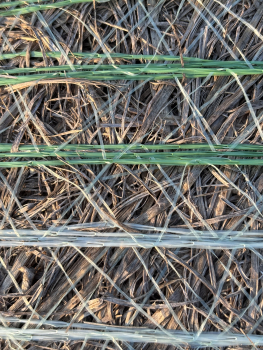
Synthetic net wrap can contaminate wool if not removed and disposed of. Photo: NCAT
Synthetic Fiber
Feeding practices can also play a major role in wool contamination, especially in confinement settings. Taking the time to remove all net wrap and poly twine from feed and properly disposing of it goes a long way. Additionally, refrain from using twine to hold up posts of gates; twine is made from poly fibers that break down into smaller strands and eventually find their way into the wool. Poly fibers cannot be combed out in processing, resulting in an unusable yarn.
Feed Particles
Using proper sheep bale feeders helps reduce the amount of time sheep spend climbing into feeders (though anyone with sheep knows they will always find a way). Feeding daily rations instead of allowing continuous access to feed can reduce contamination, although it does require more labor. If you are spreading feed or bales with a tractor or wagon, it is best to keep sheep penned away while spreading to prevent fine feed particles from settling into the wool.
It’s Shearing Day!
Speaking from experience, you can never be too prepared for shearing day. The number one priority is keeping sheep dry. A good rule of thumb is this: if you place your hand on top of the fleece and it feels even slightly damp, the sheep are too wet to shear. Moisture can clog shearing equipment, ruin the wool clip, and create unsafe or uncomfortable conditions for the shearing crew. Even a light rain or snow can delay shearing just as much as a major storm.
Shearing Set-Up
With larger flocks, shearing crews often bring wool help, i.e., an experienced crew to help with the wool handling and preparation aspect of the shearing process. If you only have a few sheep and no wool help, congratulations, you are the wool help!
Shearing crews also often bring equipment such as wool packs, wool sweeps, and skirting tables. At a minimum, have proper wool bags and a broom on hand. Wool packs are the industry standard for baling and storing wool and can be purchased online. If a wool sweep is not available, a clean shop broom works well for clearing debris from the shearing area.
Skirting involves removing undesirable wool such as wool that is contaminated with manure, paint, heavy vegetable matter, dirt, or short fibers. The key is to separate lower quality wool from the main fleece. A skirting table provides the best results when removing bellies, tags, and contaminated pieces from the fleece. Skirting involves removing undesirable contaminants from wool such as manure, paint, heavy vegetable matter, dirt, or short fibers. There are many effective DIY skirting table designs available online. If a table is not feasible, you can skirt directly on the shearing floor. The key is to separate lower quality wool from the main fleece. Additionally, laying down a canvas tarp in the shearing area helps keep wool clean and off the ground.
Sorting Wool
After skirting comes sorting. Best practice is to have separate bags ready for the main fleece line and off-sorts such as bellies, pieces, and tags (often grouped together). If the main fleece varies in quality, you can split it into an AA (highest quality) line and an A line. Even if you have limited experience with wool sorting or classing, the important take away is to sort “like wool with like wool.” Shorn belly wool goes into the belly bag. Areas of contamination, such as the crow’s nest/top knot or painted wool, go into the pieces bag. The main fleece goes into the mainline bag, taking care to remove short fibers or weak samples that break easily when pulled. (For more on fleece anatomy, check out this article from New Mexico State University). Compost or discard wool from the hind end with manure contamination, as it can add moisture to the bales. The main fleece goes into the mainline bag, taking care to remove short fibers or weak samples that break easily when pulled.
When sorting, it’s helpful to pull a sample from the fleece to evaluate quality. Measure length against your hand, with a general minimum of three inches. Test strength by gently pulling the staple apart to check for breaks. If your flock includes colored fiber sheep, shear them last to prevent contamination of white wool.
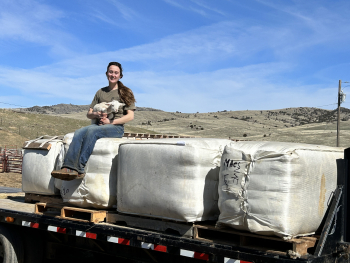
Danielle Duni sits atop bales of wool that are sorted and ready for market.
Baling Wool
Once sorted, it’s time for baling. Some shearing crews bring hydraulic wool balers that compress wool into 400-to-500-pound bales. The wool packs (bags) are then securely fastened to keep the wool clip protected.
Labeling and Storage
And don’t forget the final step: labeling! Industry standard labeling guidelines can be found through the American Sheep Industry Association. At a minimum, each bag should include the operation name, bag number, wool description (mainline or off-sorts), and year. Store wool in proper wool packs in a dry area. Storing bales on pallets helps prevent moisture absorption and allows for airflow. Ideally, wool should be stored indoors in an area with moderate temperature fluctuations.
Shearers Know Best
One of the best resources you have is your shearer. Ask what you can do to set up the area for success. A pen with an alley run is a great starting point. Keeping the shearing area clean is essential. Lightly watering the barn floor beforehand to prevent dust can help conditions be ideal. Shearers might have other tips like that to make sure the shearing goes smoothly and the wool clip is the best quality possible.
This blog is just an overview of preparing for sheep shearing. For more information, please reach out to our NCAT agriculture specialists at askanag@ncat.org. Additionally, the American Sheep Industry (ASI) provides great resources for how to prepare, sort, handle and store the wool clip. Find some of their resources below.
Resources:
Preparation Steps for Wool Quality Improvement
https://www.sheepusa.org/wp-content/uploads/2021/11/Prep-Steps-Brochure-Small-Size.pdf
Wool Contamination: American Sheep Industry Association, Inc.
https://www.sheepusa.org/wp-content/uploads/2022/06/Wool_contamination-1.pdf
Poly Contamination: American Sheep Industry Association, Inc.
https://www.sheepusa.org/wp-content/uploads/2022/06/Poly-1.pdf
Understanding Wool Grads: New Mexico State University
https://pubs.nmsu.edu/_b/B409/index.html
Code of Practice for Preparation of Wool Clips
https://www.sheepusa.org/wp-content/uploads/2021/11/code-of-practice-2021.pdf
Wool Handling Videos (for purchase): American Sheep Industry Association, Inc.
https://www.sheepusa.org/product/wool-handling-videos
This blog is produced by the National Center for Appropriate Technology through the ATTRA Sustainable Agriculture program, under a cooperative agreement with USDA Rural Development. ATTRA.NCAT.ORG.