Tag Archive for: Sustainable Agriculture

By Lee Rinehart, NCAT Agriculture Specialist 

Mike Miezianka and Ray Smith have found a way to beat the average Long Island commute time by almost seventy-five percent. They take a boat. After a fifteen-minute crossing of Great South Bay, their workplace materializes on the horizon: a series of floating cages in discrete rows covering an acre and a half of the estuary. We have arrived at Toasted Oysters Farm, one of twenty-three similar operations scattered across this shallow part of the bay that grows the region’s distinctively flavored Blue Point Oysters.
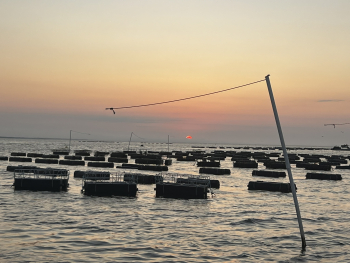
Rows of black floats sit on silver water, a pink and orange sunrise behind.

The morning commute. Photo: Lee Rinehart

The journey to Toasted Oysters Farm really began five years earlier, back in 2020. Mike was hanging with Ray in Ray’s backyard, sharing after-work drinks, and the conversation turned speculative, as often happens when long-time friends gather to let the day settle. “I’m going to own an oyster farm,” Ray said out of the blue. I can imagine Mike’s look of curiosity, and Ray’s grin as he sat across from him, sipping his drink. The idea of farming oysters was nothing new to either of them. Ray had been taking a class on oyster farming at the township, but something was different as they sat together that day. That day, there was intention. So, Mike signed up for the next oyster farming class and the die was cast. What would follow over the next five years was a journey that Mike, a Navy veteran and former New York City detective, and Ray, a paramedic, could never have anticipated before that fateful day in Ray’s backyard. 

When Mike, Ray, Luke (their summer employee), and I reached the farm the morning they took me out, the sun was balanced on the horizon, bathing the sky salmon as Ray throttled the engine down. The cages, supported by black plastic floats and each holding six oyster bags, bobbled gently in the current, longlines holding them in place, anchors at the end of each row. A converted pontoon boat lay anchored alongside the last row of cages, tethered to a floating pier. Together, they served as boat dock, staging zone, oyster sorting area, and packing house. Ray brought the boat alongside the floating dock and our workday began. 

A man stands looking at a metal tumbler used to sort oysters by size.

The tumbler Mike and Ray use to sort oysters by size. Photo: Lee Rinehart

Oysters start from seed (yes, seed… small, shelled creatures ranging from one to ten millimeters in diameter) in semirigid mesh bags. In March, Mike and Ray place the bags into floating cages where the oysters will grow rapidly, with an average of eighteen months between planting and harvest. Growth peaks in the summer months when the water temperature is warm and nutrient flows are abundant. Each day during the summer Mike and Ray work the farm, pulling bags from the cages and sorting them in a homemade tumbler, an ingenious device that looks like an oversized potato washer with holes along its surface that allows the oysters to fall into buckets underneath based on their size. After they sort the oysters to size, those that need more growth go back into bags and into the floating cages, and they rinse, bag, and ice the marketable oysters. The process continues all summer. Maintenance tasks such as de-fouling gear, repairing cages, or adjusting longlines also keep them busy throughout the growing season. Then, finally, the fall brings a lull in activity. After their last time sorting, Mike and Ray bag the remaining oysters, lay them on the bay floor to overwinter, and then haul the floating racks back to land, protecting the gear from ice damage. 

Once we were tied to the floating dock, Ray and Luke, a college biology student whose work pace never slowed all day, immediately got busy with the tumbler while Mike and I descended the boat’s stern ladder into the seventy-nine-degree water of Great South Bay. There are probably as many ways to access oyster cages as there are oyster farms, and on Mike and Ray’s farm all the oyster handling and maintenance is done by wading out into the bay’s waist-high water. A terrestrial farmer has an advantage in that they can walk easily between rows, drive tractors, or listen to a podcast while working. But an ocean farmer, well, try spending a seven-hour workday walking against an ever-increasing tidal current while manipulating oyster bags into and out of chest-high floating cages. Nothing is lashed down, and everything moves, all the time. And while land farmers may be on constant lookout for snakes and spiders, an attentive oysterman is on vigil against the painful defensive pinches of the blue crab, which finds the aquatic plants that colonize the floating cages to be ideal habitat.  

Mike says the demand for seafood is forecasted to increase by 25% from 2024 to 2032, and to cater to consumers’ greater awareness of the benefits of eating locally produced food, Toasted Oysters has adopted a system of traceability through inventory tracking and harvesting software that accurately pinpoints the location of each harvest. They market their oysters to distributors in the Long Island region thanks to the strong relationships they’ve developed with buyers. This year they are expanding into New Jersey, Pennsylvania, and Massachusetts, with a goal to increase their inventory to three million oysters by the end of 2025 to keep up with demand. In addition to distributors, Mike and Ray supply four restaurants, diversifying their distribution channels and enhancing their brand presence among people seeking the briny, savory flavor that distinguishes Blue Point Oysters from other varieties.
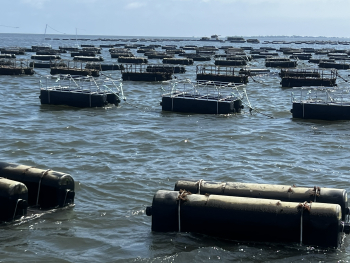
Black floating cages lined up in rows on the water.

Floating cages at Toasted Oysters Farm. Photo: Lee Rinehart

We’d been on the farm since five-thirty a.m., and as the clock approached noon the tide increased, and walking to and from the cages became a laborious push against an even deeper aqueous surge. As Mike and I handed the bulging bags of oysters up to Luke on the floating dock, we decided it was time to sort the marketable oysters, get them on ice, and call it a day. Mike and I had been talking all day as we worked, about the ecological benefits of filter-feeding shellfish, how heavy rainfall events can temporarily shut down an operation, what to look for in a marketable oyster, and the various practices and communal nature of the close-knit oyster farmer community in the bay. Then our conversation turned toward the pragmatic: I wanted to know his recommendations for beginners.  

There are so many moving parts on a shellfish farm: site selection, leasing, regulations, choosing the right equipment, marketing, and acquiring production knowledge. When Mike started out, before he even had a lease, he volunteered on oyster farms to learn the craft. “Farmers are always looking for assistance,” Mike said. Getting out and working on farms acquaints you with the rigors of a normal workday. You get firsthand knowledge of systems and techniques – like which kind of cage system to use depending on water depth, how to install anchors and longlines, what to do about biofouling on cages and cormorants and gulls pooping on your gear.  

If you catch the shellfish farming bug, then it’s time to research the available aquaculture lease sites and regulations in your area. “On Long Island,” Mike explained, “several entities manage different regions, each with its own specific rules and regulations, in addition to state regulations.” This is one of the benefits of volunteering on farms. You forge a relationship with an established farmer (who may end up being your neighbor) and you can get firsthand information on leasing and regulations.  

Volunteering is essential for learning the trade. As Mike noted, “In oyster farming, the motto is: ‘More flow, more grow, more dough.’” Good water flow is essential for delivering nutrients to your oysters and is the principal consideration in site selection. And finally, Mike recommends you “consider how the farming technique aligns with your current physical abilities. Farming in deeper water requires a larger boat and additional equipment. Conversely, in shallow water, you may need to physically roll cages for anti-fouling measures and navigate walking in tidal currents.” 
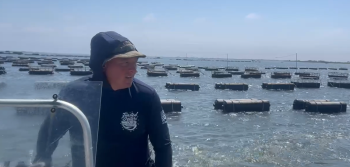
A man in a hooded jacket steers the boat away from the floating cages of the oyster farm.

Mike steers the boat away from the oyster farm at the end of the day. Photo: Lee Rinehart

Mike and Ray are proving that small-scale oyster farming can be a viable business, as they are at a point now where they are scaling to a level that will provide a sustainable income. For those who would begin the journey to having their own oyster farm, or any kind of farm for that matter, Mike’s words are salient: “Begin with small steps and maintain a big vision.”  

 Related Resources 

ATTRA Podcast: Farming Oysters with Mike Miezianka

Ocean Farming: a Conversation with Bren Smith 

Further Resources 

Toasted Oysters – Authentic Blue Point Oysters 

Cultivating the Eastern Oyster, Crassostrea virginica 

Report: State by State Summary of Shellfish Aquaculture Leasing/Permitting Requirements (2021) 
Rhode Island Shellfish Marketing Guide 

NCAT is a non-profit organization whose mission is to advance solutions in regenerative agriculture and clean energy so that both people and the land can flourish. NCAT operates locally, with deep ties to the communities and regions we serve. We share knowledge, build skills, craft practical solutions, and cultivate networks through workshops and convenings, an online resource hub, and multimedia communications. We are known for providing trusted, human-centered technical assistance in agriculture and energy.

NCAT is seeking four (4) full-time Technical Assistance Providers who will be on the implementation team of a multi-year project focused on wool producers in Colorado, Idaho, Montana, South Dakota, Utah, and Wyoming to strengthen their market access. Technical Assistance Providers work directly with targeted wool producers with resources for improving wool quality, soil health, drought resiliency, and market access improvement

This position is remote, and the employee must be based in one of the following states: Colorado, Idaho, Montana, South Dakota, Utah, and Wyoming. Relocation support is not provided.

This position is tied to a grant-funded project that is scheduled to conclude March 2028. Employment is contingent upon the continuation of project funding.

QUALIFICATIONS:

This position requires a BA/BS degree in agriculture, animal science, natural resource management, conservation, or related fields. Experience in building soil health through regenerative ranching and farming; and demonstrated competence/certification in whole farm planning, such as NRCS conservation planner certification.

DESIRED KNOWLEDGE, SKILLS, AND ABILITIES:

  • Commitment and passion for the NCAT mission.
  • Strong knowledge of animal agriculture in the West and familiarity with ag-related organizations and government agencies.
  • Understanding or willingness to learn about the sheep and wool industry.
  • Experience working for or with the NRCS.
  • Experience in providing technical assistance for conservation agriculture practices.
  • Experience working with land managers and agricultural producers in conservation planning, soil health planning, and implementation.
  • Competence in GIS mapping, data management, and using software such as the Web Soil Survey and the Rangeland Analysis Platform.
  • Competent with Microsoft Office and Google Suite.
  • Demonstrated knowledge of western ecology, plants, wildlife, soils, and climate.
  • Excellent attention to detail and demonstrated verbal and written communication skills.
  • Exceptional ability to communicate and build relationships with farmers, ranchers, community organizations, government agencies, partners, private contractors, and the general public.
  • Strong analytical and problem-solving skills.
  • Self-directed and organized with the ability to multitask to meet multiple deadlines.
  • Exceptional ability to work productively both independently and in a collaborative team setting.
  • Familiarity with the sheep and wool industry is preferred.
  • Ability to conduct on-farm fieldwork in challenging terrain, weather, and climate conditions while carrying up to 30 pounds.
  • Willingness and ability to travel around the region. Travel may involve flexible work hours, including evenings and weekends. Some overnight travel will be required.

RESPONSIBILITIES:

  • Promote and support NCAT’s mission.
  • Enroll woolgrowers in the program and ensure producer eligibility by gathering necessary documents.
  • Assist woolgrowers to implement conservation practices, best practices to improve wool quality, and increase market access opportunities.
  • Complete NRCS Environmental Evaluations in accordance with NRCS standards.
  • Provide regionally appropriate technical assistance to woolgrowers via in-person site visits, phone, and email.
  • Monitor conservation practice implementation, monitoring, and measure and report on necessary information to the USDA.
  • Collect data and contribute to quarterly project reports towards benchmarks and goals.
  • Work closely with producers to gather necessary documentation and administer incentive funds, such as but not limited to the Wool Quality Improvement Fund and Market Innovation Fund.
  • Present at conferences, producer association meetings, stakeholder meetings, and other appropriate forums.
  • Administer program details to project participants and maintain their confidential records and information.
  • Develop and maintain positive, productive, professional relationships with producers, partner organizations, agencies, research institutions, and Tribes as part of program delivery.
  • Create outreach and promotional materials, such as press releases, blog posts, and podcasts.
  • Cultivate positive, inclusive, and productive relationships internally with teammates, working collaboratively within the NCAT team and across NCAT as a whole. Teamwork is an essential function of this job.

SALARY AND BENEFITS:
This position offers a salary range of $63,000 to $67,000 based on experience and qualifications, along with a comprehensive benefits package.

APPLICATION PROCESS: Applications will be accepted until a suitable candidate can be identified. Early applications are encouraged. Applicants are encouraged to visit www.ncat.org to learn more about NCAT.

All interested applicants must apply by submitting a current resume and cover letter that highlights relevant skills and experience aligned with the listed qualifications.

To apply, please visit our workforce page and choose Technical Assistance Provider.

Questions about the application process can be directed to:
Cassie Lindau, Human Resources Manager
jobs@ncat.org
(406) 494-8644

NCAT is an equal opportunity employer. We are committed to building a diverse, inclusive, and equitable workplace. All qualified applicants will receive consideration for employment without regard to race, color, religion, gender, sexual orientation, gender identity or expression, national origin, age, disability, veteran status, or any other characteristic protected by law.

The National Center for Appropriate Technology (NCAT) has launched its Regenerator’s Atlas of America, an interactive storytelling map connecting farmers, ranchers, and land managers who are taking steps to catch and hold more water in the soil. The Regenerator’s Atlas of America is part of NCAT’s Soil for Water project.

“From Maine to Minnesota, Texas to Idaho, the Regenerator’s Atlas of America is sharing the stories of farmers and ranchers who are finding ways to catch and hold more water in the soils, making their businesses more resilient to drought, erosion, and extreme weather,” NCAT Executive Director Steve Thompson said. “The Regenerator’s Atlas of America is creating a virtual gathering place and information-sharing platform for the growing number of agricultural producers who know that soil health is key to a strong business.”

NCAT’s Soil for Water project is about connecting producers with each other to share land management practices that improve soil health, catch more water in soil, reduce erosion, sustain diverse plant and animal life, and filter out pollutants, all while improving the profitability of their businesses.

Doug Garrison, owner of DS Family Farm near Lincoln, Nebraska is among the nearly 200 farmers who have joined the free and voluntary Soil for Water network, and he’s also added his place to the Regenerator’s Atlas of America. For 25 years, Garrison has been practicing regenerative grazing and wants to connect with other ranchers who are trying similar methods.

“My main interest in Soil for Water is to learn from others who are practicing regenerative ag in their specific context. We like to see what others are doing, think about what they are doing and see what their results are,” Garrison said. “Then, we may take some of their ideas or techniques and adapt it to our farm context and try it.  We look for both similar and opposite techniques from what we are doing. You never know where you might find the next breakthrough idea for your operation.”

Unhealthy soil doesn’t absorb much water. Healthy soil acts like a sponge, capable of holding hundreds of thousands of gallons of water in an acre. Climate trends across much of the U.S. indicate longer, hotter drought periods punctuated by storms that often are more severe, according to a 2021 USDA report. Regenerative farming practices enable the soil to capture rainfall that otherwise might disappear as runoff. Economically, these practices can increase crop and forage production, drought resilience, access to lucrative new markets, and therefore profitability. Environmentally, they can improve soil health and biodiversity.

The Regenerator’s Atlas of America joins the Soil for Water Forum as another way farmers and ranchers can connect and learn from one another.

To learn more about the newly expanded Soil for Water project, add your pin to the Regenerator’s Atlas or chat at the Forum visit SOILFORWATER.ORG.

-30-

THE NATIONAL CENTER FOR APPROPRIATE TECHNOLOGY has been helping people build resilient communities through local and sustainable solutions that reduce poverty, strengthen self-reliance, and protect natural resources since 1976. Headquartered in Butte, Montana, NCAT has field offices in Arkansas, California, Colorado, Idaho, Kentucky, Mississippi, Montana, New Hampshire, Pennsylvania, and Texas. Learn more and become a friend of NCAT at NCAT.ORG.

For more than 35 years, the National Center for Appropriate Technology’s ATTRA Sustainable Agriculture program has been helping farmers and ranchers grow nutritious food and operate successful businesses without synthetic fertilizer. Now, NCAT has released a new toolkit with trusted and practical resources for farmers who want to transition away from the use of synthetic fertilizers.

“As the cost of synthetic fertilizers and global food prices continue to climb, NCAT is releasing a roadmap for farmers who are looking for a more self-reliant and resilient method of farming,” said NCAT Southeast Regional Director and Arkansas farmer Margo Hale. “A growing number of farmers are opting out of the high-input model of conventional agriculture, which we see now is so vulnerable to global events like war and supply chain disruption.”

As the world’s farmers watch the cost of synthetic fertilizer continue to increase, and global food prices shatter records kept by the U.N. Food and Agriculture Organization, the global food system is being stressed like never before. There is a more stable, resilient model being used in every corner of the United States. These farmers rely on biological sources of nitrogen, breaking free of an often-volatile global marketplace.

Farming without synthetic fertilizers is within reach for large-scale food producers, and it’s a requirement for certified organic farmers. Montana grain-grower Bob Quinn transitioned his family’s conventional farm to an organic one back in 1989. Quinn brought Khorasan wheat to the mainstream marketplace with his brand KAMUT. In Maryland, Ron Holter manages his 150-cow seasonal dairy on grass alone, with no supplementary grain. Holter’s dairy has been free of synthetic fertilizer since 1995. Dave Brandt began cover cropping his Ohio corn and soybeans in 1978. Cover crops have maintained his cash-crop yields while reducing nitrogen fertilizer use by nearly 90 percent. Brandt credits cover crops with increasing soil microbial activity naturally, which provides nutrients to the food he grows and increases the soil’s water-holding capacity.

Data show consumer demand for certified organic and other regeneratively produced foods continues to increase. The sale of organic products in the U.S. has grown more than 30 percent since 2016, and the number of organic producers is up almost 40 percent. Farmers who use regenerative methods, but might not be certified organic, are no doubt on the rise, too.

Shifting to a production method that is not reliant on synthetic fertilizers can be accomplished strategically over a three- to five-year transitional period. NCAT’s new toolkit guides farmers as they learn to use cover crops, managed grazing, and alternative soil amendments to naturally boost renewable nitrogen levels needed to maintain long-term productivity. These are accessible tools that can result in reduced input costs, increased self-reliance, and more nutritious food grown at small and large scales.

Access the free toolkit and decades of trusted, practical resources here: https://attra.ncat.org/how-to-reduce-synthetic-fertilizer-use/ .

EXPERT VOICES

NINA PRATER
Expertise Areas: Livestock, Soil Health, Organic Crops

Nina Prater has been with the National Center for Appropriate Technology (NCAT) since 2016 as a Soil Specialist and Outreach Coordinator in the Southeast Regional Office. She strives to help farmers understand soils as a living entity so that they are able to farm profitably and build healthy soils for long-term success. Nina also works closely with the Gulf States Regional Office staff to coordinate outreach efforts in that region. Nina served as an Energy Corps member in 2013 and worked for her local conservation district for 2.5 years before joining NCAT. Nina and her husband Jeremy own and operate a small sustainable livestock operation in the Ozarks hills of Arkansas, where they raise meat goats, cattle, hogs, and poultry. They utilize adaptive grazing methods to build soil health in their pastures.
LEE RINEHART
Expertise Areas: Livestock, Organic Livestock, Soil Health, Grazing, Pasture Ecology

Lee Rinehart is a graduate of Texas A&M University, where he studied animal science and agricultural education. He currently works as an agriculture specialist in the National Center for Appropriate Technology’s Northeast Regional Office, where he focuses on pasture and rangeland ecology and grazing systems. He has served as county Extension agent in Texas and Montana, organic farm educator in Pennsylvania, and cattle ranch manager in central Texas. His specialty is developing grazing plans and assisting producers in using animals to renovate pastureland. Lee is a Chief Petty Officer in the Navy Reserve and spends his free time biking, sailing, and renovating his 1925 Cape Cod house in Northeast Pennsylvania.


The National Center for Appropriate Technology (NCAT) is bringing its free Armed to Farm training back to the Hill Country, after hosting a 2015 training in Castroville, Texas. Armed to Farm will take place May 16-20, 2022, in Fredericksburg. Farmer-veterans will attend classroom sessions and travel to local farms for hands-on learning experiences. The deadline to apply is Friday, April 8.

Armed to Farm trainings include an engaging blend of farm tours, hands-on activities, and interactive classroom instruction. NCAT Sustainable Agriculture specialists will teach the sessions. Staff from USDA agencies and experienced crop and livestock producers will provide additional instruction.

“We’re eager to bring Armed to Farm back to the Lone Star State,” said Armed to Farm Program Director Margo Hale. “Armed to Farm has served more than 800 veterans in all corners of the country as they start or grow their own sustainable farm business.”  

Armed to Farm is a sustainable agriculture training program for military veterans. NCAT, a national nonprofit organization based in Butte, Montana, developed Armed to Farm in 2013 through a cooperative agreement with USDA-Rural Development. Farmer veterans learn how to make a business plan and market their products, how to access USDA programs, set business goals, and develop mentorships with seasoned farmers.

“The education that I received has been invaluable for the launching and development of our family farm, Mind Your Garden Urban Farm,” said Armed to Farm alumnus Steven Nuñez, who farms with his family in Fort Worth. “The NCAT staff were truly knowledgeable and always willing to help and answer questions. The three most helpful takeaways for me were learning of the many resources available for veterans interested in a career in agriculture, the importance of diversifying income streams for the farm operation, and most importantly, understanding how crucial it is to cultivate a new generation of farmers to carry on the service to our country that our aging farmers have provided for decades.”

This training is for military veterans in Southwest. The number of participants will be limited. Spouses or farm partners are welcome to attend with a veteran but must submit a separate application.

Click HERE to apply by April 8. NCAT will notify selected participants by April 15.

Armed to Farm Texas is supported by funding from the United States Department of Agriculture’s Natural Resources Conservation Service and the USDA Office of Partnerships and Public Engagement. Successful applicants may also receive a travel stipend thanks to our partnership with California-based Ranchin’ Vets.

Learn more about NCAT’s Armed to Farm and additional training series at ARMEDTOFARM.ORG.

In less than a decade, solar installations are expected to cover more than 3 million acres of the United States, creating a big opportunity to pair solar with agricultural land to produce food, conserve ecosystems, create renewable energy, increase pollinator habitat, and maximize farm revenue.

The National Center for Appropriate Technology, a nonprofit focused on sustainable energy and agriculture solutions, has launched the nation’s first AgriSolar Clearinghouse to connect farmers, ranchers, land managers, solar developers, and researchers with trusted, practical information to increase the co-location of solar and agriculture.

“There are tremendous benefits of pairing solar and agriculture,” NCAT Energy Programs Director Stacie Peterson, PhD said. “As America’s appetite for sustainably grown products and renewable energy continues to increase, agrisolar has the potential to provide both resources. AgriSolar is a win-win.”  

NCAT’s AgriSolar Clearinghouse features a library of peer-reviewed information, a media hub featuring videos, podcasts, and relevant news, and a user forum to connect people interested in agrisolar development in real-time.

“The AgriSolar Clearinghouse will present a platform open to all Americans for sharing the nationwide efforts in agricultural integration at solar facilities,” said American Solar Grazing Association Executive Director Lexie Hain. “The exciting thing for us at ASGA is that the AgriSolar Clearinghouse will amplify a thoughtful and trusted approach to expanding America’s efforts in solar and agricultural land use.”

The project’s diverse group of more than 30 partners and stakeholders representing private business, renewable energy, sustainable agriculture, national energy laboratories, the Smithsonian, and leading universities will be a key ingredient in supporting the expansion of agrisolar developments across the country.

NCAT’s AgriSolar Clearinghouse is funded by a three-year, $2.03 million cooperative agreement with the U.S. Department of Energy’s Solar Energy Technologies Office within the Office of Energy Efficiency and Renewable Energy. The Solar Energy Technologies Office supports early-stage research and development to improve the affordability, reliability, and domestic benefit of solar technologies on the grid.

“NCAT and our partners are well positioned to help solar developers and farmers connect to make the most out of co-locating solar arrays and agricultural land,” NCAT Executive Director Steve Thompson said. “For 45 years, NCAT has been a trusted broker of practical information to advance locally-grown and sustainable agriculture and energy solutions.”

To learn more about the AgriSolar Clearinghouse visit AGRISOLARCLEARINGHOUSE.ORG.

The National Center for Appropriate Technology (NCAT) and Ranchin’ Vets have teamed up to offer a new level of support for military veterans interested in sustainable agriculture training opportunities. Ranchin’ Vets will fund a one-time transportation stipend directly to veterans selected to participate in NCAT’s Armed to Farm training program.

Armed to Farm is a sustainable agriculture training program for military veterans. NCAT manages the program with support from a variety of funding sources, including a cooperative agreement with USDA-Rural Development. Since launching in 2013, Armed to Farm has supported more than 800 farmer veterans from 45 states with hands-on and classroom learning opportunities. Farmer veterans learn how to make a business plan and market their products, how to access USDA programs, set business goals, and develop mentorships with seasoned farmers.

Armed to Farm has always been free for veterans and their spouses or farm partners to attend. NCAT covers the cost of lodging, most meals, and local transportation during the training. However, attendees have always been responsible for getting themselves to the training site, which could require long drives across several states or even airfare.

“We want everyone who is accepted into the Armed to Farm program to be able to participate, so we are excited to partner with Ranchin’ Vets to open this opportunity to even more farmer veterans,” said Margo Hale, Armed to Farm Program Director. “Although the training itself is free, the cost of traveling to the training can be substantial and has been a barrier to veterans attending Armed to Farm in the past. We’re very thankful for this opportunity to offer another level of support to the farmer veterans who attend Armed to Farm.”

Ranchin’ Vets, a California based 501 c (3) nonprofit organization founded in 2014, serves veterans on a national level, with a mission to assist in the reintegration of veterans from military to civilian life through a variety of programs offered within the ranching and agricultural industry.

The Ranchin’ Vets Operation Hire A Vet Program connects veterans with opportunities within the agricultural industry. Veterans in the program who need additional support receive a temporary stipend towards transportation, housing and clothing as they pursue agricultural opportunities.

“Through our Operation Hire A Vet Program, we recognized the need for a training program that will equip veterans with the tools they need to be successful in their agricultural endeavors. This partnership with Armed to Farm is an incredible opportunity to work together to assure that all veterans who are interested in pursuing this path will have access to resources that will help them thrive,” said Corey Downs, Ranchin’ Vets Program Director. “Our programs go hand-in-hand, providing veterans with fully funded access to professional agricultural training, as well as assistance in seeking and obtaining agricultural employment. We are so grateful to have the opportunity to work with Armed to Farm.”  

The travel stipends will be available starting with the next Armed to Farm training, scheduled for Dec. 1-3, 2021, in Athens, Georgia. For Armed to Farm participants to receive a transportation stipend, they must successfully register with Ranchin’ Vets.

For more information about Ranchin’ Vets, visit ranchinvets.org. See ARMEDTOFARM.ORG for more about NCAT’s Armed to Farm program.

The National Center for Appropriate Technology will lead a regional partnership to help more than 300 beginning farmers and ranchers across the Northern Great Plains explore the value, viability, and resilience of raising organic field crops.

NCAT will lead this $600,000 three-year Preparing a Resilient Future project alongside the Montana Organic Association, Northern Plains Sustainable Agriculture Society, Center for Rural Affairs, the Intertribal Agriculture Council, Nebraska Sustainable Agriculture Society, International Organic Inspectors Association, North Dakota State, and University of Wyoming

“The Preparing a Resilient Future project is unique in that it will help beginning farmers and ranchers fully explore the economic and productive viability of organic systems in the Northern Great Plains,” said NCAT Agricultural and Natural Resource Economist and Project Director Jeff Schahczenski. “NCAT has long-recognized that farmers and ranchers learn best from other farmers and ranchers.”

Unlike most programs focused on beginning farmers and ranchers, the new project targets medium to large-scale field crop and livestock operations. This project was selected in a national competition under the Beginning Farmers and Ranchers Development Program funded through the USDA National Institute of Food and Agriculture.

Researchers often assume that beginning organic farmers are smaller-scale operations because of the challenge of finding and acquiring affordable land and high cost of larger-scale machinery. Programs that help beginning farmers tend to focus on organic specialty crops like fruits, vegetables, tree nuts and flowers. Research has shown that only about 25 percent of Beginning Farmers and Ranchers Development programs train and educate beginning farmers to focus on commodity field crops such as, wheat, barley, lentils, chickpeas, dry peas and beans and oilseeds as well as beef livestock production.

Why Field Crops?

Interest in growing organic field crops is on the rise in the Northern Great Plains, and there appears to be good reason to think there would be markets for them.

Research shows that organic vegetable and specialty crop growers are meeting the national demand in the U.S. because there’s a net export of their products. At the same time, organically grown field crops are being imported into the U.S. at stable and sometimes increasing rates.

“Organic farming is not prescriptive,” said Jamie Ryan Lockman, Executive Director of the Montana Organic Association and Co-Project Director. “It is a system that requires diverse crops and diverse approaches subject to constant change. Montana is the number one organic wheat- and pulse-producing state in the country; it is uniquely positioned to provide education as well as opportunities to meet, learn, collaborate, mentor, do business, and more.”

Bringing in the Community

NCAT and the project collaborators will host intensive training sessions, one-on-one technical assistance, and on-farm workshops and tours. The training will be conducted in two-day “Organic Academy Road Show” sessions. Importantly, experienced organic farmers and ranchers are some of the lead trainers in this project.  

In addition to the farmers and ranchers taking part, the sessions will include other members of their agricultural communities, including civic leaders, county Extension agents and officials from USDA agencies such as the Farm Service Administration and the Natural Resources Conservation Service.

That outreach is vital as support for the beginning farmers and to introduce organic farming and ranching to the agricultural community in their area.

Opportunities for Diversity

Over the past seven years, NCAT has helped nearly 900 military veteran farmers through its Armed to Farm training projects around the country.

In addition, NCAT and MOA have undertaken many training workshops that have included tribal members, who make up about 2 percent of all new beginning farmers in the Northern Great Plains.

That emphasis on diversity will be reflected in the Preparing a Resilient Future project, which will include at least 50 veteran, limited-resource, tribal, and socially disadvantaged participants.

“NCAT is a longtime, trusted resource for providing accessible training to farmers and ranchers,” said NCAT Executive Director Steve Thompson. “Now we have the opportunity to formally partner with several leading organic and sustainable agriculture organizations and tribal nations to deliver high-quality training to beginning farmers, ranchers, and their community support systems across the Northern Great Plains, creating a recipe for success.”

The Preparing a Resilient Future project will serve farmers and ranchers in Montana, Nebraska, North Dakota, South Dakota and Wyoming.

Small-scale farmers, food processors or distributors, or farmers markets financially impacted by Covid-19 can now apply for up to $20,000 to recover costs related to the pandemic. The National Center for Appropriate Technology (NCAT) is helping food producers access these dollars through the USDA’s Pandemic Response and Safety Grant Program. Applications are now open until Nov. 22, 2021.

If you operate a small farm producing specialty crops whose annual revenue is less than $1 million, run a farmers market, food hub, community supported agriculture (CSA) farm, a small food processing business or food manufacturing operation, you may be eligible for grant funding.

According to the USDA, the pandemic-related costs that are recoverable through this grant program relate to the following areas, and include estimating staff time to implement:

  • Workplace Safety: Implementing workplace safety measures to protect against COVID-19 such as providing personal protective equipment, thermometers, cleaning supplies, sanitizers, hand washing stations, installation and purchase of air filters or new signage.
  • Market Pivots: Implementing market pivots to protect against COVID–19. Though not exactly well-defined market pivot are related to cost of changing how you had to operate your enterprise to make it more COVID-19 safe including the staff time to implement these changes. For example, a farmers’ market may have had to restructure their layout to ensure one-way traffic and improve social distancing.
  • Retrofitting Facilities: Retrofitting facilities for worker and consumer safety to protect against COVID–19 such as installation and purchase of protective barriers, walk up windows, heat lamps/heaters, fans, tents, propane, weights, tables chairs and lighting.
  • Transportation: Providing additional transportation options to maintain social distancing and worker and consumer safety to protect against COVID-19 such as securing additional transportation services for workers or establishing new delivery routed or distribution services. For instance, a food hub might have had to shift to delivering food directly to consumers rather than just having to have common distribution point.
  • Worker Housing: Providing additional worker housing resources or services to maintain social distancing or to allow for quarantining of new or exposed employees.
  • Medical: Providing health services to protect workers against COVID-19 including offering or enabling vaccinations, testing, or healthcare treatment of infected employees, including paid leave.

This is not a competitive grant program; grants will be awarded based on eligibility. Funding is not awarded on a first-come-first-serve basis, and the 45-day application period opened October 6.

Before applying, all applicants must obtain a Data Universal Number System (DUNS) number. This DUNS number will be required to receive this grant. More information on how to obtain a DUNS number, plus full eligibility criteria can be found at the USDA’s website: https://usda-prs.grantsolutions.gov/usda.

You can also ask further questions about this program by emailing usda.ams.prs@grantsolutions.gov or call 301-238-5550. NCAT’s ATTRA Sustainable Agriculture program will provide additional support related to accessing this new grant program. Check our website at ATTRA.NCAT.ORG or sign up for our weekly e-newsletter for updates. 

If you’re a small-scale farmer, food processor or distributor, or farmers market and have been financially impacted by Covid-19, you may be able to access up to $20,000 to recover costs related to the pandemic.

The National Center for Appropriate Technology (NCAT) is helping food producers access these dollars through the USDA’s Pandemic Response and Safety Grant Program. Applications will open in early October. Producers should get prepared for the application period now.

If you operate a small farm producing specialty crops whose annual revenue is less than $1 million, run a farmers market, food hub, community supported agriculture (CSA) farm, a small food processing business or food manufacturing operation, you may be eligible for grant funding.

“Food producers provide an essential service for our communities, and these small-scale producers have continued to operate during the pandemic to make sure all of us are fed,” NCAT Executive Director Steve Thompson said. “NCAT is here to help food producers, processors and farmers markets access dollars to keep their doors open.” 

According to the USDA, the pandemic-related costs that are recoverable through this grant program relate to the following areas:

  • Workplace Safety: Implementing workplace safety measures to protect against COVID-19 such as providing personal protective equipment, thermometers, cleaning supplies, sanitizers, hand washing stations, installation and purchase of air filters or new signage.
  • Market Pivots: Implementing market pivots to protect against COVID–19. Though not exactly well-defined market pivot are related to cost of changing how you had to operate your enterprise to make it more COVID-19 safe including the staff time to implement these changes. For example, a farmers’ market may have had to restructure their layout to ensure one-way traffic and improve social distancing.
  • Retrofitting Facilities: Retrofitting facilities for worker and consumer safety to protect against COVID–19 such as installation and purchase of protective barriers, walk up windows, heat lamps/heaters, fans, tents, propane, weights, tables chairs and lighting.
  • Transportation: Providing additional transportation options to maintain social distancing and worker and consumer safety to protect against COVID-19 such as securing additional transportation services for workers or establishing new delivery routed or distribution services. For instance, a food hub might have had to shift to delivering food directly to consumers rather than just having to have common distribution point.
  • Worker Housing: Providing additional worker housing resources or services to maintain social distancing or to allow for quarantining of new or exposed employees.
  • Medical: Providing health services to protect workers against COVID-19 including offering or enabling vaccinations, testing, or healthcare treatment of infected employees, including paid leave.

This is not a competitive grant program; grants will be awarded based on eligibility. Funding is not awarded on a first-come-first-serve basis, and the 45-day application period is anticipated to open in early October.  

To be ready for the application, all applicants should obtain a Data Universal Number System (DUNS) number. This DUNS number will be required to receive this grant. More information on how to obtain a DUNS number, plus full eligibility criteria can be found at the USDA’s website: https://usda-prs.grantsolutions.gov/usda.

You can also ask further questions about this program by emailing usda.ams.prs@grantsolutions.gov or call 301-238-5550. NCAT’s ATTRA Sustainable Agriculture program will provide additional support related to accessing this new grant program. Check our website at ATTRA.NCAT.ORG or sign up for our weekly e-newsletter for updates.