Tag Archive for: Specialty Crops

By Audrey Kolde, NCAT Agriculture Specialist

Growing up, the only cut flowers I ever saw were the ones handed out at dance recitals: a rose from a proud parent or a carnation from the teacher. These classic blossoms—roses, carnations, and chrysanthemums—make up the “big three” of the cut flower world. They’re reliable, hardy, and grown for scale. But over the past two decades, bouquets have evolved into something far more diverse, textural, and beautiful.

The switch to diversity can be traced back to a pivotal moment in U.S. trade policy. In 1991, the Andean Trade Preference Act began opening the door to duty-free flower imports from Colombia. By 2012, the U.S.-Colombia Trade Promotion Agreement made Colombia’s position as the dominant supplier of cut flowers to the American market untouchable. While this surge in low-cost imports made bouquets more affordable and abundant, it also hurt domestic wholesale flower farms, which couldn’t compete on price alone.

Finding a Niche and the Digital Floral Revolution 
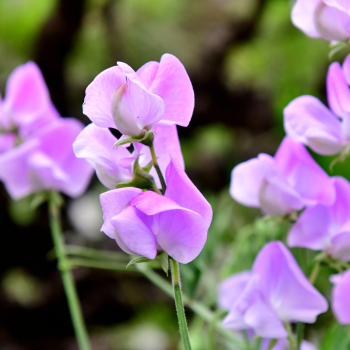
Close-up photo of lavender-colored sweet pea blossoms.

Sweet pea blossoms make a fragrant addition to bouquets.

Confronted with this challenge, U.S. flower farmers began to adapt. Instead of pursuing the wholesale giants with resilient, shippable blooms, they embraced their unique strength: growing delicate, fragrant, seasonal flowers that could not withstand long-distance transport. Local farms carved out a niche, offering sweet peas, dahlias, ranunculus, and garden roses—blooms that thrived in nearby soil but couldn’t be shipped in a box.

Social media accelerated this shift: Instagram and Pinterest introduced consumers to lush, wild, and seasonal bouquets. People’s preferences began to shift; they no longer just wanted a dozen roses. Instead, they sought flowers with unique textures, captivating fragrances, and compelling stories. Social media also gave local farmers a direct connection to consumers and florists, allowing them to bypass traditional wholesale channels. This increased visibility on digital platforms transformed previously overlooked flower varieties into sought-after blooms, sparking a grassroots revival of local flower farming.

The Rise of Direct Sales 

The local food movement of the 2010s led to a shift in consumer values towards sustainably grown flowers. Many shoppers began seeking “American Grown” labels, desiring not only beauty but also environmental and ethical accountability. This demand gave rise to more direct marketing, including flower CSA subscriptions and an expanded presence of fresh flowers at farmers’ markets. The COVID-19 pandemic accelerated this trend, when weddings, festivals, and large gatherings were canceled and wholesale orders from florists, event planners, and retailers were scaled back dramatically. What began as a crisis response evolved into a lasting business model as farms transitioned to e-commerce and direct-to-consumer sales, with many farmers quickly adapting by launching online shops, subscription flower boxes, and local delivery services. Small and mid-size flower farms can bypass traditional wholesale channels, strengthening grower-consumer relationships and creating new revenue streams. Direct-to-consumer sales have become a cornerstone of the modern floral industry.

Easy Blooms to Start Growing
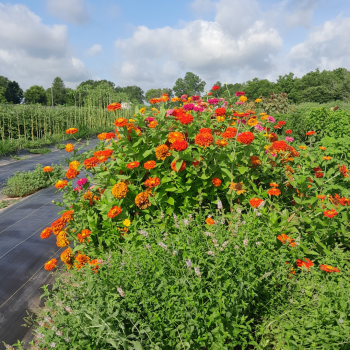
Large row of orange zinnias growing on a farm.

Zinnias are an easy flower to start with when adding cut flowers to a specialty-crop operation. Photo: Audrey Kolde

Growing and selling flowers is an easy shift for diversified farms. Summer annuals such as zinnias, sunflowers, cosmos, gomphrena, and celosia thrive in a wide range of climates and are easy to grow and sell. These “cut-and-come-again” flowers can be harvested multiple times throughout the season. For example, a single 100-foot row of zinnias or cosmos can yield 1,000 to 3,000 stems over a season, while gomphrena may produce 3,000–4,000 stems. With just a few rows, you can bring buckets of flowers to market each week. On ¼ to ½ acre, growers often supply local florists, farmers markets, or bouquet subscription services. Adding herbs like basil, mint, or rosemary offers both fragrance and foliage for arrangements.

Adding Value: Bouquets

As your skills grow, bouquet design becomes a natural next step—this is where creativity meets profitability. In busy markets, pre-made bouquets facilitate faster sales. Slower-paced markets allow for a more interactive experience, allowing customers to choose their own stems for a custom bouquet. Either way, refreshing your knowledge of basic bouquet-building techniques increases your product’s value. Learn which flowers function as focal, fillers, line flowers, and greenery, and plan your growing season with color palettes and design in mind. Kraft paper wrapping, flower food packets, and a polished table setup help elevate your market presentation. Flowers naturally lend themselves to visual marketing, so use your social media to showcase blooms in context—on a table, in a vase, or as a gift. Adding a social mission (like donating bouquets to hospital wings, elder homes, or community centers) creates emotional connection and buyer loyalty. You can also build scarcity-driven marketing strategies through limited CSA shares, preorder-only focal bouquets, or subscription deliveries to homes and offices.

Harvesting and Post-Harvest Handling
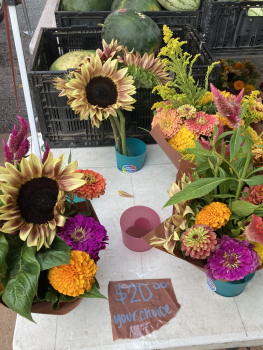
Mixed bouquets of sunflowers, zinnias, and other blooms on display at a Farmers Market table.

Bouquets for sale at a Farmers Market table. Photo: Nina Prater

To ensure top-quality blooms, proper harvesting and post-harvest care are crucial. Cut flowers early in the morning or late in the evening with sharp, sanitized floral snips to minimize stem damage and maximize water uptake. Immediately place stems in clean buckets filled with cool water and preservative (homemade or commercial). Strip leaves below the waterline to reduce bacteria, and move flowers to a cool, shaded area—or ideally a CoolBot-equipped cooler (34–38°F)—as soon as possible.

Leveling Up Quality

Using cucumber netting or flower support mesh helps produce straighter stems. Low tunnels and caterpillar tunnels protect crops from wind and rain, extending the growing season. Shade cloth can prevent petal burn and help grow longer stems, while row cover (like Reemay) provides light frost protection and speeds up early growth. Insect netting blocks common pests without the use of chemicals, and drip irrigation keeps foliage dry, preventing diseases such as botrytis and powdery mildew. These lightweight, movable tools are well-suited for use on plots ranging from ¼ to 1 acre and make it easy to adapt quickly to changing conditions.

Beautiful Profit

Flower farming isn’t just a source of income—it’s a fulfilling lifestyle that balances creativity and connection to your local community. Lynn Byczynski, author of The Flower Farmer, has inspired growers since 1997 with the message that well-managed flower farms can earn $25,000 to $30,000 per acre through direct sales. Income varies based on marketing, crop choice, and local demand: farmers’ markets may bring in $500–$2,000 per week, while CSA subscriptions often sell for $15–$25 per share per week.

Start Blooming

Engaging in flower farming can be a deeply rewarding endeavor, whether your motivations are a desire for profit, a passion for horticulture, or a combination of both. This vibrant industry offers an opportunity to cultivate stunning blooms while honing your skills in planting, nurturing, and harvesting flowers. As you immerse yourself in the art of flower farming, you’ll discover the intricacies of soil health, seasonal cycles, and sustainable practices that not only enhance your yields but also connect you to the beauty of nature. With each season, you’ll witness the fruits of your labor come to life, fostering a sense of accomplishment and satisfaction that grows alongside your expertise in this blossoming field.

References  

Byczynski, Lynn. The Flower Farmer: An Organic Grower’s Guide to Raising and Selling Cut Flowers. 2nd ed., Chelsea Green Publishing, 2008.

Flower farming is making a comeback as gardeners grow a local niche. 2023. The Produce News.  https://theproducenews.com

DTC flower sales have blossomed during the pandemic. 2021. Bloomberg Second Measure. https://secondmeasure.com  


Related ATTRA Resources:  

Specialty Cup Flower Production and Marketing Publication:

https://attra.ncat.org/publication/specialty-cut-flower-production-and-marketing/

Podcast: A Flower Farm Blossoms:

https://attra.ncat.org/a-flower-farm-blossoms/


Other  Resources: 

Association of Specialty Cut Flower Growers

Growing for Market Magazine: Getting started with Cut Flowers Part 1: The Why and How of it

Kentucky Center for Crop Diversification: Cut Flower Resources

North Carolina State Extension: Cut Flowers
By Darron Gaus, NCAT Agriculture Specialist 

A Taste of July 

When I was farming in San Antonio, Texas, one of my favorite crops to grow was watermelon. I would often stop during harvest to sit on the sun-warmed soil, cut open a 10-pound source of potassium-rich hydration, and chat with the crew while juice flowed down our chins. I even carried a shaker of pink Himalayan sea salt in my back pocket, ready for the quick draw when that moment came. (And if you’ve never salted your watermelon, give it a try. Just trust me on this.) Those were special moments that helped us all endure the arduous work of farming. 

Over the course of nearly 20 seasons, I grew watermelons in almost every way imaginable and learned a lot about this unique cucurbit. I often pondered if the “water” in “watermelon” comes from the contents or its water-seeking abilities. Watermelon can congregate its fibrous root system to function like a central tap root. It does this in sandy soils with astounding efficiency, even potentially reaching down into the water table itself. I grew watermelons in modeling clay, the blackest of gumbos. After the first few seasons, I learned that I needed to play to the watermelon’s strengths. If I wanted the soil’s water to convert into hydration to enjoy during my future break times, I had to adapt my growing methods. 

Learning from Failure and Abundance 

I began conventionally, using industry-standard methods for growing watermelon at scale. My crew and I chisel plowed once a year and disk harrowed three times in every direction. Then we prepped the beds in one pass with the fine, almost desiccated clay shaped by a metal pan, covered with plastic mulch, and bisected by a single line of drip irrigation in the middle of each. After all that, I had to pump the water back in that I just helped evaporate into thin air. Three hundred thousand gallons of water for the five acres of soon-to-be-planted watermelons poured through pipes, hoses, and drip tape to ensure transplants or seeds had available moisture as soon as they dropped into their new home for the next 80 to 100 days.  

Time-sensitive cultivation with 12-inch listers (arrow-shaped metal sweeps designed to move soil to either side of a center furrow) and hand-weeding the holes was the only thing left to do before harvest. Plant density was high in this system, and the yield was great, but keeping up with water demands in the high shrink-swell clay was a constant failure. The hardpan that formed from so many equipment passes was impenetrable, even for the well-adapted watermelon roots. 

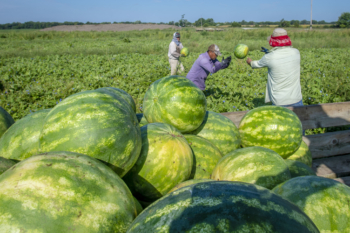
Farmworkers bringing in the watermelon harvest. Photo: USDA, Preston Keres.

After two seasons of conventional methods, I began implementing conservation practices that would increase organic matter, conserve soil moisture, and reduce my time on the tractor. Increasing organic matter in the heavy clay I farmed greatly increased porosity, water retention, living biology in the soil, and nutrient cycling. Cover crops, with a mix of at least three species, became my new obsession. Three quarters of the 105 acres were under cover crops designed for specific benefits: high biomass for weed suppression and organic matter, a brassica for insect trapping and greater soil porosity, and a legume for nitrogen fixation.  

The cover crops provided one more critical benefit: they captured every rain drop that fell. I no longer had rill erosion in my furrows after a two-inch-per-hour rainfall. The large rills that once forced me to waste time sweeping beds back up were gone. Soil aggregation and tilth improved. Organic matter increased and the high pH came down. Watermelons grew like they were supposed to.  

The first season of adopting this new farming approach came with its share of challenges. We had to develop innovative cultivation techniques to manage weed pressure and adjust our bed preparation methods to work with a high-residue topsoil layer. These adjustments initially led to a 20% drop in yields. However, after a season of learning and refining our practices, the results were remarkable—yields rebounded to impressive levels, all while requiring significantly less irrigation. 

Pushing the Envelope

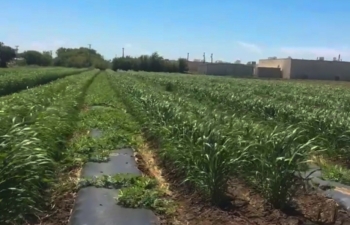
Watermelon interplanted with Sudan grass. Photo by Darron Gaus.

Once I started seeing the changes that the conservation practices were making, I wanted to add more. I wanted to try new things, so I pushed the envelope. I wanted those juice-covered-chin breaks in harvesting watermelon in November, not just July. The only thing standing in the way was overcoming the water demand of an August planting. August in San Antonio is usually 31 days of triple-digit temperatures and no rain in the forecast. Sudan grass grows tall quickly in these conditions, so I interplanted it with the watermelon. The idea was that the Sudan grass would provide wind breaks and shade to the seedlings, helping to conserve soil moisture. And it worked! We harvested watermelon in November that year, but it came with consequences. The harvest took place in nine-foot-tall grass-walled tunnels, which made passing the watermelons to the edges of the field for easy pick-up impossible. Every single watermelon (all undersized because of lack of sunlight during fruiting) had to be individually walked out of the field. Luckily, we had 200 volunteers from the Air Force on the day of harvest, and in spite of the tall grass, they still managed to pack out 12,000 pounds of three-to-five-pound fruits in just under two hours. That November was the only fall harvest of watermelon in my career; the price of labor was too steep. I pushed it too far, but I learned. 

Water Rising to the Surface 

Watermelons taught me many lessons, but none as important as water conservation. What began as a simple pursuit of sweetness transformed into a lesson about the lifeline that sustains these plants: water. Each watermelon I grew represented the delicate balance between abundance and scarcity. I learned how much water it takes to nurture just one fruit, and how easily that resource can be taken for granted.  

Within the vibrant green rind and the refreshing red flesh is a story of soil, sun, and most critically, sustainability. In tending to the vines, I began to see the bigger picture. I saw how water connects everything: the land, the food we eat, and the future we hope to build. What started as farming became a quiet education in stewardship.  

Watermelons, in their quiet way, reminded me that what’s beneath the surface often matters most—our water, our world, our shared responsibility.  

Come back for Part Two of the sweetest story ever told. It involves compost, city citations, crowded cover crops, and conservation dryland farming. 

By Andy Pressman, NCAT Sustainable Agriculture Program Director

“Homegrown tomatoes, homegrown tomatoes,
What’d life be without homegrown tomatoes?
Only two things that money can’t buy
And that’s true love and homegrown tomatoes.”

– Guy Clark, Homegrown Tomatoes

Listen to a clip of “Homegrown Tomatoes” by Guy Clark

The author’s daughter enjoying a homegrown tomato.

It sure is hard to imagine life without homegrown tomatoes. For some, like American folk singer Guy Clark, it is well worth the wait over the winter months for a sun-ripened tomato fresh off the vine, and for the experience of first biting into one and feeling that rush of flavor as it explodes in your mouth. This moment of joy is not limited to gardeners—anyone can seek out these precious, homegrown flavors from farmers who grow tomatoes skillfully and with great care.

Tomatoes are a staple summer crop for many diversified farms: high-value, in-demand, and, when conditions are right, highly productive. But as summers grow hotter and more unpredictable, even this dependable crop can show signs of stress. Blossom drop, sunscald, delayed or uneven ripening, and declines in yield are symptoms caused by intense heat.

Whether you’re selling at farmers markets, through CSA shares, or to wholesale accounts, heat stress in tomato production can quickly translate into lost income. With the right strategies, you can mitigate heat-related issues and maintain healthy, productive plants, even at the height of summer. Read on for common heat-related issues and how to solve them.

Fruit Set and Blossom Drop

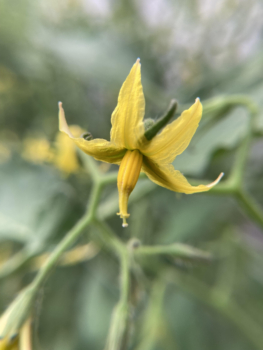
Heat can impede fruit set when daytime highs are consistently over 90°F and nighttime temperatures stay above 70°F. Blossoms can drop and pollen can become less viable as the plant shifts from reproductive to survival mode. Choosing heat-tolerant varieties and staggering plantings to avoid peak summer stress, including planting early in high tunnels, can reduce blossom drop. Using hoops and shade cloth in the field can reduce the sun’s intensity. Managing soil temperature and moisture by utilizing practices such as drip irrigation and mulching can also help retain flowers.

Close-up of a tomato blossom. Photo credit: Nina Prater.

Pollination

Fruit deformities can result from a lack of pollination. Planting pollinator habitats in and around tomato plantings can increase pollination from native pollinators. It’s also a good idea to limit insecticide use (even organic-approved insecticides) during bloom periods. Hand-pollinating plants can improve pollination rates, especially in high tunnels. Applying a kelp or seaweed fertilizer as a foliar spray during early flowering also helps mitigate heat-related stress that impacts pollination and causes misshapen fruits.

Sunscald

Sunscald on tomatoes occurs when the fruit is exposed to intense sun, especially after the plants are pruned and leaf cover is reduced. Sunscald causes the fruit to develop leathery white or gray patches on the skin that make it unmarketable. Maintaining leaf canopy during periods of extreme heat by limiting pruning and sucker removal can reduce sunscald. Trellising can assist in providing more leaf canopy, while also assisting with airflow. And, as with blossom drop, utilizing shade techniques in high tunnels or in the field can reduce the risk of sunscald during periods of intense heat.

Ripening Issues and Yellow Shouldering

Extended periods of high temperatures can cause uneven or delayed ripening, and can also cause the fruit to exhibit green or yellow tops, known as yellow shouldering. Managing potassium availability in the soil can help prevent these issues. Use soil tests to determine potassium levels and apply amendments, such as kelp meal, as needed. Adding too much nitrogen, especially late in the season, can prolong vegetative growth, which slows fruit ripening. If daytime heat is affecting the color or appearance of the fruit, consider harvesting early and ripening indoors.

Blossom-End Rot

Another disorder caused by heat stress is blossom-end rot. While tied to inadequate amounts of calcium, blossom-end rot is more associated with a lack of water. The hotter the temperature, the more water is lost to transpiration from the tomato plants. This increase in water loss causes small lesions on the blossom end of the fruit that gradually spread and turn the area into a brownish or tan color. Timely irrigation and maintaining proper pH and calcium levels in the soil can prevent blossom-end rot.

White Core

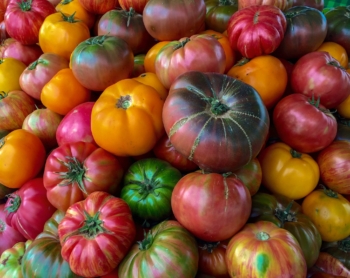
Variety of beautiful heirloom tomatoes. Photo credit: USDA Lance Cheung.

Internally, tomatoes can develop a hard white core from excessive heat and inadequate fertility. In moderate cases, white core can occur just beneath the flower-shaped leaf, or calyx, on the top of the fruit. In more extreme cases, you may see white core extend through the entire fruit. Having adequate foliage cover and potassium levels can prevent white core. Additionally, older varieties are more susceptible to white core, while newer varieties are less prone to this issue. Therefore, variety selection can again help mitigate this disorder.

Fruit Cracking

Mid- to late-summer tomato harvests often occur during dry periods. However, an afternoon shower can cause the fruit to swell faster than the skin can stretch, resulting in fruit cracking. Fruit cracking can also occur through sudden irrigation during a dry spell. Cracking can be managed by reducing moisture fluctuations, and through the consistent use of drip irrigation. Mulching conserves soil moisture and reduces the risk of temperature swings. If a sudden rain shower is in the forecast after a dry spell, harvesting tomatoes at first blush or the breaker stage (a slight change in color from green to no more than 10% pink, red, orange, or yellow) and ripening indoors will keep the fruit from cracking. Research shows that ripening in a protected structure at temperatures between 55° F and 65° F is equal to ripening on the vine, while ripening at 68° F increases the sweetness and overall flavor of the tomato.

Tomatoes may love the heat, but even they have their limits. By observing your plants closely, using techniques to mitigate heat stress, choosing the right varieties, and managing soil and water strategically, you can protect your crops and enjoy a fruitful harvest. And, while the summer heat may test your patience and your plants, there’s still something magic about harvesting a perfect slicer in the middle of July—enough to make you hum a little of Guy Clark’s tune on your way back from the field.

Read more on tomato production in our ATTRA publication, Organic Tomato Production.

In this episode of Voices from the Field, NCAT Sustainable Agriculture Specialist Audrey Kolde talks with Timothy Gipson, co-owner and co-founder of The Great Mississippi Tea Company in Brookhaven, Mississippi. Their conversation touches on the challenges and successes the company has had growing this popular specialty crop in the Magnolia State.

Related ATTRA Resources:

Other Resources:

Have questions or need help? Contact us.

Please complete a brief survey to let us know your thoughts about the content of this podcast.

You can get in touch with NCAT/ATTRA specialists and find access to our trusted, practical sustainable-agriculture publications, webinars, videos, and other resources at ATTRA.NCAT.ORG.