Tag Archive for: Fruit

By Darron Gaus, NCAT Agriculture Specialist 

A Taste of July 

When I was farming in San Antonio, Texas, one of my favorite crops to grow was watermelon. I would often stop during harvest to sit on the sun-warmed soil, cut open a 10-pound source of potassium-rich hydration, and chat with the crew while juice flowed down our chins. I even carried a shaker of pink Himalayan sea salt in my back pocket, ready for the quick draw when that moment came. (And if you’ve never salted your watermelon, give it a try. Just trust me on this.) Those were special moments that helped us all endure the arduous work of farming. 

Over the course of nearly 20 seasons, I grew watermelons in almost every way imaginable and learned a lot about this unique cucurbit. I often pondered if the “water” in “watermelon” comes from the contents or its water-seeking abilities. Watermelon can congregate its fibrous root system to function like a central tap root. It does this in sandy soils with astounding efficiency, even potentially reaching down into the water table itself. I grew watermelons in modeling clay, the blackest of gumbos. After the first few seasons, I learned that I needed to play to the watermelon’s strengths. If I wanted the soil’s water to convert into hydration to enjoy during my future break times, I had to adapt my growing methods. 

Learning from Failure and Abundance 

I began conventionally, using industry-standard methods for growing watermelon at scale. My crew and I chisel plowed once a year and disk harrowed three times in every direction. Then we prepped the beds in one pass with the fine, almost desiccated clay shaped by a metal pan, covered with plastic mulch, and bisected by a single line of drip irrigation in the middle of each. After all that, I had to pump the water back in that I just helped evaporate into thin air. Three hundred thousand gallons of water for the five acres of soon-to-be-planted watermelons poured through pipes, hoses, and drip tape to ensure transplants or seeds had available moisture as soon as they dropped into their new home for the next 80 to 100 days.  

Time-sensitive cultivation with 12-inch listers (arrow-shaped metal sweeps designed to move soil to either side of a center furrow) and hand-weeding the holes was the only thing left to do before harvest. Plant density was high in this system, and the yield was great, but keeping up with water demands in the high shrink-swell clay was a constant failure. The hardpan that formed from so many equipment passes was impenetrable, even for the well-adapted watermelon roots. 
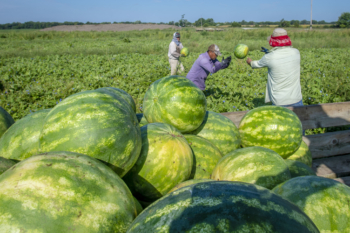
Farmworkers bringing in the watermelon harvest. Photo: USDA, Preston Keres.

After two seasons of conventional methods, I began implementing conservation practices that would increase organic matter, conserve soil moisture, and reduce my time on the tractor. Increasing organic matter in the heavy clay I farmed greatly increased porosity, water retention, living biology in the soil, and nutrient cycling. Cover crops, with a mix of at least three species, became my new obsession. Three quarters of the 105 acres were under cover crops designed for specific benefits: high biomass for weed suppression and organic matter, a brassica for insect trapping and greater soil porosity, and a legume for nitrogen fixation.  

The cover crops provided one more critical benefit: they captured every rain drop that fell. I no longer had rill erosion in my furrows after a two-inch-per-hour rainfall. The large rills that once forced me to waste time sweeping beds back up were gone. Soil aggregation and tilth improved. Organic matter increased and the high pH came down. Watermelons grew like they were supposed to.  

The first season of adopting this new farming approach came with its share of challenges. We had to develop innovative cultivation techniques to manage weed pressure and adjust our bed preparation methods to work with a high-residue topsoil layer. These adjustments initially led to a 20% drop in yields. However, after a season of learning and refining our practices, the results were remarkable—yields rebounded to impressive levels, all while requiring significantly less irrigation. 

Pushing the Envelope
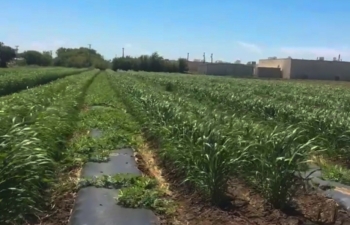
Watermelon interplanted with Sudan grass. Photo by Darron Gaus.

Once I started seeing the changes that the conservation practices were making, I wanted to add more. I wanted to try new things, so I pushed the envelope. I wanted those juice-covered-chin breaks in harvesting watermelon in November, not just July. The only thing standing in the way was overcoming the water demand of an August planting. August in San Antonio is usually 31 days of triple-digit temperatures and no rain in the forecast. Sudan grass grows tall quickly in these conditions, so I interplanted it with the watermelon. The idea was that the Sudan grass would provide wind breaks and shade to the seedlings, helping to conserve soil moisture. And it worked! We harvested watermelon in November that year, but it came with consequences. The harvest took place in nine-foot-tall grass-walled tunnels, which made passing the watermelons to the edges of the field for easy pick-up impossible. Every single watermelon (all undersized because of lack of sunlight during fruiting) had to be individually walked out of the field. Luckily, we had 200 volunteers from the Air Force on the day of harvest, and in spite of the tall grass, they still managed to pack out 12,000 pounds of three-to-five-pound fruits in just under two hours. That November was the only fall harvest of watermelon in my career; the price of labor was too steep. I pushed it too far, but I learned. 

Water Rising to the Surface 

Watermelons taught me many lessons, but none as important as water conservation. What began as a simple pursuit of sweetness transformed into a lesson about the lifeline that sustains these plants: water. Each watermelon I grew represented the delicate balance between abundance and scarcity. I learned how much water it takes to nurture just one fruit, and how easily that resource can be taken for granted.  

Within the vibrant green rind and the refreshing red flesh is a story of soil, sun, and most critically, sustainability. In tending to the vines, I began to see the bigger picture. I saw how water connects everything: the land, the food we eat, and the future we hope to build. What started as farming became a quiet education in stewardship.  

Watermelons, in their quiet way, reminded me that what’s beneath the surface often matters most—our water, our world, our shared responsibility.  

Come back for Part Two of the sweetest story ever told. It involves compost, city citations, crowded cover crops, and conservation dryland farming. 

Better Than I Feared but Worse Than It Looks

By Guy K. Ames, NCAT Horticulture Specialist

Photo at right: Peach flowers from a previous spring, a sight we won’t be seeing much of this year because of the deep freeze.

A dipping polar vortex delivered a cruel and chilling Valentine’s gift to the Midwest and South on Valentine’s Week 2021. The damage in Texas may be among the worst. It certainly garnered the most headlines. An estimated $300 million winter citrus crop in the Rio Grande Valley is gone. Gone. Worse, it’s likely that the trees in the valley suffered damage, the full extent of which won’t be known for weeks and possibly months. To the non-fruit-growing observer, the trees might look fine but they’re not. It’s worse than it looks.

Near Fayetteville, Arkansas, where I live and grow fruit, we broke the all-time winter cold record at our local airport, Drake Field, when we hit -20 degrees F. (The all-time Fayetteville low is -24 set in 1899.)  At my own ridgetop farm, by virtue of elevation about 500′ higher than Drake Field, we escaped the worst, recording -12. Still, that was about 12 degrees colder than the zero that was predicted, and I feared the worst for my muscadines and my two 3,000-gallon cisterns, which I hadn’t drained. Frankly, I feared those cisterns would be ruptured and rendered worthless (they weren’t). And like the Texas citrus growers, I won’t know the full extent of the damage to my muscadines for some weeks to come. They look okay, but I know from experience that they’re not.

Apple blossom
Luckily, the author’s apples are blooming this spring despite February’s freeze.

Climate change is laden with paradoxes. Overall, it’s clear that the planet is warming. To the Valley citrus grower seeing his oranges frozen and on the ground, it’s hard to believe that the polar vortex is a product of climate change, but it is. Climatologists can explain it in detail, but I hope it will suffice to say here that the added warmth to our planetary system leads to more extreme events: more severe storms, more severe droughts, more extreme heat events and even some extreme cold events. These extremes and the uncertainty surrounding them are worrisome for all farmers, but for the growers of perennial fruits the worry runs even deeper.

An apple grower can’t replant every time a late frost ruins one year’s crop. An apple tree takes years to produce its first crop, and it must produce several crops before it pays back the years of investment. By contrast, a soybean or corn grower might have a couple opportunities to replant in any given year if an untimely freeze wastes his first young seedlings. I’m not saying this is pleasant or comes without expense to the soybean or corn grower, but all is not lost!

But Valentine’s Week 2021 was not just a late frost. This was potentially a tree, bush, and vine killer. Apples, pears, peaches, blueberries, grapes, and all other deciduous perennial fruits have evolved physiological mechanisms to escape death from winter’s cold. Together these mechanisms are known as dormancy. The tree, vine or bush puts itself into a sort of deep sleep that keep it safe until better, warmer conditions return. These perennial plants, depending on the climate where they evolved, will have longer or shorter dormancy periods which can vary among plants. A species, or even a variety within a species, will have a “chilling requirement,” which means that that species or variety must have a certain amount of cold before it can come out of dormancy.

The trunk of a pawpaw tree, split in two places due to freeze damage.
Splits in a pawpaw’s trunk from a previous year’s damage. We won’t see this yet from this year’s cold snap—right now the trunks look fine. This type of damage may not become visible for weeks or months.

This is a safety mechanism keeping the plant from waking up too early when temperatures might still be fatally cold. This all works very smoothly in a more-or-less stable climate. But in an unstable climate characterized by too-warm winters, late spring freezes, and sudden and severe cold snaps, the plant can become confused and come out of dormancy partially or completely and get damaged or killed.

The increasing frequency of such freeze damage events in fruit crops is well-documented and presented in ATTRA’s Climate Change and Perennial Fruit and Nut Production: Investing in Reslience in Uncertain Times. The most common form of this damage is frost killing the flowers, and thus the crop, of fruit plants. This is because the warmer winters are inducing earlier bloomtimes for these crops while the dates of the last killing frost remain roughly the same. For instance, apples might bloom in March now in NW Arkansas—a month earlier than 50 years ago—only to have the flowers or young fruitlets killed by a frost on April 10. This very thing has happened to me with varying degrees of crop loss the last three seasons!

But a more serious form of damage is the potential loss of whole plants when warm winter temperatures render the plants’ tissues tender…and then a cold snap roars in like this one on Valentine’s Week 2021.

It turns out that, for me, this extreme event was not as bad as I had feared.  The pears, apples, bunch grapes and blackberries all look okay, though damage could still manifest later.  Looks like I’m going to have some trunk cracking on a few pawpaw trees. Blackberry and blueberry plants probably lost some fruit buds, but it looks like the plants were spared. The peaches suffered worse, with 99% of the flowers lost in the bud (before they could even open), but the trees seem largely undamaged. And this is exactly how nature planned it. Most of these cold hardy species came through just fine. Even if the crop is lost or partially lost, the plant will live to try again next year.

A muscadine trunk killed by the cold in a previous year is surrounded by new growth sent up from the roots.
The main trunk of this muscadine was killed by the cold in a previous year, but the roots sent up new growth.

I can’t tell quite yet how bad the damage is to the muscadines, but I expect that I probably lost some whole vines, at least to the ground. Resprouts from the roots can replace these but I will still have lost a couple years of cropping before the new vines will begin fruiting. Looking at the southern extent of the freezing temperatures, this will probably be true for muscadines all over Arkansas and probably throughout the South.

In the parts of the South where sub-tropical plants like figs, Asian persimmons, pomegranates, black mulberries, loquats, and similar plants can grow, these will probably be devastated. Some of these, like the figs, can come back from the roots. Luckily, the snow that accompanied the cold provided some insulation keeping soil temperatures considerably higher than the air temperatures. But there will be heart-breaking losses to many homeowners and some commercial growers. I’m thinking sadly of some of the huge dooryard fig trees in East Texas where I grew up that are most likely doomed.

Truthfully, I feel lucky. It’s not as bad as I had feared.  Probably most of the fruit growers farther north from me will only suffer minor damage.  It’s the folks who grow perennial fruits farther south that are and will be experiencing the worst losses. If you’re not a fruit grower you probably won’t be able to tell but it’s almost certainly worse than it looks.

 All photos by Guy K. Ames.

By Guy K. Ames, NCAT Horticulture Specialist

In Northwest Arkansas I’m seeing peach leaf curl in my orchard. It’s April, but the calendar date is not as important as the growth stage of the peaches. The professionals call this time “shuck split.” The “shuck,” or the last remnant of the flower, is splitting and falling from the growing young fruit. This is a crucial time for the developing fruit as it is growing rapidly, and this is not a good time for the tree to be stressed. This disease, incited by the fungus Taphrina deformans, causes the leaf to deform and swell irregularly (see photo). As you can imagine, leaf function—primarily photosynthesis and respiration—suffers and the tree is stressed. The more severe the curl (the more leaves are affected), the more stressful it is to the tree.

Managing Peach Leaf Curl

You’re going to want to do something about it, but there’s not much you can do once you see it on your trees other than to remember to spray next year during dormancy. Here’s why. The fungus overwinters in the tiny crevices around the leaf scale (or leaf bud). As soon as the leaf bud begins to swell in the early spring the fungus invades the leaf tissue. That’s right, the fungus is inside the leaf and thus protected from normal fungicide sprays! You should apply sprays of lime-sulfur (the best organic fungicide for this disease) sometime in March before the leaf buds begin to swell. If the trees have gone through severe infection, you can apply once in November when the leaves have fallen and then again in the spring before the new leaves emerge.

Helping an Infected Tree

A tree with a severe infection will sometimes drop all its infected leaves and try to push a new crop of leaves. This is understandably stressful for the tree, so if it happens, the grower could help the tree out by applying a quick release fertilizer of some sort. Organic growers could choose compost tea or fish emulsion. If the infection wasn’t severe (only a small percentage of leaves were infected), then you may need to do nothing. There is only the single infection period, so newly emerging leaves will be safe from T. deformans.

There are a few somewhat resistant varieties, including Clayton, Candor, and Frost, but this resistance is only relative to other more susceptible varieties and often can’t be relied upon for control.

Here’s hoping your leaves aren’t curly!

More Information

Guy shows examples of peach leaf curl and the leaf buds where the fungus overwinters in his video What is Peach Leaf Curl? on ATTRA Sustainable Agriculture’s YouTube channel.

For more on peach diseases, see the ATTRA Sustainable Agriculture publications Peach Diseases Identification Sheet and Peaches: Organic and Low-Spray Production.

Contact Guy and NCAT’s other agriculture specialists by emailing askanag@ncat.org or calling 800-346-9140.

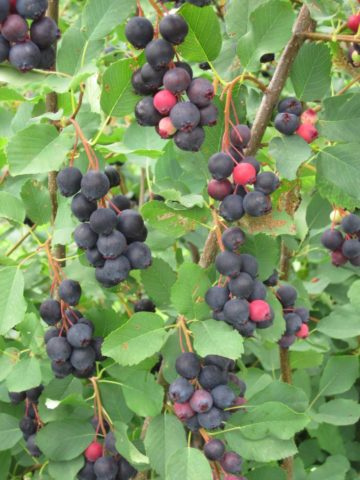
juneberry fruit

Juneberries on a branch

By Guy K. Ames, NCAT Horticulture Specialist

At right: Juneberry fruits look quite like medium-sized blueberries, but the juneberry is actually much more closely related to apples and pears. Photo: Guy Ames, NCAT.

Of the many names for this plant, “chuckleberry” is certainly my favorite, but I’ve only seen it in writing, never heard it spoken. Around the Ozarks where I live “sarvis” or “sarvisberry” seems to be the most commonly spoken, at least among the old-timers. If a name is known at all for this berry among the newcomers to the Ozarks, “service” replaces “sarvis.”  “Sarvis,” I think, is presumed to be a thick southern linguistic variant of “service.” “Shadblow” and “shadbush” seem to me to be the weirdest names, but they are documented and widely used at least in coastal regions. (Shad is a once-common fish whose annual spawning runs up the rivers of colonial New England happened to coincide with the early springtime blooming of this tree.)

What’s in a Name

Other names include saskatoon, juneberry, blueberry tree, chuckley pear, and, of course, the Latin binomials of which there are several because within its genus, Amelanchier, there are several species. All of the species produce berries nearly indistinguishable from the others. And all these names, except and very notably the saskatoon, pass over the Native American names, which were presumably many because Amelanchier grows over a wide area and commended itself to all who ate it.

When I first moved to the Ozarks in 1971-72, the sarvisberry trees (as I first learned to call them) were the first bloomers that I would notice on the dull gray wooded hills of the Ozarks in February. In their profusion of bright, white blooms they were a welcome harbinger of spring. One probably erroneous explanation for the origin of “serviceberry” is that the blooming of the tree indicated that the soil was thawed enough to dig graves and hold services for the folks who didn’t make it through the winter.

Although it is improbable, the funereal explanation persists and I rather enjoy it. Like Persephone returning from Hades every spring, it presents a beautiful and poignant reminder of the rebirth part of the never-ending cycle of life and death.

Speaking of death, a juneberry pie or cobbler is to die for! When eaten fresh, the juneberry has a detectable almond flavor that comes from its small, edible seeds. But when cooked into pies or cobblers, that almond aroma becomes pronounced and will fill a kitchen and spill deliciously into the house!

Mistaken Identity

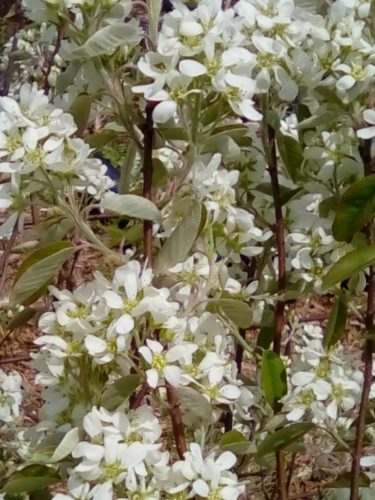
A juneberry bush full of white blossoms.

A juneberry bush in bloom. Photo: Margo Hale, NCAT.

When you first see a juneberry fruit you might have a hard time distinguishing it from a medium-sized blueberry. However, the juneberry, technically a pome fruit, is much more closely related to apples and pears than to blueberry. A few intrepid grafters have even had limited success grafting pear wood onto juneberry (graft compatibility is an indirect proof of relatedness).

Sometimes the juneberry is referred to as a tree, sometimes a bush. That difference is not just in the eye of the beholder. The species native to the Ozarks, A. arborea, like the species name suggests (arborea = tree), assumes the form of a small tree. The species that I prefer for fruit production and endemic to most of the Northeast United States, A. canadensis, is a multi-stemmed bush usually around 12 ft. tall. The saskatoon, A. alnifolia, native to the Northern Plains and into the foothills of the Canadian Rockies looks like a shorter version of A. canadensis. It usually tops out around 6-8 ft. Regardless of species, the fruit looks and mostly tastes the same.

Juneberry’s Uses

Though the Native Americans used the juneberry wherever it grew (pemmican was one way the juneberry was preserved and used), until relatively recently it has not been pressed into commercial service. That is beginning to change. The University of Saskatchewan is conducting research and breeding to commercialize the saskatoon, A. alnifolia. And in the United States, Cornell University Extension has done some limited research and promoted juneberries as an alternative to the persnickety blueberry. In Canada there is a nascent saskatoon industry marketing frozen and canned saskatoons as well as wines, jams and jellies made from saskatoons.

Whatever they’re called, they are easy to grow. They’re not nearly as finicky as blueberries regarding soil pH and watering. And, if you get the right species for your area, you’re not likely to have any disease problems (I and other growers in the Ozarks have found A. alnifolia or saskatoon to be susceptible to cedar-apple rust). And though they bloom very, very early, the blooms never seem to be damaged by late spring freezes and frosts. I have juneberries year after year, often in years that other fruit crops are wiped out by weather or disease.

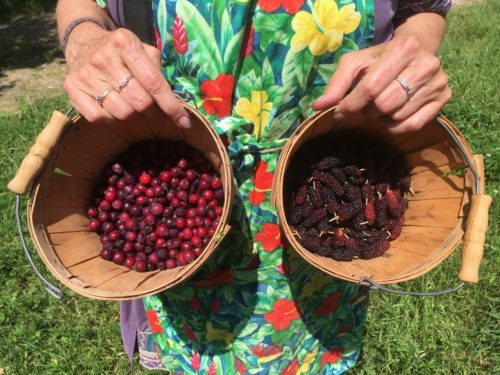
A woman holds a basket of ripe juneberries in her left hand and a basket of ripe mulberries in her right hand.

Juneberries (left) and mulberries ripen at the same time—in May, not June! Photo: Guy Ames, NCAT.

As with most small berries, the commercial viability of juneberries will revolve around harvesting costs. In Canada, researchers hope to find techniques and cultivars that will lead to the uniform ripening that allows mechanical harvesting. Elsewhere and until that happens, individual farmers will have to figure out ways to efficiently pick and effectively market the fruit to make juneberry production a viable money-making proposition. But that should not preclude gardeners and homesteaders from planting these easy-to-grow and highly productive berry plants in their gardens for home use.

Related ATTRA Resources

Fruit Trees, Bushes, and Vines for Natural Growing in the Ozarks