Tag Archive for: Agroforestry

By Mike Lewis, NCAT Agriculture Specialist 

The forest is not merely a backdrop for raising pigs in silvopasture. The forest is a living partner in the cycle of growth and renewal. When pigs are raised thoughtfully among the trees, they become agents of fertility and soil health, creating a balance that benefits the animals, the trees, and the land. This balance isn’t a given, though – it requires intention, observation, and a gentle hand to maintain.  

Pigs should ideally be moved every three to seven days to prevent over-disturbance that can cause soil erosion, compaction, and overgrazing. Fencing is one of the most important tools required for this practice. Portable electric fencing—made of polywire or mesh netting, supported by step-in posts—allows farmers to move pigs quickly and safely. A well-maintained fence that delivers a reliable charge of 6 Joules or more encourages pigs to respect boundaries, keeping them within the paddock and protecting sensitive areas.  

Moving pigs from one paddock to the next isn’t as hard as it might seem at first. Leaving paths or corridors between paddocks helps reduce stress and builds trust in animals during moves. A simple trick is to carry the feed bucket when moving pigs—this familiar sound will encourage them to follow calmly. 
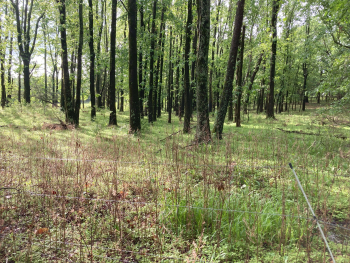
Electric fence in the foreground in front of a grassy forest floor.

Forest where pigs have grazed that has been allowed to rest and recover. Photo: Nina Prater, NCAT

Rest periods for paddocks, typically between 30 and 90 days to allow forages to fully recover, allow the forest floor to regenerate. Wetter or more fragile soils may require longer rest periods. Walking the paddock before turning pigs in provides valuable insight into whether the ground is ready or needs more time.  

Appropriate stocking rates will help maintain a balanced silvopasture system. A general guideline is to stock between 10 and 20 pigs per acre in a rotation system, but this varies based on tree density, soil type, and forage availability. Observing the ground after a rotation will allow you to assess if the stocking density is appropriate; if leaf litter remains intact and fungi are still visible, the pressure on the land is likely well-managed.  

It is best to err on the side of understocking, as it is easier to build up a system than to repair overused ground. It is also important to avoid farrowing pigs in the rotation paddocks, as sows and piglets need stable, sheltered areas with minimal disturbance.  

Protecting the trees themselves is vital. Young saplings are especially vulnerable and will benefit from wire mesh guards or rigid tree protectors to prevent pigs from chewing on bark or rubbing against the trunks. A single pig can uproot a small oak sapling in minutes, so take measures to protect your future forest. Also take care to avoid compaction around tree roots, especially after rain. Rotating pigs away from these sensitive areas during wet conditions preserves root health and prevents long-term damage.  

Timing moves to suit soil conditions is a practice rooted in respect and care for the land. Wet or saturated soil is very soft, and grazing pigs on it can lead to soil compaction and erosion, damaging both pasture and the forest understory. When the soil dries and firms, pigs can safely root and disturb the leaf litter, helping to clear invasive plants and cycle nutrients back into the soil without causing lasting harm. 
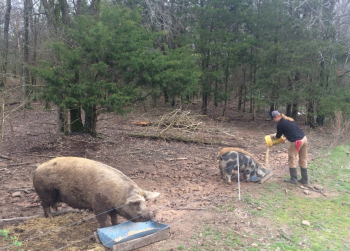
One pig eats from a blue trough in the foreground, and a farmer pours feed to two more pigs in a second trough in the midground, with a forest in the background.

Feeding pigs in portable troughs helps reduce excessive soil disturbance. Photo: Nina Prater, NCAT

Feeding management supports both pig health and land stewardship. While pigs will forage widely on acorns, roots, and greens, supplemental feed is necessary to reach market weight efficiently. Feed balanced rations, including grains or fermented feeds, in a way that encourages natural behavior and spreads manure evenly. Using portable feeders will allow you to move feeding sites around the paddock, which help limit the creation of wallows or overly concentrated manure piles. Seasonal mast like acorns and hickories offer rich forage, but it is important to limit pig time in these areas after the pigs have feasted to allow trees to recover from trampling. Monitoring the pigs’ body condition throughout the rotation is key. Pasture-raised pigs may grow more slowly than confined animals, but their meat often develops a richer flavor and firmer texture.  

Above all, raising pigs in silvopasture is a practice of attentive observation and adaptability. No single plan fits all seasons or sites. Successful farmers walk their land daily, watching rooting patterns, monitoring tree health, and noting soil recovery. Keeping a simple journal with observations and adjustments helps build a deeper understanding over time. Managing a regenerative pig enterprise in the forest is not about control, but cooperation. It’s a dialogue between steward and land, where both pig and tree flourish.  

In the end, silvopasture invites the producer to foster an approach of patience and respect. When managed with care, pigs do more than grow; they become part of the story of soil and tree, of land renewed and bounty shared. Through this work, farmers honor not only the meat they harvest but the living, breathing landscape that sustains them.  

ATTRA Resources:

Agroforestry integrates agriculture and forestry to get the most out of a single piece of land. The National Center for Appropriate Technology’s ATTRA Sustainable Agriculture program has released new resources that detail how by adding trees to crop and livestock operations, farmers and ranchers can “over-yield,” that is, produce multiple products from the same piece of land.

Agroforesty also benefits the farm and the greater ecosystem by creating wildlife habitat, sequestering carbon dioxide from the atmosphere, increasing beneficial insect populations, improving soil water-holding capacity, controlling soil erosion, reducing leaching and runoff, and improving soil fertility.

ATTRA has long been a trusted source for practical information about designing and maintaining agroforestry systems.

Four new publications and five videos make that connection even stronger by showcasing the use of agroforestry in urban settings and offering practical tools to growers who would like to begin urban agroforesty operations.

“Agroforestry practices can help ease issues that urban and suburban farmers often face,” says Katherine Favor, the NCAT Agriculture Specialist who penned the new publications. “Urban areas often face issues like water contamination from mismanaged stormwater runoff, heavy metal buildup in the soil, pollution, lack of privacy, and lack of habitat for wildlife, among others. Trees that are integrated properly into urban landscapes can address those problems and can produce food for families and communities.”

The new publications can be downloaded at no cost from the ATTRA website. Plus, learn even more about the benefits of agroforestry Tuesday, March 7 during NCAT’s annual conference, Growing Hope: Practical Tools for Our Changing Climate.

  • Urban Agroforestry Tipsheet: Food Forests and Beyond 
    Urban agroforestry, sometimes called community agroforestry, is the intentional integration of perennial trees and shrubs into farms and communities in urban and suburban areas to provide benefits to the community and to improve sustainability and resilience.
  • Urban Agroforestry Case Study:  A Food Forest on Public Park Land
    The Festival Beach Food Forest is located on three-quarters of an acre of public park land in Austin, Texas. Open day and night to the public, it provides a source of food for the community to forage and a place to connect with nature and each other.
  • Urban Agroforestry Case Study: Utilizing Agroforestry in Floodplain Restoration Projects
    To prevent the loss of property and life, the City of Austin decided to purchase homes in dangerous floodplain areas, relocate residents to safer areas, and restore the floodplain buyout area in an ecological way.

Urban Agroforesty Tipsheet Food Forests and Beyond also is available in a Spanish translation.

  • Hoja de Datos La Agroforestería Urbana: Bosques Comestibles y Más
    La agroforestería urbana, a veces llamada agroforestería comunitaria, es la integración intencional de árboles y arbustos perennes en granjas y comunidades en áreas urbanas y suburbanas, para proporcionar beneficios a la comunidad y mejorar la sostenibilidad y la resiliencia. 


Agroforestry videos also are available on the ATTRA website. 

  • Multiple Levels of a South Texas Food Forest
    In this video, we take you on a tour of the food forest at Keepers of the Garden, an urban agroforestry farm in Corpus Christi, Texas. This urban agroforestry farm is located in the Southern Subhumid Gulf Coastal Prairies ecoregion, in hardiness zone 9b, and it            serves not only as a production farm, but also as an educational center for schools, a refuge for local wildlife, and a community hub.  
  • Managing and Maintaining a Coffee System in California
    In this video, organic farmer Scott Murray discusses how to manage and maintain a coffee system in warm areas such as Southern California. Scott talks about pruning, pest management, harvest, quality control, processing, marketing, selecting varieties for Southern California, and interplanting with trees to create a beneficial microclimate. 
  • Managing Water and Nutrients in a Coffee and Avocado Alley Cropping System
    In this video, we head to Jason Mraz’s family farm in San Diego, California, where he is growing both specialty coffee and avocados in a single integrated alley cropping system. This video explores the specifics of the below-ground considerations to think about when managing a coffee and avocado alley cropping system, including how to meet both crops’ water and nutrient needs.
  • Designing a Coffee and Alley Cropping System
    This video case study takes us on a tour of Jason Mraz’s family farm in San Diego, California, where he is growing both specialty coffee and avocados in a single integrated alley cropping system. 
  • Planning and Establishing a Coffee System in Southern California
    In this video, organic farmer Scott Murray discusses everything you need to know about    how to plan and establish a coffee plantation in warm areas like Southern California. Scott discusses growing coffee seedlings in the nursery, transplanting, hardening off, and interplanting with trees to create a beneficial microclimate. 

ATTRA Sustainable Agriculture Specialist Katherine Favor also has shared her expertise on agroforestry in several recent ATTRA blogs posts. ATTRA’s agroforestry resources can plant the seed of new ideas for new products and ecosystem benefits on your operation. Check them out, along with ATTRA’s other trusted and practical resources at attra.ncat.org/topics/agroforestry/.