
By Darron Gaus, NCAT Agriculture Specialist
A Taste of July
When I was farming in San Antonio, Texas, one of my favorite crops to grow was watermelon. I would often stop during harvest to sit on the sun-warmed soil, cut open a 10-pound source of potassium-rich hydration, and chat with the crew while juice flowed down our chins. I even carried a shaker of pink Himalayan sea salt in my back pocket, ready for the quick draw when that moment came. (And if you’ve never salted your watermelon, give it a try. Just trust me on this.) Those were special moments that helped us all endure the arduous work of farming.
Over the course of nearly 20 seasons, I grew watermelons in almost every way imaginable and learned a lot about this unique cucurbit. I often pondered if the “water” in “watermelon” comes from the contents or its water-seeking abilities. Watermelon can congregate its fibrous root system to function like a central tap root. It does this in sandy soils with astounding efficiency, even potentially reaching down into the water table itself. I grew watermelons in modeling clay, the blackest of gumbos. After the first few seasons, I learned that I needed to play to the watermelon’s strengths. If I wanted the soil’s water to convert into hydration to enjoy during my future break times, I had to adapt my growing methods.
Learning from Failure and Abundance
I began conventionally, using industry-standard methods for growing watermelon at scale. My crew and I chisel plowed once a year and disk harrowed three times in every direction. Then we prepped the beds in one pass with the fine, almost desiccated clay shaped by a metal pan, covered with plastic mulch, and bisected by a single line of drip irrigation in the middle of each. After all that, I had to pump the water back in that I just helped evaporate into thin air. Three hundred thousand gallons of water for the five acres of soon-to-be-planted watermelons poured through pipes, hoses, and drip tape to ensure transplants or seeds had available moisture as soon as they dropped into their new home for the next 80 to 100 days.
Time-sensitive cultivation with 12-inch listers (arrow-shaped metal sweeps designed to move soil to either side of a center furrow) and hand-weeding the holes was the only thing left to do before harvest. Plant density was high in this system, and the yield was great, but keeping up with water demands in the high shrink-swell clay was a constant failure. The hardpan that formed from so many equipment passes was impenetrable, even for the well-adapted watermelon roots.
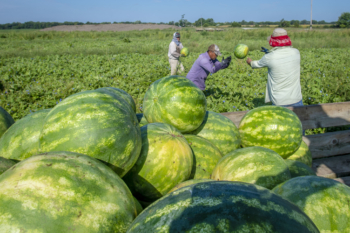
Farmworkers bringing in the watermelon harvest. Photo: USDA, Preston Keres.
After two seasons of conventional methods, I began implementing conservation practices that would increase organic matter, conserve soil moisture, and reduce my time on the tractor. Increasing organic matter in the heavy clay I farmed greatly increased porosity, water retention, living biology in the soil, and nutrient cycling. Cover crops, with a mix of at least three species, became my new obsession. Three quarters of the 105 acres were under cover crops designed for specific benefits: high biomass for weed suppression and organic matter, a brassica for insect trapping and greater soil porosity, and a legume for nitrogen fixation.
The cover crops provided one more critical benefit: they captured every rain drop that fell. I no longer had rill erosion in my furrows after a two-inch-per-hour rainfall. The large rills that once forced me to waste time sweeping beds back up were gone. Soil aggregation and tilth improved. Organic matter increased and the high pH came down. Watermelons grew like they were supposed to.
The first season of adopting this new farming approach came with its share of challenges. We had to develop innovative cultivation techniques to manage weed pressure and adjust our bed preparation methods to work with a high-residue topsoil layer. These adjustments initially led to a 20% drop in yields. However, after a season of learning and refining our practices, the results were remarkable—yields rebounded to impressive levels, all while requiring significantly less irrigation.
Pushing the Envelope
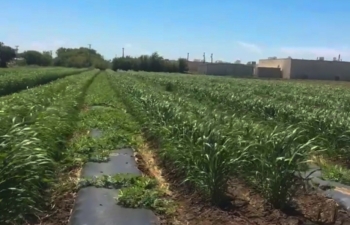
Watermelon interplanted with Sudan grass. Photo by Darron Gaus.
Once I started seeing the changes that the conservation practices were making, I wanted to add more. I wanted to try new things, so I pushed the envelope. I wanted those juice-covered-chin breaks in harvesting watermelon in November, not just July. The only thing standing in the way was overcoming the water demand of an August planting. August in San Antonio is usually 31 days of triple-digit temperatures and no rain in the forecast. Sudan grass grows tall quickly in these conditions, so I interplanted it with the watermelon. The idea was that the Sudan grass would provide wind breaks and shade to the seedlings, helping to conserve soil moisture. And it worked! We harvested watermelon in November that year, but it came with consequences. The harvest took place in nine-foot-tall grass-walled tunnels, which made passing the watermelons to the edges of the field for easy pick-up impossible. Every single watermelon (all undersized because of lack of sunlight during fruiting) had to be individually walked out of the field. Luckily, we had 200 volunteers from the Air Force on the day of harvest, and in spite of the tall grass, they still managed to pack out 12,000 pounds of three-to-five-pound fruits in just under two hours. That November was the only fall harvest of watermelon in my career; the price of labor was too steep. I pushed it too far, but I learned.
Water Rising to the Surface
Watermelons taught me many lessons, but none as important as water conservation. What began as a simple pursuit of sweetness transformed into a lesson about the lifeline that sustains these plants: water. Each watermelon I grew represented the delicate balance between abundance and scarcity. I learned how much water it takes to nurture just one fruit, and how easily that resource can be taken for granted.
Within the vibrant green rind and the refreshing red flesh is a story of soil, sun, and most critically, sustainability. In tending to the vines, I began to see the bigger picture. I saw how water connects everything: the land, the food we eat, and the future we hope to build. What started as farming became a quiet education in stewardship.
Watermelons, in their quiet way, reminded me that what’s beneath the surface often matters most—our water, our world, our shared responsibility.
Come back for Part Two of the sweetest story ever told. It involves compost, city citations, crowded cover crops, and conservation dryland farming.