By Mike Lewis, NCAT Agriculture Specialist 

The forest is not merely a backdrop for raising pigs in silvopasture. The forest is a living partner in the cycle of growth and renewal. When pigs are raised thoughtfully among the trees, they become agents of fertility and soil health, creating a balance that benefits the animals, the trees, and the land. This balance isn’t a given, though – it requires intention, observation, and a gentle hand to maintain.  

Pigs should ideally be moved every three to seven days to prevent over-disturbance that can cause soil erosion, compaction, and overgrazing. Fencing is one of the most important tools required for this practice. Portable electric fencing—made of polywire or mesh netting, supported by step-in posts—allows farmers to move pigs quickly and safely. A well-maintained fence that delivers a reliable charge of 6 Joules or more encourages pigs to respect boundaries, keeping them within the paddock and protecting sensitive areas.  

Moving pigs from one paddock to the next isn’t as hard as it might seem at first. Leaving paths or corridors between paddocks helps reduce stress and builds trust in animals during moves. A simple trick is to carry the feed bucket when moving pigs—this familiar sound will encourage them to follow calmly. 

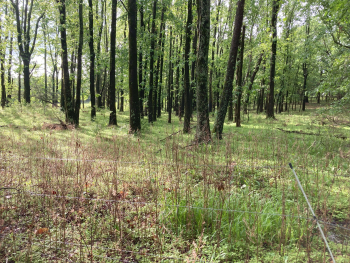
Electric fence in the foreground in front of a grassy forest floor.

Forest where pigs have grazed that has been allowed to rest and recover. Photo: Nina Prater, NCAT

Rest periods for paddocks, typically between 30 and 90 days to allow forages to fully recover, allow the forest floor to regenerate. Wetter or more fragile soils may require longer rest periods. Walking the paddock before turning pigs in provides valuable insight into whether the ground is ready or needs more time.  

Appropriate stocking rates will help maintain a balanced silvopasture system. A general guideline is to stock between 10 and 20 pigs per acre in a rotation system, but this varies based on tree density, soil type, and forage availability. Observing the ground after a rotation will allow you to assess if the stocking density is appropriate; if leaf litter remains intact and fungi are still visible, the pressure on the land is likely well-managed.  

It is best to err on the side of understocking, as it is easier to build up a system than to repair overused ground. It is also important to avoid farrowing pigs in the rotation paddocks, as sows and piglets need stable, sheltered areas with minimal disturbance.  

Protecting the trees themselves is vital. Young saplings are especially vulnerable and will benefit from wire mesh guards or rigid tree protectors to prevent pigs from chewing on bark or rubbing against the trunks. A single pig can uproot a small oak sapling in minutes, so take measures to protect your future forest. Also take care to avoid compaction around tree roots, especially after rain. Rotating pigs away from these sensitive areas during wet conditions preserves root health and prevents long-term damage.  

Timing moves to suit soil conditions is a practice rooted in respect and care for the land. Wet or saturated soil is very soft, and grazing pigs on it can lead to soil compaction and erosion, damaging both pasture and the forest understory. When the soil dries and firms, pigs can safely root and disturb the leaf litter, helping to clear invasive plants and cycle nutrients back into the soil without causing lasting harm. 

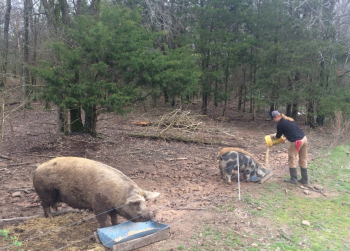
One pig eats from a blue trough in the foreground, and a farmer pours feed to two more pigs in a second trough in the midground, with a forest in the background.

Feeding pigs in portable troughs helps reduce excessive soil disturbance. Photo: Nina Prater, NCAT

Feeding management supports both pig health and land stewardship. While pigs will forage widely on acorns, roots, and greens, supplemental feed is necessary to reach market weight efficiently. Feed balanced rations, including grains or fermented feeds, in a way that encourages natural behavior and spreads manure evenly. Using portable feeders will allow you to move feeding sites around the paddock, which help limit the creation of wallows or overly concentrated manure piles. Seasonal mast like acorns and hickories offer rich forage, but it is important to limit pig time in these areas after the pigs have feasted to allow trees to recover from trampling. Monitoring the pigs’ body condition throughout the rotation is key. Pasture-raised pigs may grow more slowly than confined animals, but their meat often develops a richer flavor and firmer texture.  

Above all, raising pigs in silvopasture is a practice of attentive observation and adaptability. No single plan fits all seasons or sites. Successful farmers walk their land daily, watching rooting patterns, monitoring tree health, and noting soil recovery. Keeping a simple journal with observations and adjustments helps build a deeper understanding over time. Managing a regenerative pig enterprise in the forest is not about control, but cooperation. It’s a dialogue between steward and land, where both pig and tree flourish.  

In the end, silvopasture invites the producer to foster an approach of patience and respect. When managed with care, pigs do more than grow; they become part of the story of soil and tree, of land renewed and bounty shared. Through this work, farmers honor not only the meat they harvest but the living, breathing landscape that sustains them.  

ATTRA Resources:

By Eric Fuchs-Stengel, NCAT Agriculture Specialist

Back in the olden times, hardscrabble beekeepers worked their hives in the hot sun with no suits or gloves. They would puff on cigars, blowing smoke up around their faces, filling the air underneath their wide-brimmed bee veils. This smoke would keep bees, either defensive or curious, away from their upturned mustaches, long beards, and sunbaked faces. Meanwhile, these old-timers would work methodically, gently squeezing the bellows of their copper smokers, floating a thick gray smoke, often a mix of burning pine needles and wood chips, into their Langstroth beehives.

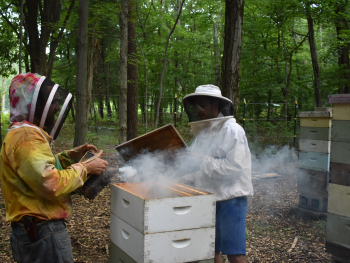
Two people stand on either side of a Langstroth beehive, one of them holding the lid while the other applies smoke to the hive.

Two beekeepers applying smoke to a Langstroth hive. Photo: Eric Fuchs-Stengel

The smoke served (and continues to serve) many functions: it distracts the bees, confuses their olfaction system (smell and pheromone communication), and signifies the potential of an incoming forest fire. The simple practice of using a smoker goes all the way back to ancient times and is still a cornerstone of modern-day beekeeping. Modern beekeepers may have lost the cigars and the outlandish facial hair, but the smoker remains in both copper, stainless steel, and aluminum forms and is a symbol of sustainable, productive, and successful beekeeping.

When I was a brand-new beekeeper, my local bee club partnered with a remarkable bee mentor who rarely used a bee smoker. She was extraordinarily successful with her hives, stewarding many through Varroa mite infestations and cold winters. She prioritized moving slowly and thoughtfully, with movements that were not jarring or alarming to bees. I have not seen this slow and steady “Tai Chi” style of beekeeping replicated anywhere else in the beekeeping world. She would on occasion use smoke, but it was rarely needed when she worked her mature, well-aged, well-mannered, and “spiritually connected,” hives in her home apiary. On a beautiful, sunny, summer day, I would watch my mentor slowly opening, inspecting, and working the hives with her bare hands—no smoker lit, no fear at all, and no defensive hives stinging and buzzing her in the face. Truly, a sight to behold.

As an inexperienced beekeeper, I thought this was the way I should begin raising my bees, which brings us to our story. For several years I kept my colonies on a horse farm. My mentor would visit me and wear a bee suit with no gloves so that she could feel what was happening in the hives and to what extent she was jostling the frames around. The bees were calm and peaceful around her. She was a master of this practice. I, on the other hand, was extremely nervous. I wore a full bee suit, thick leather gloves, and sweated profusely every time I worked my hives in the sun. The smell of my stress radiated outward, and my sweat soaked into the suit, which I did not really wash. In an attempt to imitate my mentor, I did not use a smoker. I would try to be gentle. Slow. Steady. But the fully aware, undistracted-by-smoke, energetic bees would BUZZ LOUDLY and swarm around my face covered by my bee veil. This would lead to me crushing bees under my fingers with the thick leather gloves, jarring and jolting frames as I removed them from the colony.

Diagram of the parts of a Langstroth hive, showing from top to bottom the outer cover, inner cover, medium honey super, deep hive body, and bottom board.

Basic anatomy of a Langstroth hive. Source: Jason Nelson, 2008.

In the heat of summer, I would struggle lifting off the heavy honey super, then the top deep, to do a full inspection on the bottom deep—as I had interpreted that to be standard practice—at least once a month. (In actuality, I was over-inspecting my colony due to my inexperience. A skilled beekeeper can read the comb in a hive to determine its health and would need to dive deep into the brood chamber much less frequently.) The bees would buzz, cluster on top of the deep frames, and bubble over the sides of the hive box like lava.


In short, my bees were angry. My leather gloves were covered in stingers. The edges of the hives were full of dead bees crushed between the deeps and supers. My suit was smelly with the stench of nervous sweat. Every time I went to the hives I was scared and worked faster to try to avoid the eruption of bees out of the colony, which only made things worse.

Toward the end of July, I found one of my hives densely packed and sealed tight with propolis, which made it difficult to open. Every time I freed the inner cover, prying it apart with my hive tool, a loud crack would sound, and the sweet smell of bananas would flow out into the air. That banana smell is the alarm pheromone released by the bees’ Koschevnikov gland, which contains isoamyl acetate (the same compound that naturally occurs in bananas). The bees would produce this pheromone upon my arrival and fan it throughout the hive. As I lifted the lid off the hive, the bees buzzed and flew into my veil aggressively, then shot out into the surrounding area, stinging farm visitors, and harassing workers.

For the seasoned beekeepers reading this, it already sounds like a nightmare scenario. But to top it all off, something else had also been occurring that I had not realized would be an issue. About fifteen feet in front of the hive was the farm’s horse-washing station. Every day, several horses would be brought out of the stalls and sprayed down, soaped up, and washed—in the flight path of the forager bees. The animal smell and dust would waft into the hive entrances, further agitating hives already on edge from my nervous management practices.

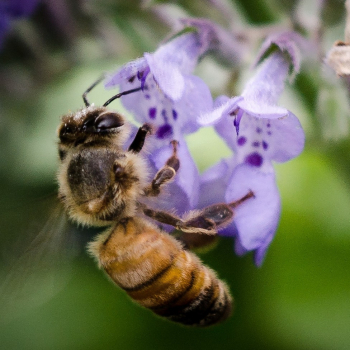
Close-up of a honeybee perched on a purple flower.

Honeybees are excellent at mapping and remembering where to find nectar. Photo: Lance Cheung, USDA

Honeybees have a great memory when it comes to smells. Their brain is tiny but contains up to one million neurons and is organized into clusters called “lobes.” Each lobe controls distinct functions or activities, and one particularly important lobe is called, the “mushroom body.” This lobe is enlarged in honeybees and takes up to 20% of their brain. Its purpose is to receive sensory information like smell and taste, learn about that information, and remember it for the future. This is what allows the bee’s brain to recall certain flowers that are good nectar sources. Likewise, they can also recall the smells of threats like horses, or a scared beekeeper like me.

As the season progressed, I started to receive calls about honeybees stinging visitors as they got out of their cars. Farm staff could be on the other side of the farm working when all a sudden a stray honeybee would fly in their face, get stuck in their hair, and sting them. My colony had become chronically on-edge, and something needed to be done. First, I tried to re-queen the colony. I bought a gentle, healthy, and highly regarded Carniolan queen from a local queen breeder and put it in the hive. This did change the hive temperament a little bit, but I still had stinging issues and excess defensiveness from the colony. When winter arrived, I decided to move the colony to a new location. It took me years to fully understand all the factors that led to turning this hive—which had initially been calm and peaceful—into the volcano of overflowing guard bees that it became. Here are some key lessons I learned:

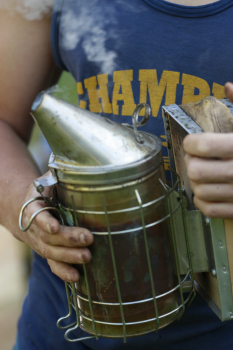
Close-up photo of a person holding a metal smoker used in beekeeping.

One common model of smoker used in beekeeping to keep the hives calm. Photo: Eric Fuchs-Stengel

  • Use a smoker. As a new beekeeper you can’t avoid crushing and killing bees and one of the absolute best tools to avoid prevent stress on bees is a smoker. Today, I usually light my smoker with a tiny bit of dry cardboard. Then I pile it up slowly with pine needles and woodchips. I top it off with a layer of wet mugwort weeds, green grassy material, or other green vegetative material growing around the farm. This green layer will cool the smoke as it leaves the smoker, ensuring the smoke is not so hot it would burn the bee wings or spread hot ash into the hive. I use mugwort as my first choice because the bees appear to like the smell.
  • Observe your site. Scope out your potential apiary location before you place hives there. What animals live in the area? What type of weather patterns impact it? Is there a strong wind? Lots of shade? Too much sun? Will weeds impact the hive entrance?
  • Be careful about smells! Wash your bee suit and gloves monthly. Try your best to visit your hives after a shower when your personal pheromones are at a minimum. Try to stay less sweaty when you work your hives by buying a ventilated bee suit and dressing lightly under it.
  • Don’t stress over applying smoke at the beginning. If you want to be “Zen” with your bees, that can happen over time. Master the basics first and then you can experiment with no gloves, no suit, or no smoke.
  • Use equipment that works for you: Thick leather gloves with no dexterity will kill bees if you aren’t careful. If you are feeling brave and comfortable with your hives, try thinner gloves that fit tighter to the hand or nitrile exam gloves (which the bees can sting through) so you can have dexterity without leaving skin exposed.

I hope you can benefit from the mistakes I made as a new beekeeper, so you’ll be able to start your beekeeping career off a little less painfully than I did. Please feel free to reach out to me with questions, or to let me know if there is other beekeeping information you need from us at ATTRA!

Sources:

Paoli, M. and Galizia, G. 2021. Olfactory coding in honeybees, Cell & Tissue Research 383, pp. 35–58.

Conrad, R. 2017. Natural Beekeeping, Revised and Expended ed. From Chapter 2, Working With The Hive / Attitude. Chelsea Green Publishing, White River Junction, VT. pp. 30–31.

ATTRA Resources:

Podcast episode: Beekeeping Basics with Eric Fuchs-Stengel


By Audrey Kolde, NCAT Agriculture Specialist

Growing up, the only cut flowers I ever saw were the ones handed out at dance recitals: a rose from a proud parent or a carnation from the teacher. These classic blossoms—roses, carnations, and chrysanthemums—make up the “big three” of the cut flower world. They’re reliable, hardy, and grown for scale. But over the past two decades, bouquets have evolved into something far more diverse, textural, and beautiful.

The switch to diversity can be traced back to a pivotal moment in U.S. trade policy. In 1991, the Andean Trade Preference Act began opening the door to duty-free flower imports from Colombia. By 2012, the U.S.-Colombia Trade Promotion Agreement made Colombia’s position as the dominant supplier of cut flowers to the American market untouchable. While this surge in low-cost imports made bouquets more affordable and abundant, it also hurt domestic wholesale flower farms, which couldn’t compete on price alone.

Finding a Niche and the Digital Floral Revolution 

Close-up photo of lavender-colored sweet pea blossoms.

Sweet pea blossoms make a fragrant addition to bouquets.

Confronted with this challenge, U.S. flower farmers began to adapt. Instead of pursuing the wholesale giants with resilient, shippable blooms, they embraced their unique strength: growing delicate, fragrant, seasonal flowers that could not withstand long-distance transport. Local farms carved out a niche, offering sweet peas, dahlias, ranunculus, and garden roses—blooms that thrived in nearby soil but couldn’t be shipped in a box.

Social media accelerated this shift: Instagram and Pinterest introduced consumers to lush, wild, and seasonal bouquets. People’s preferences began to shift; they no longer just wanted a dozen roses. Instead, they sought flowers with unique textures, captivating fragrances, and compelling stories. Social media also gave local farmers a direct connection to consumers and florists, allowing them to bypass traditional wholesale channels. This increased visibility on digital platforms transformed previously overlooked flower varieties into sought-after blooms, sparking a grassroots revival of local flower farming.

The Rise of Direct Sales 

The local food movement of the 2010s led to a shift in consumer values towards sustainably grown flowers. Many shoppers began seeking “American Grown” labels, desiring not only beauty but also environmental and ethical accountability. This demand gave rise to more direct marketing, including flower CSA subscriptions and an expanded presence of fresh flowers at farmers’ markets. The COVID-19 pandemic accelerated this trend, when weddings, festivals, and large gatherings were canceled and wholesale orders from florists, event planners, and retailers were scaled back dramatically. What began as a crisis response evolved into a lasting business model as farms transitioned to e-commerce and direct-to-consumer sales, with many farmers quickly adapting by launching online shops, subscription flower boxes, and local delivery services. Small and mid-size flower farms can bypass traditional wholesale channels, strengthening grower-consumer relationships and creating new revenue streams. Direct-to-consumer sales have become a cornerstone of the modern floral industry.

Easy Blooms to Start Growing
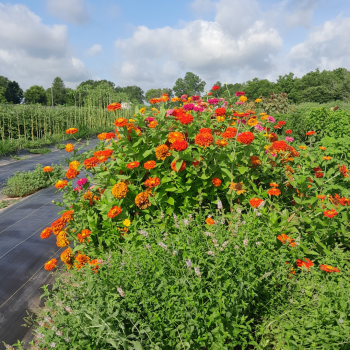
Large row of orange zinnias growing on a farm.

Zinnias are an easy flower to start with when adding cut flowers to a specialty-crop operation. Photo: Audrey Kolde

Growing and selling flowers is an easy shift for diversified farms. Summer annuals such as zinnias, sunflowers, cosmos, gomphrena, and celosia thrive in a wide range of climates and are easy to grow and sell. These “cut-and-come-again” flowers can be harvested multiple times throughout the season. For example, a single 100-foot row of zinnias or cosmos can yield 1,000 to 3,000 stems over a season, while gomphrena may produce 3,000–4,000 stems. With just a few rows, you can bring buckets of flowers to market each week. On ¼ to ½ acre, growers often supply local florists, farmers markets, or bouquet subscription services. Adding herbs like basil, mint, or rosemary offers both fragrance and foliage for arrangements.

Adding Value: Bouquets

As your skills grow, bouquet design becomes a natural next step—this is where creativity meets profitability. In busy markets, pre-made bouquets facilitate faster sales. Slower-paced markets allow for a more interactive experience, allowing customers to choose their own stems for a custom bouquet. Either way, refreshing your knowledge of basic bouquet-building techniques increases your product’s value. Learn which flowers function as focal, fillers, line flowers, and greenery, and plan your growing season with color palettes and design in mind. Kraft paper wrapping, flower food packets, and a polished table setup help elevate your market presentation. Flowers naturally lend themselves to visual marketing, so use your social media to showcase blooms in context—on a table, in a vase, or as a gift. Adding a social mission (like donating bouquets to hospital wings, elder homes, or community centers) creates emotional connection and buyer loyalty. You can also build scarcity-driven marketing strategies through limited CSA shares, preorder-only focal bouquets, or subscription deliveries to homes and offices.

Harvesting and Post-Harvest Handling
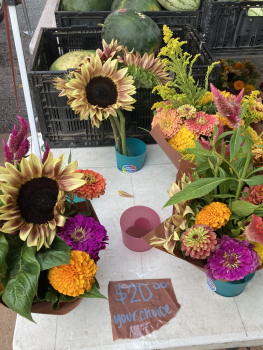
Mixed bouquets of sunflowers, zinnias, and other blooms on display at a Farmers Market table.

Bouquets for sale at a Farmers Market table. Photo: Nina Prater

To ensure top-quality blooms, proper harvesting and post-harvest care are crucial. Cut flowers early in the morning or late in the evening with sharp, sanitized floral snips to minimize stem damage and maximize water uptake. Immediately place stems in clean buckets filled with cool water and preservative (homemade or commercial). Strip leaves below the waterline to reduce bacteria, and move flowers to a cool, shaded area—or ideally a CoolBot-equipped cooler (34–38°F)—as soon as possible.

Leveling Up Quality

Using cucumber netting or flower support mesh helps produce straighter stems. Low tunnels and caterpillar tunnels protect crops from wind and rain, extending the growing season. Shade cloth can prevent petal burn and help grow longer stems, while row cover (like Reemay) provides light frost protection and speeds up early growth. Insect netting blocks common pests without the use of chemicals, and drip irrigation keeps foliage dry, preventing diseases such as botrytis and powdery mildew. These lightweight, movable tools are well-suited for use on plots ranging from ¼ to 1 acre and make it easy to adapt quickly to changing conditions.

Beautiful Profit

Flower farming isn’t just a source of income—it’s a fulfilling lifestyle that balances creativity and connection to your local community. Lynn Byczynski, author of The Flower Farmer, has inspired growers since 1997 with the message that well-managed flower farms can earn $25,000 to $30,000 per acre through direct sales. Income varies based on marketing, crop choice, and local demand: farmers’ markets may bring in $500–$2,000 per week, while CSA subscriptions often sell for $15–$25 per share per week.

Start Blooming

Engaging in flower farming can be a deeply rewarding endeavor, whether your motivations are a desire for profit, a passion for horticulture, or a combination of both. This vibrant industry offers an opportunity to cultivate stunning blooms while honing your skills in planting, nurturing, and harvesting flowers. As you immerse yourself in the art of flower farming, you’ll discover the intricacies of soil health, seasonal cycles, and sustainable practices that not only enhance your yields but also connect you to the beauty of nature. With each season, you’ll witness the fruits of your labor come to life, fostering a sense of accomplishment and satisfaction that grows alongside your expertise in this blossoming field.

References  

Byczynski, Lynn. The Flower Farmer: An Organic Grower’s Guide to Raising and Selling Cut Flowers. 2nd ed., Chelsea Green Publishing, 2008.

Flower farming is making a comeback as gardeners grow a local niche. 2023. The Produce News.  https://theproducenews.com

DTC flower sales have blossomed during the pandemic. 2021. Bloomberg Second Measure. https://secondmeasure.com  


Related ATTRA Resources:  

Specialty Cup Flower Production and Marketing Publication:

https://attra.ncat.org/publication/specialty-cut-flower-production-and-marketing/

Podcast: A Flower Farm Blossoms:

https://attra.ncat.org/a-flower-farm-blossoms/


Other  Resources: 

Association of Specialty Cut Flower Growers

Growing for Market Magazine: Getting started with Cut Flowers Part 1: The Why and How of it

Kentucky Center for Crop Diversification: Cut Flower Resources

North Carolina State Extension: Cut Flowers

The Biochar Research Network Act has been reintroduced in the US House as HR 4764  and in the US Senate as S2450. The legislation has a long list of bipartisan sponsors including Senators Chuck Grassley (IA-R) and Martin Heinrich (NM-D), as well as Representatives Mariannette Miller Meeks (IA-R), Chellie Pingree (ME-D), Dan Newhouse (WA-R), Kim Schrier (WA-D), Rodney Feenstra (IA-R), Zack Nunn (IA-R), Mike Lawler (NY-R), Sean Casten (IL-D) and Jimmy Panetta (CA-D).

Democrats and Republicans in Washington don’t often agree. But they do agree that the federal government should invest in research to close critical knowledge gaps on the agronomic and forestry benefits of biochar.

The Act calls for a national, multi-site, research project to test a common set of biochar types in varying soils and circumstances. The research will inform farmers and foresters on which biochar types will have positive effects in their conditions.

Biochar is produced by heating biomass in the absence of oxygen. Research has demonstrated that biochar can improve soil health, reduce soil emissions of methane and nitrous oxide, increase soil water holding capacity, improve the efficiency of plant nutrient use and raise crop yields. The improved soil water holding capacity can be particularly valuable in enhancing the resilience of crops to extreme weather by soaking up heavy downpours and storing the moisture for use by crops in subsequent dry periods.

Research results on biochar have been inconsistent, however, because diverse types of biochar are being tested in varying conditions. The research supported by the Act would help determine which types of biochar will achieve particular agronomic objectives in differing conditions.

NCAT’s Biochar Policy Project initiated introduction of the Act. If you would like us to keep you informed on developments on biochar related legislation, you can sign up here. We’ll let you know when your email to your representative in Congress can make a difference.

By Darron Gaus, NCAT Agriculture Specialist 

A Taste of July 

When I was farming in San Antonio, Texas, one of my favorite crops to grow was watermelon. I would often stop during harvest to sit on the sun-warmed soil, cut open a 10-pound source of potassium-rich hydration, and chat with the crew while juice flowed down our chins. I even carried a shaker of pink Himalayan sea salt in my back pocket, ready for the quick draw when that moment came. (And if you’ve never salted your watermelon, give it a try. Just trust me on this.) Those were special moments that helped us all endure the arduous work of farming. 

Over the course of nearly 20 seasons, I grew watermelons in almost every way imaginable and learned a lot about this unique cucurbit. I often pondered if the “water” in “watermelon” comes from the contents or its water-seeking abilities. Watermelon can congregate its fibrous root system to function like a central tap root. It does this in sandy soils with astounding efficiency, even potentially reaching down into the water table itself. I grew watermelons in modeling clay, the blackest of gumbos. After the first few seasons, I learned that I needed to play to the watermelon’s strengths. If I wanted the soil’s water to convert into hydration to enjoy during my future break times, I had to adapt my growing methods. 

Learning from Failure and Abundance 

I began conventionally, using industry-standard methods for growing watermelon at scale. My crew and I chisel plowed once a year and disk harrowed three times in every direction. Then we prepped the beds in one pass with the fine, almost desiccated clay shaped by a metal pan, covered with plastic mulch, and bisected by a single line of drip irrigation in the middle of each. After all that, I had to pump the water back in that I just helped evaporate into thin air. Three hundred thousand gallons of water for the five acres of soon-to-be-planted watermelons poured through pipes, hoses, and drip tape to ensure transplants or seeds had available moisture as soon as they dropped into their new home for the next 80 to 100 days.  

Time-sensitive cultivation with 12-inch listers (arrow-shaped metal sweeps designed to move soil to either side of a center furrow) and hand-weeding the holes was the only thing left to do before harvest. Plant density was high in this system, and the yield was great, but keeping up with water demands in the high shrink-swell clay was a constant failure. The hardpan that formed from so many equipment passes was impenetrable, even for the well-adapted watermelon roots. 

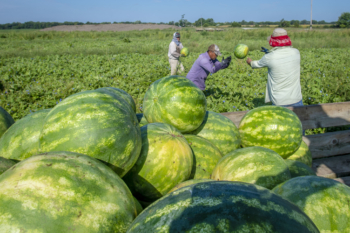
Farmworkers bringing in the watermelon harvest. Photo: USDA, Preston Keres.

After two seasons of conventional methods, I began implementing conservation practices that would increase organic matter, conserve soil moisture, and reduce my time on the tractor. Increasing organic matter in the heavy clay I farmed greatly increased porosity, water retention, living biology in the soil, and nutrient cycling. Cover crops, with a mix of at least three species, became my new obsession. Three quarters of the 105 acres were under cover crops designed for specific benefits: high biomass for weed suppression and organic matter, a brassica for insect trapping and greater soil porosity, and a legume for nitrogen fixation.  

The cover crops provided one more critical benefit: they captured every rain drop that fell. I no longer had rill erosion in my furrows after a two-inch-per-hour rainfall. The large rills that once forced me to waste time sweeping beds back up were gone. Soil aggregation and tilth improved. Organic matter increased and the high pH came down. Watermelons grew like they were supposed to.  

The first season of adopting this new farming approach came with its share of challenges. We had to develop innovative cultivation techniques to manage weed pressure and adjust our bed preparation methods to work with a high-residue topsoil layer. These adjustments initially led to a 20% drop in yields. However, after a season of learning and refining our practices, the results were remarkable—yields rebounded to impressive levels, all while requiring significantly less irrigation. 

Pushing the Envelope

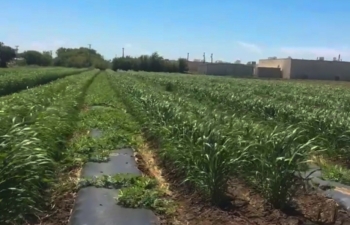
Watermelon interplanted with Sudan grass. Photo by Darron Gaus.

Once I started seeing the changes that the conservation practices were making, I wanted to add more. I wanted to try new things, so I pushed the envelope. I wanted those juice-covered-chin breaks in harvesting watermelon in November, not just July. The only thing standing in the way was overcoming the water demand of an August planting. August in San Antonio is usually 31 days of triple-digit temperatures and no rain in the forecast. Sudan grass grows tall quickly in these conditions, so I interplanted it with the watermelon. The idea was that the Sudan grass would provide wind breaks and shade to the seedlings, helping to conserve soil moisture. And it worked! We harvested watermelon in November that year, but it came with consequences. The harvest took place in nine-foot-tall grass-walled tunnels, which made passing the watermelons to the edges of the field for easy pick-up impossible. Every single watermelon (all undersized because of lack of sunlight during fruiting) had to be individually walked out of the field. Luckily, we had 200 volunteers from the Air Force on the day of harvest, and in spite of the tall grass, they still managed to pack out 12,000 pounds of three-to-five-pound fruits in just under two hours. That November was the only fall harvest of watermelon in my career; the price of labor was too steep. I pushed it too far, but I learned. 

Water Rising to the Surface 

Watermelons taught me many lessons, but none as important as water conservation. What began as a simple pursuit of sweetness transformed into a lesson about the lifeline that sustains these plants: water. Each watermelon I grew represented the delicate balance between abundance and scarcity. I learned how much water it takes to nurture just one fruit, and how easily that resource can be taken for granted.  

Within the vibrant green rind and the refreshing red flesh is a story of soil, sun, and most critically, sustainability. In tending to the vines, I began to see the bigger picture. I saw how water connects everything: the land, the food we eat, and the future we hope to build. What started as farming became a quiet education in stewardship.  

Watermelons, in their quiet way, reminded me that what’s beneath the surface often matters most—our water, our world, our shared responsibility.  

Come back for Part Two of the sweetest story ever told. It involves compost, city citations, crowded cover crops, and conservation dryland farming. 

By Andy Pressman, NCAT Sustainable Agriculture Program Director

“Homegrown tomatoes, homegrown tomatoes,
What’d life be without homegrown tomatoes?
Only two things that money can’t buy
And that’s true love and homegrown tomatoes.”

– Guy Clark, Homegrown Tomatoes

Listen to a clip of “Homegrown Tomatoes” by Guy Clark

The author’s daughter enjoying a homegrown tomato.

It sure is hard to imagine life without homegrown tomatoes. For some, like American folk singer Guy Clark, it is well worth the wait over the winter months for a sun-ripened tomato fresh off the vine, and for the experience of first biting into one and feeling that rush of flavor as it explodes in your mouth. This moment of joy is not limited to gardeners—anyone can seek out these precious, homegrown flavors from farmers who grow tomatoes skillfully and with great care.

Tomatoes are a staple summer crop for many diversified farms: high-value, in-demand, and, when conditions are right, highly productive. But as summers grow hotter and more unpredictable, even this dependable crop can show signs of stress. Blossom drop, sunscald, delayed or uneven ripening, and declines in yield are symptoms caused by intense heat.

Whether you’re selling at farmers markets, through CSA shares, or to wholesale accounts, heat stress in tomato production can quickly translate into lost income. With the right strategies, you can mitigate heat-related issues and maintain healthy, productive plants, even at the height of summer. Read on for common heat-related issues and how to solve them.

Fruit Set and Blossom Drop

Heat can impede fruit set when daytime highs are consistently over 90°F and nighttime temperatures stay above 70°F. Blossoms can drop and pollen can become less viable as the plant shifts from reproductive to survival mode. Choosing heat-tolerant varieties and staggering plantings to avoid peak summer stress, including planting early in high tunnels, can reduce blossom drop. Using hoops and shade cloth in the field can reduce the sun’s intensity. Managing soil temperature and moisture by utilizing practices such as drip irrigation and mulching can also help retain flowers.

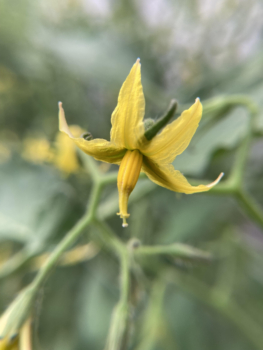
Close-up of a tomato blossom. Photo credit: Nina Prater.

Pollination

Fruit deformities can result from a lack of pollination. Planting pollinator habitats in and around tomato plantings can increase pollination from native pollinators. It’s also a good idea to limit insecticide use (even organic-approved insecticides) during bloom periods. Hand-pollinating plants can improve pollination rates, especially in high tunnels. Applying a kelp or seaweed fertilizer as a foliar spray during early flowering also helps mitigate heat-related stress that impacts pollination and causes misshapen fruits.

Sunscald

Sunscald on tomatoes occurs when the fruit is exposed to intense sun, especially after the plants are pruned and leaf cover is reduced. Sunscald causes the fruit to develop leathery white or gray patches on the skin that make it unmarketable. Maintaining leaf canopy during periods of extreme heat by limiting pruning and sucker removal can reduce sunscald. Trellising can assist in providing more leaf canopy, while also assisting with airflow. And, as with blossom drop, utilizing shade techniques in high tunnels or in the field can reduce the risk of sunscald during periods of intense heat.

Ripening Issues and Yellow Shouldering

Extended periods of high temperatures can cause uneven or delayed ripening, and can also cause the fruit to exhibit green or yellow tops, known as yellow shouldering. Managing potassium availability in the soil can help prevent these issues. Use soil tests to determine potassium levels and apply amendments, such as kelp meal, as needed. Adding too much nitrogen, especially late in the season, can prolong vegetative growth, which slows fruit ripening. If daytime heat is affecting the color or appearance of the fruit, consider harvesting early and ripening indoors.

Blossom-End Rot

Another disorder caused by heat stress is blossom-end rot. While tied to inadequate amounts of calcium, blossom-end rot is more associated with a lack of water. The hotter the temperature, the more water is lost to transpiration from the tomato plants. This increase in water loss causes small lesions on the blossom end of the fruit that gradually spread and turn the area into a brownish or tan color. Timely irrigation and maintaining proper pH and calcium levels in the soil can prevent blossom-end rot.

White Core

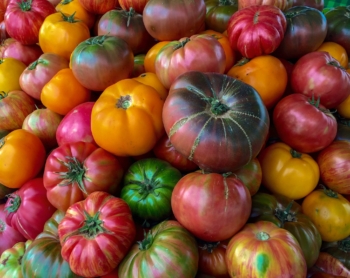
Variety of beautiful heirloom tomatoes. Photo credit: USDA Lance Cheung.

Internally, tomatoes can develop a hard white core from excessive heat and inadequate fertility. In moderate cases, white core can occur just beneath the flower-shaped leaf, or calyx, on the top of the fruit. In more extreme cases, you may see white core extend through the entire fruit. Having adequate foliage cover and potassium levels can prevent white core. Additionally, older varieties are more susceptible to white core, while newer varieties are less prone to this issue. Therefore, variety selection can again help mitigate this disorder.

Fruit Cracking

Mid- to late-summer tomato harvests often occur during dry periods. However, an afternoon shower can cause the fruit to swell faster than the skin can stretch, resulting in fruit cracking. Fruit cracking can also occur through sudden irrigation during a dry spell. Cracking can be managed by reducing moisture fluctuations, and through the consistent use of drip irrigation. Mulching conserves soil moisture and reduces the risk of temperature swings. If a sudden rain shower is in the forecast after a dry spell, harvesting tomatoes at first blush or the breaker stage (a slight change in color from green to no more than 10% pink, red, orange, or yellow) and ripening indoors will keep the fruit from cracking. Research shows that ripening in a protected structure at temperatures between 55° F and 65° F is equal to ripening on the vine, while ripening at 68° F increases the sweetness and overall flavor of the tomato.

Tomatoes may love the heat, but even they have their limits. By observing your plants closely, using techniques to mitigate heat stress, choosing the right varieties, and managing soil and water strategically, you can protect your crops and enjoy a fruitful harvest. And, while the summer heat may test your patience and your plants, there’s still something magic about harvesting a perfect slicer in the middle of July—enough to make you hum a little of Guy Clark’s tune on your way back from the field.

Read more on tomato production in our ATTRA publication, Organic Tomato Production.

By Maura Henn, NCAT Local Food Systems Specialist 

What do farmers markets, locally owned grocery stores, and community compost centers have in common?   

If you answered they are all part of a functioning local food system, you would be right. If you had asked me that question six years ago, I may have been able to make the connection that they had something to do with food, but my answer would have ended there! Even though I had managed a farmers market, worked at cooperative grocery store, and regularly sought out and enjoyed locally produced food, it wasn’t until I started working at NCAT that I realized that I had been participating in local food systems my entire life.  

A local food system refers to the network that connects local producers and consumers, promoting the consumption of locally-grown food. A local food system includes the overlap and collaboration of five key sectors: production, processing, distribution, consumption, and waste management and food recovery. Though there is not a federally established definition of local food, it is generally accepted that local food is food that travels the entire supply chain, from production to waste management in the same locality.   

Buying local foods strengthens local economies and helps keep family farmers farming. It also creates a connection between consumers and local farmers that enhances both individual and community health. Efforts such as urban farms, community gardens, farmers markets, locally-owned small grocers, and composting programs all contribute to local food systems.  

Here is a breakdown of what makes up the local food system: 

  • Production is the act of cultivating land and growing crops as well as raising, feeding, and breeding livestock. Production can also include fishing, hunting, and foraging. Local farms and ranches, community and school gardens, and urban farms are all examples of places where local food production takes place. 
  • Processing transforms raw ingredients, physically or chemically, into value-added products through butchering, cooking, baking, curing, fermenting, and milling. Processing may also include harvesting, packaging, and combining raw products that can then be found in restaurants, bakeries, or grocery stores using local ingredients. Entrepreneurs using community kitchens to prepare small batches of their latest recipes, or school kitchens prepping fresh vegetables for a salad bar as part of their Farm to School program are examples of processing in action. 
  • Distribution includes how we move the food we eat from farms, ranches, and processing sites to farmers markets, grocery stores, food cooperatives, food hubs, community supported agriculture (CSA) programs, and wholesalers. Distribution also includes the transportation and business logistics needed to make it all happen.
  • Consumption, probably the simplest process to explain, is the joyful act of eating the locally produced and processed food through a wide array of physically safe, affordable, and culturally acceptable places, including home kitchens, institutional cafeterias, shelters, schools, workplaces, hospitals, concessions, cafes, restaurants, and food banks.  
  • Waste Management and Recovery: Often managed by municipalities, waste management can take on a few different forms, such as weekly curbside trash and recycling pick-up. Some communities have compost services to help reduce the amount of fruit, vegetables, and yard waste that is deposited in landfills or garbage incinerators. Food recovery is a form of waste management. Also known as food rescue, food salvage, or surplus food redistribution, it is the practice of gleaning edible food that would otherwise go to waste from places such as farms, produce markets, grocery stores, restaurants, or dining facilities and distributing it to local emergency food programs. 

Of all the processes of local food systems, food recovery is the one I think has the most opportunity for expansion within communities, which can help deliver safe and edible food to people who need it. Gleaning programs allow for unsold food to be donated to food pantries, food access programs such as community fridges, or even directly to consumers. When I was a full-time college student who also needed to work full time to cover rent and living expenses, I relied heavily on the “red tagged” food that was made available to staff at the local food cooperative where I was employed. The red tagged food was available to take home free of charge because it had met its sell-by date. I look back now and realize I had been a recipient of a gleaning program. Without that supplemental source of food I would have had a hard time managing all that was required in both schoolwork and my job. 

As with all aspects of local food systems, one vital ingredient is present in each sector: people. Without people growing, preparing, selling, eating, and mindfully disposing of food byproducts, local food systems would not exist. Some are called to the profession of farming and ranching and choose to market their products locally—a vital part of the local food system. Those of us who aren’t farmers or ranchers still have essential roles to play in the system. We all participate in our local food system in one way or another. Those of us who are able can choose to invest in these local systems by supporting local farmers, sharing our garden yields with neighbors, installing a compost system in our backyard, or countless other actions we can take as members of a local food community. Local food systems are for everyone, and everyone has a place within them.  

ATTRA Resources: 

Episode 376: Talking ‘Health in the Hood’ with Asha Walker – ATTRA – Sustainable Agriculture 

Episode 337. ATTRA and SARE: Building Local Food Systems in Montana – ATTRA – Sustainable Agriculture 

Start a Farm in the City – ATTRA – Sustainable Agriculture 

Composting: The Basics – ATTRA – Sustainable Agriculture 

NCAT Marketing Tip Sheet Series – ATTRA – Sustainable Agriculture 

Additional Resources: 

Local and Regional Food Systems Resource Guide | Agricultural Marketing Service 

National Gleaning Project 


By Darron Gaus, NCAT Sustainable Agriculture Specialist 

Across the arid West, the choices producers make about how they graze, plant, and manage their soil ripple far beyond (and below) the fence line. When producers choose to implement water conservation practices, they are choosing to not just sustain agriculture, but also to protect wildlife, support habitats, and recharge aquifers that serve millions.

The Ogallala Aquifer in particular is a vital source of water for drinking and irrigation across eight states, and it is under stress. But with thoughtful land stewardship, it is possible to slow depletion and even allow aquifer recharge. The best news is that the conservation practices that recharge the aquifer also improve soil health, increase drought resilience, improve profitability, and create habitat for species like pollinators, songbirds, and even the lesser prairie chicken.

Conserving a Lifeline: The Ogallala Aquifer

The Ogallala Aquifer lies beneath the vast grasslands of the Southern Great Plains. This geological reservoir of groundwater has quietly powered the region’s agriculture and rural communities for generations. But that lifeline is shrinking. Decades of pumping, often faster than natural recharge can occur, has led to widespread depletion in many areas.

Fortunately, regenerative conservation practices offer a way forward. Practices such as managing for deep-rooted perennial grasses, rotating livestock to avoid overgrazing, reducing tillage, and increasing ground cover all help slow runoff and encourage water infiltration.

These practices are proactive rather than reactive. Building the conditions for aquifer recharge and for drought resilience requires conservation planning, instead of just reacting to weather extremes as they happen. The aquifer level responds to these long-term decisions. Managing diverse perennial cover and maximizing ground cover to minimize bare soil helps create conditions that soak in every drop of rain to sustain crops, livestock, and wildlife even through dry spells.

Working Lands, Living Landscapes

Across the Southern Great Plains, a growing number of farmers and ranchers are discovering that what’s good for water is good for the land, what’s good for the bird is good for the herd, and all of it is great for the bottom line. Adaptive grazing strategies that mimic historic bison movement patterns are helping keep grasses vigorous and resilient. Cover cropping and minimal tillage are building organic matter and protecting soil from erosion and drought. Where invasive woody species have crowded out native grasses, prescribed fire and mechanical removal are bringing back the open structure grasslands need to thrive. This isn’t about bringing back a single species, it’s about reweaving the fabric of the prairie, one pasture at a time.

This holistic approach builds a landscape that holds onto its water, supports wildlife, and weathers droughts more effectively. In the long term, it also reduces input costs, improves forage production, and helps producers manage risk. The environmental and economic benefits come hand-in-hand.

A Prairie Bird, a Bigger Picture

One species that benefits greatly from these regenerative practices is the lesser prairie chicken. Though it is federally listed and often surrounded by political debate, it stands for a much broader truth: the conditions that support its survival also support thriving grassland systems. Native grasses, forb diversity, insect abundance, and managed disturbance like fire and grazing are as important for bird broods as they are for forage and aquifer recharge. It’s all part of a holistic approach where habitat for birds, forage for cattle, and recharging aquifers are not competing interests, but complementary outcomes.

The Abundant Ogallala Project: Turning Principles into Practice

Recognizing these overlapping benefits and interwoven challenges, NCAT launched the Abundant Ogallala Project, which supports producers in adopting regenerative practices that restore prairie health and support groundwater sustainability. Whether the focus is improving pasture health, building drought resilience, or restoring habitat for species like the lesser prairie chicken, Abundant Ogallala is about supporting real, on-the-ground solutions.

This summer, the project will also host a free webinar series called From Scarcity to Sustainability: A Vision for the Southern Great Plains. Ranchers, researchers, and conservationists, who are finding common ground through stewardship, will come together to share stories and strategies about building resilience from the ground up—literally.

You can learn more about signing up for a free conservation plan and register for the series by visiting the Abundant Ogallala Project page or emailing us at AbundantOgallala@ncat.org.

A Season of Hope

Whether you’re raising cattle, growing cover crops, or restoring native range, your land can be more than a production space. It can be a refuge. A reservoir. A place where soil, water, and wildlife work together in balance. As spring unfolds, we’re reminded that every decision we make matters on our land, under our feet, and for the generations to come. It reminds us that the decisions we make on the land echo far beyond this season. It also reminds us that nature is resilient. That a rancher’s grazing plan, a patch of native wildflowers, or a single decision to leave a little more cover can make all the difference. As we walk through this season, we invite you to see your land not just as a production ground, but as a habitat. As a sponge for rain, a filter for nutrients, and a canvas for renewal. When we farm and ranch with intention, the prairie answers back. It blooms. It sings. And sometimes, if we’re consistent, it rewards us with more than mere beauty. It provides income and a quality of life we all dream of.

By Mike Lewis, NCAT Senior Manager and Farmer Veteran  

It was quiet when it happened. Not the kind of quiet that feels empty, but the kind that wraps around you like the stillness before a summer storm. A couple of weeks ago, my coworker Eric and I spent a day wandering through Armstrong Redwoods State Natural Reserve in Sonoma, California. We had come to the region for a year-end celebration hosted by Ranchin’ Vets, one of our Armed to Farm partners. But that day, we were just two friends walking through a forest of giants. 

We didn’t expect to hear the groaning, cracking, and deep roar that followed. A thousand-year-old redwood—one of the elders of that forest—began to fall. We stood still, breath caught, as the ancient tree surrendered to gravity and centuries of standing strong. It collapsed with a thunder that rolled through the valley like the voice of God.

There was no panic in the moment. Just awe. Sadness, yes, and something like reverence. It felt like watching a great soul leave the earth—but also like being let in on a secret. A rare, sacred kind of transformation. We hadn’t come to witness anything that monumental, but sometimes the earth has its own plans.

As we approached the fallen redwood, we were struck not just by its size, but by its presence. Even fallen, it was not diminished. The tree, we knew, was not done with its work. Its life had changed form, not ended. Now it would become a home to insects and birds. It would hold moisture, enrich soil, and slowly feed the roots of new growth. Its service to the forest would continue—just in quieter, slower, more hidden ways. 

That moment lingered with us, especially considering the work that had brought us there. Veterans—the ones we train, work alongside, and learn from—often come home changed. Some carry the visible scars of their service; others bear the invisible ones. But many of them return not to rest, but to serve again—this time by growing food, stewarding land, and nurturing the very communities they once left to protect. 

Like the redwood, their fall from battle does not mark the end of their story. In fact, it begins a new chapter of service. One rooted not in combat, but in care. Not in defense, but in cultivation. 

The redwood fell exactly where it had stood for over a thousand years—a reminder that there’s something sacred about place. That tree will now nurture the forest that once nurtured it. And that, too, is the story of many veterans who return to their communities, not only to heal themselves, but to heal the land and people around them. 

In our trainings, we see this time and again: veterans reconnecting with the soil, finding meaning in seeds, livestock, rain, and hard work. Farming offers more than a livelihood. It offers a sense of rootedness, of coming home in a deeper way. It’s not about escaping from the past but building the future—allowing one’s story to take new shape in familiar ground. 

The land doesn’t ask veterans to forget who they were. It invites them to become fully who they are now. 

As we looked around the grove, we noticed something else: no part of the tree would go to waste. The forest already knows how to receive it. Birds will perch on its limbs. Mushrooms will take root in its bark. Young trees will sprout in the softened soil beneath it. 

The forest never loses its own. 

That truth echoes in the way we view veterans in our work. Too often, society treats their transition as an ending—a closing of one chapter with no roadmap for what comes next. But in agrarian life, we see something different. We see a forest that welcomes them back. We see communities strengthened by their presence. We see the way they feed the ecosystem with their skills, their values, and their willingness to serve again—this time as cultivators of resilience, local knowledge, and hope. 

We like to imagine that life has chapters: childhood, youth, service, retirement. But that’s not how nature works. The redwood doesn’t retire. It simply moves from one mode of giving to another. The ecosystem doesn’t discard what falls; it transforms it into the conditions for life. 

Service isn’t a season. It’s a cycle. 

Veterans know this in their bones. They understand commitment, discipline, purpose—and many of them are now discovering how those same values apply not just in battle, but in fields, kitchens, farmers markets, and classrooms. They are becoming food producers, educators, mentors, and neighbors. They are learning to grow instead of defend—to restore rather than react. And in doing so, they help restore the places they love. 

Back in the forest, after the fall, the birds kept singing. Sunlight filtered down to the understory in a new way. And Eric and I stood there, not in grief, but in gratitude. We had witnessed something ancient and holy—a reminder that even the mightiest among us are still part of a much larger cycle. 

Maybe that’s what the redwood was trying to show us: that when we root ourselves in service to others and to the land, we never really stop growing. Even when we fall, we fall into the arms of something that knows exactly what to do with us. 

The forest never forgets. 

The land never wastes. 

And the work of service—real service—never ends. 

By NCAT Conservation Planner Cody Brown and NCAT Senior Conservation Planner Alisha Horak

If the word ‘wool’ conjures up memories of itchy socks and the scratchy blankets your grandparents would pull out when it got cold, it’s time to modernize your view on this warm, soft, functional fiber! Wool has come a long way in recent years. The wool industry has improved processing methods to increase wool’s versatility and comfort, and consumers are loving it, driving the demand for sustainable fibers. In response, the global woolen textiles market, which was valued at 190.4 billion dollars in 2023, is expected to grow almost eight percent every year between now and 2030.

Close-up photo of medium-gray wool sweater.

Wool is a timeless, sustainable fiber that can be used to make comfortable, functional clothes.

The fibers that make up your wardrobe may all make comfortable, useful clothes, but there are growing concerns about a wide range of environmental impacts these different fibers can have. Synthetic fiber’s elasticity, comfort, and cheap cost of production have made it a fierce competitor with natural fibers since the invention of nylon in the 1930s. However, synthetic textiles can lead to microplastic pollution, among other environmental costs. These concerns are starting an industry-wide shift to seek natural fiber sources with verified benefits to land and climate.

The prevalence of synthetics has led to a decline in the American wool industry and the domestic wool processing infrastructure that supported American wool in the past. This caused wool growers to have an increased dependency on volatile international wool markets. To be more profitable, wool producers and domestic wool processors can work together to serve the market of sustainability-interested consumers.

Close-up photo of a cross-section of wool insulation.

Wool insulation is a sustainable alternative to synthetic insulations and a potential market for coarse wool fibers.

Wool isn’t just for clothes, either. The fashion industry and the fine wool producers that support them are seeing an increase in demand for fine wool (i.e., the softest types of wool with the smallest fiber diameter), but medium and coarse wool producers also have opportunities to serve the sustainable fiber market. Medium and coarse wool can be turned into carpets and insulation, replacing synthetic fibers in our homes.

The best part is, when sheep producers use managed grazing techniques, they can actually build soil health and improve the health of the landscape. NCAT has a wide variety of resources available to help farmers and ranchers produce wool in sustainable, ethical ways, so together we can rebuild the American wool market from the soil up.

Producers and consumers both win with wool. It’s a sustainable material for clothing and other products. Wool’s durability, breathability, and insulative properties make it an easy choice when prioritizing the quality of materials. With a growing demand for sustainability across the nation, NCAT aims to empower wool producers through ATTRA’s sustainable agriculture information service, cost-share incentives, conservation plans, and access to new verified fiber markets that benefit the land, producers, and consumers. 

Additional Resources: 

Climate Beneficial Fiber Project

Tips for Marketing Sheep and Goat Products: Fiber

Building the Market for Climate-Beneficial Wool

Climate Beneficial Fiber Partnership: Introduction for Producers

Voices from the Field Podcast Episode 355. Soil-to-Skin: Rebecca Burgess of Fibershed on Building Community