By Rex Dufour, NCAT Sustainable Agriculture Specialist

Photo: Cover crop mix on April 28, 2020. Red crimson clover, mixed with orange California poppy, blue California Phacelia, and pink Persian clover (lower left). These flowers support large populations of predators, parasites, and pollinators.

For the past growing season, my staff and I have been involved with designing and managing a cover crop mix in pecan orchards in Northern California to attract beneficials, which provide some control of two species of pecan aphids. This monitoring took me back to the days in the early 1980’s when I was working as a licensed pest control advisor in Corralitos, CA, monitoring mites, fruit tree leaf rollers, and codling moths in apple orchards in the area.  I enjoyed the work then, and I continue to enjoy observing the progression of a crops biology.  Controlling aphids in pecans with chemicals generally requires two or three spray applications over the season. By planting a cover crop, we believe the grower has saved one or two sprays, one of which would likely have been a neonicotinoid, a class of insecticides which have been banned from Europe due to impacts on non-target organisms.  We’ve also learned that alternate row mowing of the cover crop can extend the flowering and, therefore, the availability of nectar and pollen for supporting a wide variety of beneficial insects that suppress aphid populations. On a personal note, it was an absolute joy to walk around in a diverse cover crop mix, with the perfume of Persian clover all about, while listening to and seeing the incredible diversity of life these practices bring into an orchard, compared to a bare dirt orchard floor. It was a privilege to do this work.

With funding from California Wildlife Conservation Board, this project is a collaboration between the Environmental Defense Fund (EDF) and the National Center for Appropriate Technology (NCAT) to work with two pecan orchards: one at PacGold in Colusa, owned by Ben King; and one at Bypass Farms, managed by Reyes, on the north side of the Sacramento River, just east of Route 5. The goal is to develop habitat in or adjacent to the orchard that can support beneficial insects, including monarch populations.

The major pests of pecans in California orchards are the yellow pecan aphid and the black margined pecan aphid. The yellow pecan aphid is the more benign pest of the two and generally appears first, in the late spring and early summer. Unless honeydew generated by the aphids becomes a problem, the economic threshold for the yellow pecan aphid is an average of 20 aphids per compound leaf during this time of year. It should be noted that these thresholds and dates (outlined below) were developed for conventionally managed pecan orchards without any cover crops.

  • Before June 1: Apply an insecticide for aphid control if honeydew is accumulating
  • June 1 to August 15: Apply an insecticide if the total number of aphids exceeds an average of 20 per compound leaf
  • August 15 to leaf fall: Apply an insecticide if the total number of aphids exceeds an average of 10 per compound leaf

To date, the cover crops have saved the grower of the larger orchard (Pacific Gold, 197 acres) at least one spray, perhaps two. (See Table 1 for cover crop species mix and comments.) Because of the low price of pecans, this grower made a commitment not to spray for the whole season. This is fortunate for us because we can observe the pest-predator evolution throughout the season. The NCAT team does three types of monitoring.  Every two weeks, we sweep at 10 locations in the larger orchard to better understand what beneficials are coming into the cover crop. We also place new sticky traps in the pecan canopy to better understand if the beneficials from the cover crop are moving into the canopy, as well as to determine which parasites and predators are in the canopy. We’ve found many green and brown lacewing adults, other predators, and many species of small, parasitic wasps.

We perform weekly monitoring of aphids in the pecan canopy. This information provides the grower with some good data for making spray/no-spray decisions. We select three compound leaf samples from each of 20 trees located around the 200-acre orchard and count the aphids, as well as green lacewing eggs, and other predators, such as all life stages of ladybird beetle, assassin bugs, syrphid flies, and spiders. The aphid counts are listed in the graph below by date. As you can see, the aphid counts peaked in late August and then plummeted pretty dramatically as predator populations caught up with the aphids. The aphid populations slowly increased and exceeded the late-season threshold of 10 aphids/leaf, but aside from some honeydew and some sooty mold (which grows on the honeydew but doesn’t damage the leaves), I didn’t observe any damage from the late-season yellow pecan aphids. And the late-season counts never exceeded the early-season threshold of 20 aphids/compound leaf.

The aphid populations are being managed by the changing array of predators, including very tiny spiders that weave small webs on the leaves. These tiny spiders feed on the first and second instars of the aphids, just as newly hatched ladybird beetle larvae do. Small predators, small prey. But we also found that small predators, such as very small lacewing larvae and lad bird beetle larvae (second or third instars for you entomologist-types) will attack winged adult aphids (see photos).

In the sticky traps, we found many very small wasps that are either insect egg parasites or aphid parasites, but because of the heavy predation of the aphids, we found very few aphid mummies (aphids that have been parasitized). There was likely a high turnover of aphid populations due to predation, so the wasp parasites didn’t have enough time to mature before their host was eaten.  Having a diverse array of predators and parasites, with different prey and host preferences, provides dynamic and flexible aphid suppression. The photos show some of the predators and parasites we’ve found.


Photo (right): This second-instar green lacewing larva is taking on a larger, winged yellow pecan aphid. Green lacewing larva are voracious predators of aphid and other small, soft-bodied insects.


Photo (left): A mama spider and her egg mass. We found many spiders smaller than this preying on aphids.


Photo (right): Assassin bug nymphs and adults are later-season predators.  The smaller, newly hatched nymphs feed on yellow pecan aphids.


Table 1: Cover crop species, seeding rates, and some observations

CC Species Name Comments
Persian Clover Seed mix drilled @ 15 lbs/acre on 197 acres. Persian clover (an annual) dominated late spring, and came on after crimson clover.
Crimson Clover Seed mix drilled @ 15 lbs/acre on 197 acres.  Crimson clover (an annual) dominated early spring, and went to seed earlier that Persian clover.
Red Clover Seed mix drilled @ 15 lbs/acre on 197 acres. Red clover (a perennial clover) flowered after first mowing in early/mid June.
Cayuse Oats Seed mix drilled @ 15 lbs/acre on 197 acres.  Oats only appeared occasionally.
Narrow leaf milkweed Part of seed mix broadcast @ 12lbs/acre on 119 acres.  Neither milkweed species were observed at PacGold, but did grow at Bypass farms.
Showy milkweed Part of seed mix broadcast @ 12 lbs/acre on 119 acres. Some did grow at Bypass farms.
Common yarrow Part of seed mix broadcast @ 12 lbs/acre on 119 acres.  Yarrow was rarely observed.
Lacy phacelia Part of seed mix broadcast @ 12 lbs/acre on 119 acres
California phacelia Part of seed mix broadcast @ 12 lbs/acre on 119 acres.  California phacelia bloomed early spring in some patches but was not widespread.
California poppy Part of seed mix broadcast @ 12 lbs/acre on 119 acres.  California poppy was seen at the edges of dense legume cover crop, and in some of the sparser cover crop mid-spring.
Creeping Wild Rye Part of seed mix broadcast @ 12 lbs/acre on 119 acres. Did not observe this growing at PacGold.
Sweet alyssum Seed mix broadcast @ 12 lbs/acre on 119 acres. Sweet alyssum was able to grow at the border of the alley and tree row, where herbicides controlled weeds.


Alleys in orchards are underutilized as habitat for beneficial insects. What we found was not surprising—planting cover crops in the alleys can provide nectar and pollen resources for a wide range of beneficials, some of which migrate into the pecan canopy in search of prey. It’s good to remember that cover crops, which require management inputs, are an investment in the biological system of checks and balances which supports populations of parasites and predators of aphids and other insects. Investments such as seed costs, planting costs, and other management considerations (e.g., seed drill or broadcast?), mowing costs, can have significant returns. There is, however, a learning curve related to how best to manage the cover crop. Knowledge about when to plant the cover, what species to include, and when to mow, will be guided by experience.

If you’re interested in planting cover crops, there are many resources, including NRCS, RCDs, NCAT, other nonprofits, and seed suppliers. For example, we found mowing alternate rows is less disruptive to beneficial insects. Cover crops are also an investment in the soil, supporting a healthier soil, which will store and cycle nutrients more efficiently, and absorb and store more water.

Due to their long growing season and late harvest, pecans are ideally suited to cover crops. They’re generally harvested in October, and if the trees are irrigated with microsprinklers, cover crops can be grown in the alley for several months to attract and maintain populations of beneficials. Alternate mowing of alleys, spaced about every two weeks, can allow cover crops to go to seed, and at the same time help extend the time flowers can provide nectar and pollen resources for the beneficials.

This blog has described just a few aspects of this project. If you are interested in learning more, contact me at rexd@ncat.org, or 530-792-7338. For information about a wide range of sustainable and organic practices, visit NCAT’s ATTRA website at www.attra.ncat.org.

Related ATTRA Resources:

Overview of Cover Crops and Green Manures

Cover Crop 340 for Organic Systems

Cover Crop Options for Hot and Humid Areas

A Pictorial Guide to Hedgerow Plants for Beneficial Insects

All photos by Rex Dufour, NCAT


By Margo Hale, NCAT Southeast Regional Director, Armed to Farm Program Director, and Agriculture Specialist

My day begins with a hot cup of coffee and a quick check of our farm. What a thrill to find a new baby calf from our Belted Galloways, to watch the antics of our pig, to have my girls gather farm-fresh eggs, and to watch the goats grazing. Livestock bring life to the farm!

Then again, livestock can bring difficulty. The bull escaped; we need to return him to the pasture and fix the fence. The processor doesn’t have a slot for the pig, the price of chicken feed rises, and the goats get into mischief.

While I can’t imagine life without livestock, I recognize that they don’t fit on every farm or for every farm family. Let’s consider the benefits and some of the challenges of living with livestock.

 Benefits of Livestock

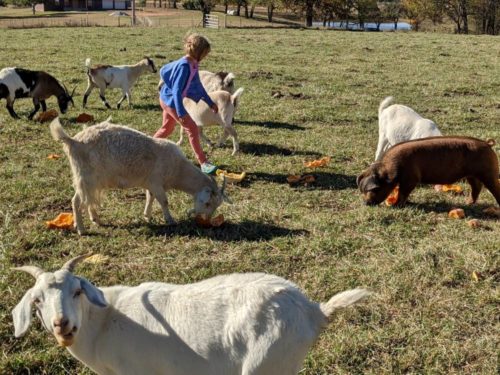
Goats and pigs eating discarded pumpkins.

Livestock can turn your over-ripe or excess vegetables into meat. On the Hale farm, goats and pigs take care of the discarded Halloween pumpkins. Photo: Margo Hale, NCAT.

On our farm, and yours, livestock turn pasture and browse into healthy meat. Pasture-raised hogs and poultry need other feed as well, but the meat and eggs produced on pasture are healthier for our family and community. Those grazing animals improve the fertility of our land and boost soil health. And during the garden season our livestock “recycle” excess or over-ripe vegetables, turning waste into meat or eggs. Farms that already have a customer base will find that adding farm-raised meat or eggs can really boost sales and bring in new customers.

There are also many intangible, but real, benefits, as we have learned. Livestock are fun to watch and interesting to raise. They’re valuable for teaching children to be responsible, observant, and curious. They teach kids how science and nature work and how food is grown. These life-long lessons were given to me as a child, and it is satisfying to pass them on to my children, as well.

Assessing Resources

For our family, livestock are a perfect fit. Are they for you?

Before getting started with any enterprise, it is important to consider the goals you have for your farm, family, and lifestyle. How will livestock help you meet your farm goals? Your farm goals, including financial goals, will impact the livestock species you choose, your scale of production, and marketing streams.

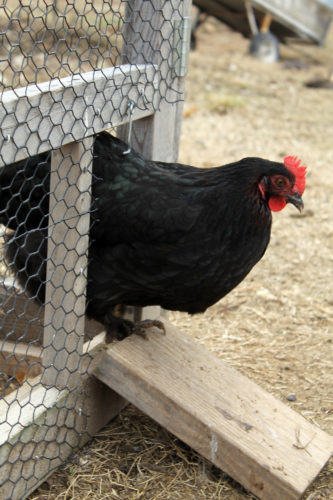
A black chicken exits a wire enclosure.

Chickens are easier to contain and need much less space than cattle, so they can be a good fit on small acreage. Photo: Robyn Metzger, NCAT.

Next, what are your available resources? Consider land, money, infrastructure, and time. Some enterprises lend themselves best to smaller acreages: poultry, rabbits, and bees take little space. Grazing livestock need more area so that you can protect soil and pastures and keep livestock healthy.   If you have sufficient acreage to raise larger livestock, then the type of forages may influence your decisions. Woodlots are a good fit for hogs and goats, whereas farms with mostly grass pastures best suit sheep and cattle.

Another factor that influences your choice of enterprise is the money you have available to invest in livestock and infrastructure. You can start small with any enterprise, but some are easier and cheaper to contain, such as poultry and rabbits. Grazing livestock need a larger enclosure and are therefore more expensive to start. If there is existing infrastructure, that is very helpful. If not, you will need to budget funds for fence, water, and needed equipment. These up-front costs can be significant, but they are vital. You don’t want an angry phone call from your neighbor about your goats killing their fruit trees!

Having a way to deliver adequate quantities of water to your livestock is also imperative and can be tricky to figure out. In addition, livestock usually need supplementary feed. Poultry, rabbits, and hogs need grain, while grazing animals need hay in winter. Where can you source feed, for what price?  Where can you store feed to keep it dry and protected from livestock and rodents? Feed goes into the budget, as all feed costs are paid before you get meat to sell.

Shelter may be an issue. In our moderate climate and with our choice of hardy cattle and goats, we rarely need shelter. However, baby goats born in a cold rain will suffer. If they get too chilled to nurse, they will die. Therefore, we need a plan for circumstances where the livestock do need shelter.

Local markets and processing may also influence your choice. Pasture-raised eggs are always popular, but what is the selling price for a dozen in your area? Can you make money selling at that price, given your feed cost? Similarly, meat enterprises may be feasible or not, depending on the local prices, processing, and feed costs. You will need to do some homework, investigating the local situation and plugging the numbers into a budget to see if the enterprise makes sense. The sample budgets in ATTRA’s Small Scale Livestock Production publication can serve as a starting point. Also see publications on the ATTRA livestock page about whatever enterprise you are considering. Know before you begin what you can produce and for what cost—this knowledge can help guide your choice of livestock enterprise and save your family from a costly mistake.

Time is a precious resource and your farm setup and the enterprises you choose must take this into consideration. Our family includes two children and two full-time, off-farm jobs; therefore, one of our goals is to have easy-to-manage enterprises that don’t take much time. That is important when we need to leave the farm; also, our farm sitter needs the chores to be low-stress and easy to complete. We accomplish that by being intentional in our enterprise selection, infrastructure setup, and our management. Don’t set yourself up for disappointment by taking on more than you can easily manage in the time you have available.

In next week’s blog, I will share some of the strategies and infrastructure we use on our farm to save time and money. Stay tuned!

Learning More

No matter what livestock you choose, it is best to start small. Learn with a few animals so your mistakes—and you will make mistakes—won’t be as costly. Continuously monitor your enterprise and adjust as needed. Remember to keep your farm and family or lifestyle goals in mind. Is this livestock enterprise helping you meet those goals? For example, while our sheep were profitable, we found that we didn’t enjoy raising them and they took too much time. In contrast, my coworker, NCAT Livestock Specialist Linda Coffey, found that sheep worked better than meat goats on their farm. Their customers wanted lamb and the sheep made best use of the pastures. We sold our sheep, and Linda sold the meat goats. Both of us are happier.

There is much to learn about raising and marketing livestock. I would suggest finding a mentor who you can learn from and lean on for advice. Connecting with local producer or grazing groups is a great way to find a mentor. ATTRA has many resources (linked below), and our Livestock Specialists are available to answer questions and talk with you about these considerations. Linda and I will be discussing species specific considerations in an upcoming podcast. Send your questions to us at  margoh@ncat.org and lindac@ncat.org.

ATTRA Resources

Getting Started with Livestock Podcast

Small Scale Livestock Production

ATTRA Livestock and Pasture resources

Livestock as a Tool: Improving Soil Health, Boosting Crops

Integrating Livestock and Crops

Managed Grazing Tutorial

Healthy Animals, Happy Farm

Working With Your Meat Processor

By Jamie Fanous, Sustainable Agriculture Specialist

Like many, during these challenging times, I’ve turned to home gardening! I’ve used gardening as an opportunity to reconnect with nature and clear my head, all while staying close to home during the quarantine.

Interested in home gardening? Need to build a raised garden bed frame? Check out this amazing video on the NCAT Youtube page with Jeremy Prater!

Over the course of these summer months, I’ve grown a variety of fruits and vegetables, including eggplant, tomatoes, melons, summer squash, zucchini, peppers, tomatillos, and even herbs and flowers. Since home gardening is often at a very small scale, it can allow for more time to dedicate to monitoring and tending. I’ve been able to carefully monitor my garden’s water moisture, soil quality, and plant health, as well as identify plant diseases, pests, and beneficial insects.
I’ve also maintained a variety of beautiful native plants such as ceanothus or California Lilacs, which serve as a valuable habitat for beneficial insects! Having various native plants, flowers, and herbs has been instrumental for the garden particularly for pest suppression and pollination. Insects like native bees, honeybees, butterflies, ladybird beetles, lacewings, and spiders are vibrant additions to the garden which have encouraged the fruits and vegetables to flourish and reduce pressure from damaging pests like aphids.

Interested in more information on Beneficial Insects? See this ATTRA Publication: A Pictorial Guide to Hedgerow Plants for Beneficial Insects

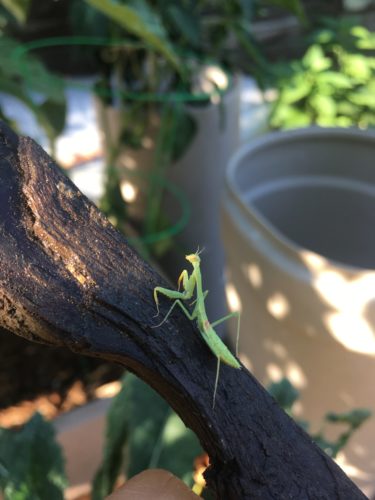
Since I began gardening I’ve seen so many exciting beneficial insects with one, in particular, standing out –  the Praying Mantis (Tenodera aridifloia sinesis)! Known for its bulging eyes and head that can spin 180 degrees, the praying mantis is a valuable predator to have in the garden. The praying mantis has earned its name by the way in which it waits for prey, by folding its front legs inward, which appear as praying hands. The praying mantises are stunning predators and are valuable to the garden, however, they do not pick and choose their prey and have been known to consume both pests and beneficial insects.
It has been an exciting journey tending to the garden and I look forward to continuing it. The fall is just around the corner which means new vegetables to grow and new beneficial insects to discover!


Relevant Resources:

Build a Basic Wooden Raised-Garden Bed Frame –  https://www.youtube.com/watch?v=ScuK2Ktp2FA

A Pictorial Guide to Hedgerow Plants for Beneficial Insects – https://attra.ncat.org/product/a-pictorial-guide-to-hedgerow-plants-for-beneficial-insects/

Beneficial Insects You Want in your Garden – California Gardening https://www.youtube.com/watch?v=YkMaZqfHMHc

CNN Article about Mental Health & Gardening – https://www.cnn.com/2020/05/03/health/how-to-start-gardening-coronavirus-wellness/index.html


By Guy K. Ames, NCAT Horticulture Specialist

It’s the time of year when apple and pear growers are watching their trees like hawks. . .because the crows are watching the trees, too—like, well, crows.

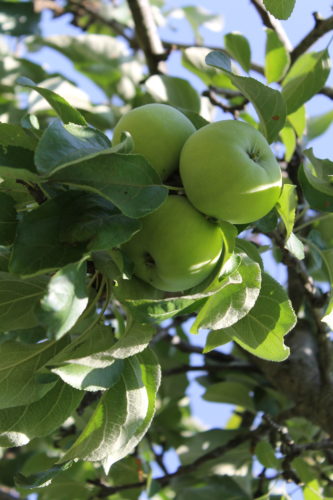
Ripening fruit becomes attractive to crows and many other critters. The fruit sugars are just too much to resist. And beating the other critters to the fruit is one of the reasons you need to know when to pick. This is not always as clear as you’d think because, when it comes to apples and pears, there is ripe and there is “ripe.”

Ripe for the Picking

Pome fruits, apples, pears and quince, are “physiologically ripe” (the seeds are mature) sometime before they are their sweetest and before they begin falling from their parent trees. This is important because as soon as they are physiologically ripe they can be picked and expected to finish ripening off the tree! Fruit left on the tree past this first stage of ripening will continue to sweeten and change color and texture. There is nothing wrong with letting an apple reach peak sweetness on the tree. But doing so could compromise its firmness and storability. . .and it remains on the tree for the crows to find.

Pears, at least the European types, are a somewhat different story. European-type pears—like the familiar Bartlett and Comice—ripen best off the tree. This is not true for Asian pears, which ripen fine on the tree. If left to ripen on the tree, European pears generally start ripening from the inside out and can be grainy or mushy. These pears are best picked just shy of full ripe (but physiologically ripe) then chilled and “cured.”

Curing is simply a matter of allowing the pear to reach perfection at room temperature on your kitchen counter or table. If you’re in a hurry you can put the pears in a paper bag. Bag with a banana to further hasten the process. To check for perfect ripeness, hold the pear in your hand and push on the fruit near the stem area with your thumb. When the pear gives just a little to your thumb pressure it is ready to eat.

Follow the Signs to Ripe Fruit

But back to physiological ripeness and other indicators of ripeness. Here are some important indicators:

  1. The hanging fruit begins to change color. Even green apples like Granny Smith and most pears have a subtle color shift when ripening begins in earnest, but the untrained eye might not see it. But red apples will show a more obvious color shift from green toward red as they approach ripeness.
  2. Some fruit begins to fall. This is usually a solid giveaway, but it doesn’t mean that every fruit on the tree is at exactly the same stage. As fruit approaches maturity, a layer of tissue on the stem accumulates abscisic acid in preparation to drop the apple or pear. The grower can exploit this phenomenon to determine ripeness. Gently lift a fruit from the vertical hanging position to something approaching horizontal. If the fruit is ready, the abscission layer will break cleanly where it joins the twig or spur it is attached to.
  3. The seeds are hard and brown or black. This is the surest indicator of physiological ripeness because, after all, that’s what this whole thing is all about. The fruit gets sweet to attract creatures like us to eat it and spread the seeds. If the fruit gets eaten too early, before the seeds are ready, then the whole thing was for naught! Seeds that are soft and white are not ready and the fruit isn’t ripe. If you were to pick the fruit before the seed is mature, the fruit will not continue to ripen.
  4. The fruit pleases your palate. Hey, there’s no substitute for your taste. If you like it, then it’s ready!

There are four key indicators of ripeness in apples and pears.The professionals have other tools, like a starch test and a refractometer for measuring sugars, but even the pros will use the four other indicators listed above.
Storing Apples and Pears

If your intent is to store your apples or pears, then catching them right when they are first physiologically ripe will allow you to take these fruit while still firm and store them. Sometimes they will last for months depending on what you might have to keep them cool.

Interestingly, it could be argued that pome fruits are still very much alive after picking. They are still respiring (exchanging gases like oxygen and ethylene) and starches are continuing to convert to sugars. We’ve already mentioned that European pears reach their highest flavors after storage and curing. Similarly, many apple varieties don’t achieve their finest, most complex flavors until they’ve been stored for a while.

Happy eating!

Additional Information on Apples and Pears

For more on apple and pear production, see the ATTRA Sustainable Agriculture publications Apples: Organic Production Guide and Pears: Organic Production. You’ll find many other resources on fruit production on the ATTRA website’s Fruits page, including publications, podcasts, and videos.

Guy has written several blog posts on the joys and challenges of fruit production. His previous posts include Pear Trees Exemplify Resilience, Restorative Pruning, Dwarfing Apple Rootstocks: Pros and Cons, Fall Planting Fruit Trees, and Battling Borers in Organic Apple Production.

You can contact Guy or other NCAT agriculture specialists by email at askanag@ncat.org or 800-346-9140.

By Ann Baier, NCAT Sustainable Agriculture Specialist

Foreword: After the recent passing of her mother, Ann reflects on some valuable lessons and preparations, especially relevant in the time of a pandemic.

Building resilience in agriculture and communities is at the heart of our work at the National Center for Appropriate Technology (NCAT). For over 40 years and continuing in this time of the pandemic, we persist in agricultural endeavors that support just and ecological food and farming systems in the midst of racial and economic inequalities and the public health implications of COVID-19.

Unexpected things happen all the time, in food and farming businesses, and in life. For a farm business to be resilient amid the unpredictable, we develop risk management plans and integrated pest management strategies to minimize loss and weather adversity. We create standard operating procedures, food safety plans, quality control measures. We analyze hazards and address critical control points and develop recall plans. We buy insurance. We set emergency preparedness plans in place, considering regional probabilities of a wildfire, flood, earthquake, hurricane or tornado, illness, or death.

Each of us has some capacity to prepare, prevent, or mitigate unpredictable events that may or may not happen in life and business. We also need to prepare for the inevitable (death)—that which will happen; we just don’t know how or when. During a pandemic, we are slightly more aware of our mortality, that any one of us could suddenly reach the end of our life. Our lives, no matter how long they may be, are finite. Even though talking about death may seem difficult at first, preparing for its eventuality won’t cause it!

Last year, my women’s group began discussing aging. (We are all aging, no matter how old we are!) We committed to meeting regularly to support and inspire each other to prepare for life’s eventual end. Each month we address a topic, such as Health and Medical Care, Legal Arrangements, Information for Survivors, Legacy / Succession, and Death Cleaning. We share meaningful reflections, practical help, and even laughter as we work toward clarity and organization. Our experience may be helpful to others.

The best time to make emergency preparedness plans is before the emergency begins. I’ll gather my important papers, map out an escape route, decide on an out-of-state contact and a family gathering place before a disaster looms and communications are lost. The best time to prepare to die is while we are healthy and of sound mind. When the possibility of illness and the eventuality of death seem far-off in the future rather than imminent, I can work with a clearer mind, and ground my decisions in carefully considered and dearly held values. It is quite all right to set arrangements in writing and not need them; it is more costly, legally complex, and emotionally exhausting to need, and not have them. Putting my affairs in order can give me peace of mind while I’m alive, especially understanding how I can minimize the legal, financial and emotional burdens on my loved ones–or business partners–when I cross life’s finish line.

Part I: Health and Medical Care: Advance Health Care Directives

My Mom used to joke, “None of us is going to get out of here alive!” Indeed, she made a timely exit from her life’s journey earlier this year. Her passing was peaceful and consistent with her values, thanks to her preparations. Mom completed both an Advance Health Care Directive (AHCD) and Physicians Orders on Life-Sustaining Treatment (POLST) form, I had copies, and both documents were on file with her health care system. Mindful that someday she would take “that journey that needs no baggage,” my Mom had put her wishes in writing years prior when thoughts of physical frailty or mental incompetence were merely hypothetical.

No matter my age or current health status, I can consider various scenarios and write down my wishes. What if I get into an accident or fall suddenly ill, get a brain tumor, or lose my memory? There are times when discussing the real possibility–or probability– of disability or death might feel like taking away someone’s hope. It is best to prepare now, while I can still reason clearly and speak for myself. Knowing I have discussed my values and criteria for decision-making with my family and my doctor and filed my advance health care directive with my health care system, I can be at ease.

My Mom had a fall. At age 95, it was not her first, but this one was different. The doctor who assessed her condition asked if we wanted to honor my mother’s POLST. “Yes,” I said, knowing we’d had the necessary conversations ahead of time. “Then we are providing comfort measures.” I clarified, “This may lead to the end of her life?” “Yes.” Having Mom’s wishes in writing gave me peace of mind. I did not need to second-guess, or worry that a family member would question her end-of-life care. It also allowed her a natural death, free of invasive medical interventions. She was able to die as simply as she lived, with modest use of finite medical resources.

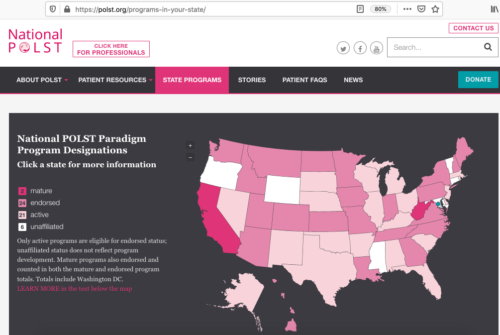
Advance Health Care Directive templates are easy to find; many health care systems provide them. Physicians Orders on Life-Sustaining Treatment, or POLST, is described in https://polst.org/: “All adults should have an advance directive to help identify a surrogate decision-maker and provide information about what treatments they want for an unknown medical emergency. A POLST form is for when you become seriously ill or frail and toward the end of life. A POLST form does not replace an advance directive — they work together.” The POLST form has three sections with checkboxes to express your wishes with respect to: A) Resuscitation (Attempt or Not); B) Medical Interventions (Full, Selective or Comfort-Focused Care); C) Artificially Administered Nutrition (Long-term, Trial or None), followed by D) Information and Signatures—yours and your doctor’s. That’s all. Together, the AHCD and POLST can save costly confusion for family members and care providers when life hangs in the balance. It is reassuring to have written guidance about when to try what kinds of interventions, and when to accept death when it is time.

Part II: Legal Affairs

Making legal arrangements, appropriate to one’s family composition and farm business, is a worthy investment of time and money. Get reliable legal advice! Key documents often include a Will, General Durable Power of Attorney, and a Living or Revocable Trust. A Trust complements the Will, and allows the property to be transferred to beneficiaries without the expense and delay of probate court proceedings. A Trust is “funded” by titling items of value (such as bank accounts and real property) in the name of the Trust, and recording deeds with the county.

A Trust names beneficiaries and Successor and/or Co-Trustees. “We wouldn’t want to declare you incompetent!” explained my Mom’s estate attorney, as she drew up the Trust.  And explained the key distinction between Co-Trustee and Successor Trustee. Being named Co-Trustee gave me the legal authority to take care of Mom’s affairs as her energy waned, her eyesight faded, and her hand grew increasingly unsteady over several years. The latter would have allowed me to act only if and when the primary Trustee was declared physically or mentally incapable by a medical professional. Because life provides no guarantees about a person’s longevity or the order of death (one of my mom’s children died before she did), it is good to name more than one Co-Trustee, and the order in which they would serve.

Making necessary legal arrangements does not mean giving up or losing hope. It’s simply a good idea. At any moment, I may find myself needing to act, in some legal capacity, on behalf of my spouse, sibling or business partner—or one of them for me! Some people lose capacity gradually, with age or dementia; others more suddenly, due to an accident, stroke, heart attack, or some rapidly progressing illness. Human beings may find it increasingly embarrassing, frightening, or uncomfortable to speak of getting one’s affairs in order when failing health or death become real possibilities. Anyone’s judgment can be clouded by emotion, fear, or stress when the balance of life itself or the future of business seem to hang on some critical decision. Why not set things in order now?

Further Reading:

  • Being Mortal: Illness, Medicine and What Matters in the End by Atul Gawande
  • Get It Together: Organize Your Records So Your Family Won’t Have To by Melanie Cullen, September 2018, 8th Edition, NOLO Pres
By Luke Freeman, NCAT Horticulture Specialist

We are excited to announce that we have two new incubator farmers participating in the Woolsey Incubator Farm program in Fayetteville, AR! Their names are Lucy Capelle and Sandra Wesson, and they have both begun work on their quarter-acre farm plots.

We had a slow start to the season with disruptions from COVID-19 and Cobblestone Farms hiring a new farm manager. However, we have been able to onboard our new farmers in time for them to plant their fall-season crops.

Incubator farm project participant in greenhouse

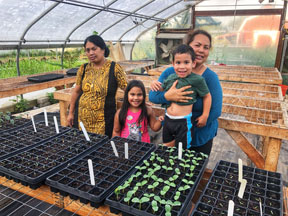
Incubator farmer Lucy Capelle, at right, with friend Shailer Balton and their little farm helpers.

Lucy Capelle is a gardener who works in Northwest Arkansas’s Marshallese community to encourage health and wellness through gardening, good nutrition, and active lifestyles. She wants to develop her farm business to serve the Marshallese community. She hopes they can buy fresh fruits and vegetables from their own local farmers and revive traditional farming practices from the Marshall Islands.

Lucy grew up helping her father on their coconut, banana, and pumpkin plantations on the Marshall Islands. She helped plant and harvest their crops and also tended to the chickens and pigs they raised.

Lucy has already started her late-season summer crops and fall-season crops in the greenhouse. She will be growing corn, okra, squash, pumpkins, broccoli, cabbage, and fall root crops this year.

Sandra Wesson also has a background in gardening. She is interested in growing her skills to supply organic produce to local restaurants and farmers markets in Northwest Arkansas. She is from Central Arkansas, but recently moved to Fayetteville for work and to be close to her grandchild. In Central Arkansas she was close to market farmers Mary and Rickey Bone of Lighthouse Farms and was inspired by their successful farm business.

Incubator farm project participant stands in field.

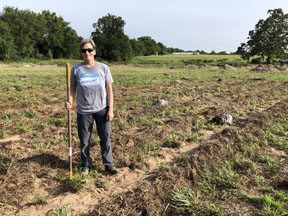
Incubator farmer Sandra Wesson preps her plot for fall crops.

Sandra is currently working on preparing her plot for planting, removing the plastic mulch and crop residues from last year.

Events this Fall

We have plans to host two more workshops at Cobblestone on organic vegetable production. We also plan to have project partners lead field trips to the farm this fall. However, our staff are monitoring the COVID-19 situation to determine the most responsible way to use the incubator farm as an educational resource. At this point we are considering the option of allowing farmers to participate in the workshops remotely through video, but we have yet to make the call.

Incubator farm plot

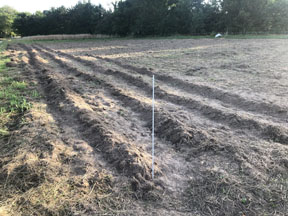
Lucy’s farm plot, getting ready for planting.

Stay tuned on our Facebook page to find out when our workshops will take place and how you can participate.

Project Background and Overview

The Woolsey Incubator Farm Project is complex and ambitious. It wouldn’t be possible without our great partners and supportive community. Our mission is to educate K-12 students and adults of all ages in Northwest Arkansas about sustainable agriculture and environmental conservation. We want to demonstrate how local food systems affect the environment. We also want to highlight the role that sustainable agriculture can play in environmental stewardship. Following is a list of goals we hope to accomplish with the help of our partners.

  • Train and support five incubator farmers as they start and grow their farm businesses.
  • Train farmers and prospective farmers on sustainable agriculture practices. We’ll host a series of four practical skills trainings led by NCAT agriculture specialists at Cobblestone Farms.
  • Educate members of the community on the environmental benefits of wetland prairie and native plants. Illinois River Watershed Partnership (IRWP) will lead a passive restoration of two acres of wetland prairie at the Woolsey Farm. IRWP will then lead a prairie walk at the property. They will also create and post signage on the property to educate the community about how wetland prairie and native plants affect the ecosystem.
  • Educate primary-level students about local agriculture, environmental stewardship, and local food systems through field trips to Cobblestone Farms and the Woolsey Incubator Farm.
  • Educate high school students through field trips to Cobblestone Farms and the Woolsey Incubator Farm.

Creating an incubator farm is key to accomplishing our goals. It will be the home base for our educational activities. We are working closely with the City of Fayetteville to prepare the city-owned historic Woolsey Farm site to house the incubator farm. Once it’s established, we expect the Woolsey Incubator Farm to educate hundreds of farmers, students, and adults for years to come. Cobblestone Farms generously provided plots for our first incubator farmers until the Woolsey Farm property is ready. For more on our activities for this project, see our previous blog post Incubator Farm Project Cultivates Farmers and Community.

More Information

Whether you’re a beginning farmer or have years of experience, check out the ATTRA Sustainable Agriculture website! There are hundreds of resources on sustainable agriculture topics, including publications, videos, online courses, webinars, podcasts, and more. And if you’d like an agriculture specialist to provide a one-on-one consultation, call 1-800-346-9140 or email your questions to askanag@ncat.org.

By Martin Guerena, Sustainable Agriculture Specialist

During these challenging times, home gardening has become one of the more popular past times for many people. But what about those of us who don’t want to be at the beck and call of an intensive garden while simultaneously wanting to enjoy the beauty and benefits of a beautiful garden?

While gardening vegetables allows some independence from local supermarkets and the extra expense of organic produce, some of us have the convenience of local farmers’ markets and stores that supply healthy organic food even during these times of COVID-19.  I am the type of gardener who appreciates a low garden management/hammock time ratio,  the amount of work it takes to care for vegetables makes me inclined to invest my labor strategically and support my local farmers. Additionally, California has been in a drought for the past 20 years and with climate change, there will be a significant challenge to the future water supply.  Instead of giving up on gardening, I decided to plant native and drought-tolerant plants creating a xeriscape of flowering plants for pollinators and other beneficial insects.

The beauty of the flowering plants is inspiring and contributes to our family’s quality of life, and knowing that they are providing habitat for beneficial insects is satisfying as well.  The plants in my garden are a mixture of resilient perennials and annuals which include: Verbena, Yarrow, various Sages, Blue Flax, Lavender, Telegraph Weed, Gumweed, Ceanothus, Flannel Bush, Penstemon, Sedum, Buckwheat, California fuchsia, California Poppy, Love in a Mist, and native grasses such as deer grass, creeping wild rye, California melic, and purple needlegrass. If you live outside of California you can check resources like the Sunset Western Garden Book and local native plants websites that describe plants suited for your conditions. They may also be a good source for seeds and seedlings.  You may also want to check ATTRA’s A Pictorial Guide to Hedgerow Plants for Beneficial Insects, which characterizes several of the most beneficial hedgerow plant species used in farmscaping for native pollinators, and insect predators and parasites in California. It provides plant names, bloom times, heights, and descriptions that note considerations for selection and establishment.

A layer of woodchip mulch placed around the plants keeps the soil covered and moist reducing the need to weed and irrigate frequently. I start irrigating about a month after the last significant rain in the spring and then every 3 to 4 weeks (with careful species selection, irrigation can be reduced further) until the beginning of the rainy season in late fall.

The insects I see on these flowers include bees, wasps, flies, butterflies, moths, beetles and very tiny wasps that I see swarming and hovering above the flowers. Besides pollinators, many of these insects are predators and parasites of pests. Predatory species include praying mantids, ladybugs, green and brown lacewings, assassin bugs, soldier beetles, minute pirate bug, big-eyed bug, syrphid flies, tachinid flies, parasitic wasps, and spiders.

These beneficial insects require refuge plus a pollen and nectar source to feed and provide the ecosystem services of pest control on various insect pests. My stone fruits and pear trees rarely have any aphids or other insect pests through the season.

In summary, the benefits of drought-tolerant gardens are:

  1. Harnessing of pollinators and beneficial insects.
  2. Attracts other wildlife such as birds and reptiles.
  3. Reduced water use and water bill.
  4. Less maintenance.
  5. Beautiful landscape.

ATTRA Resources

Photos and text by Nina Prater, NCAT Sustainable Agriculture Specialist

Image at right: Jeremy Prater practicing his shiitake mushroom inoculation skills at the mushroom workshop in Fayetteville, AR.

Last year, the NCAT Southeast office partnered with the University of Missouri’s Agroforestry Center to host a one-day mushroom cultivation workshop in Fayetteville, Arkansas. Gregory Ormsby Mori with the Agroforestry Center provided hands-on instruction, showing multiple ways of growing mushrooms. These included shiitake mushrooms in logs, oyster mushrooms grown on log totems, and wine cap mushrooms grown in a straw/woodchip bed. (Read a re-cap of the event here: https://www.ncat.org/growing-edible-mushrooms-workshop-recap-and-resources/). My husband Jeremy and I attended the workshop and were inspired to get started right away. We have a livestock farm in the Ozark Mountains of Arkansas, but we’re always looking for ways to diversify our operation. Mushrooms seemed like a good fit. We manage over 100 acres of forest, a ready source of both material and shady land for mushroom production.

Making a Wine Cap Mushroom Bed

There’s nothing quite like a hands-on workshop to inspire you to dive right into a new project. After the workshop, we went home and ordered spawn for oyster mushrooms, shiitakes, and wine caps. We got the oyster mushroom totems and shiitake logs inoculated last spring, but ran out of time to do the wine caps. We stored the wine cap spawn in the back of the fridge for a year (farmers’ fridges are such interesting places—we also have animal vaccines and pawpaw seeds tucked in the back at the moment).  In early April of this year, we were able to establish a wine cap mushroom bed.

You can watch this short video to see exactly how we made our wine cap mushroom bed. If you prefer a very brief written version, it’s easy: you find a shady spot either within your garden under tall plants, or in a wooded area. First, clear the surface to expose the soil and sprinkle some spawn. Next, start layering your wood chips (hardwood preferably), spawn, fresh straw, then spawn again. Continue that lasagna-like pattern (chips, spawn, straw, spawn) until you run out of spawn. Finally, top it off with wood chips to hold it all down. Soaking your wood chips and straw ahead of time is ideal.

In our video, you can see that we watered the materials as we went, since we were not able to pre-soak. We have followed up on this by making sure we watered the bed well on days it didn’t rain. It’s too early yet to say if we were successful, but I’m already optimistically researching wine cap mushroom recipes.

More on Mushrooms

Mushrooms are a great way to add diversity to your farm operation. On our farm, we’re doing it primarily for our own consumption. But our secondary purpose is as a trial-run to see if it is something we would enjoy doing commercially. To learn more about mushroom cultivation, check out these resources:

ATTRA Publication:

Mushroom Cultivation and Marketing: https://attra.ncat.org/product/mushroom-cultivation-and-marketing/

ATTRA Podcast:

Introduction to Mycology: https://attra.ncat.org/introduction-to-mycology-podcast/

University of Missouri:

Cultivation and Cuisine: Getting Started with Wine Cap Mushrooms, By Hannah Hemmelgarn, University of Missouri Center for Agroforestry: http://agebb.missouri.edu/agforest/archives/v23n2/gh4.php

Call or contact your local Farm Service Agency today!

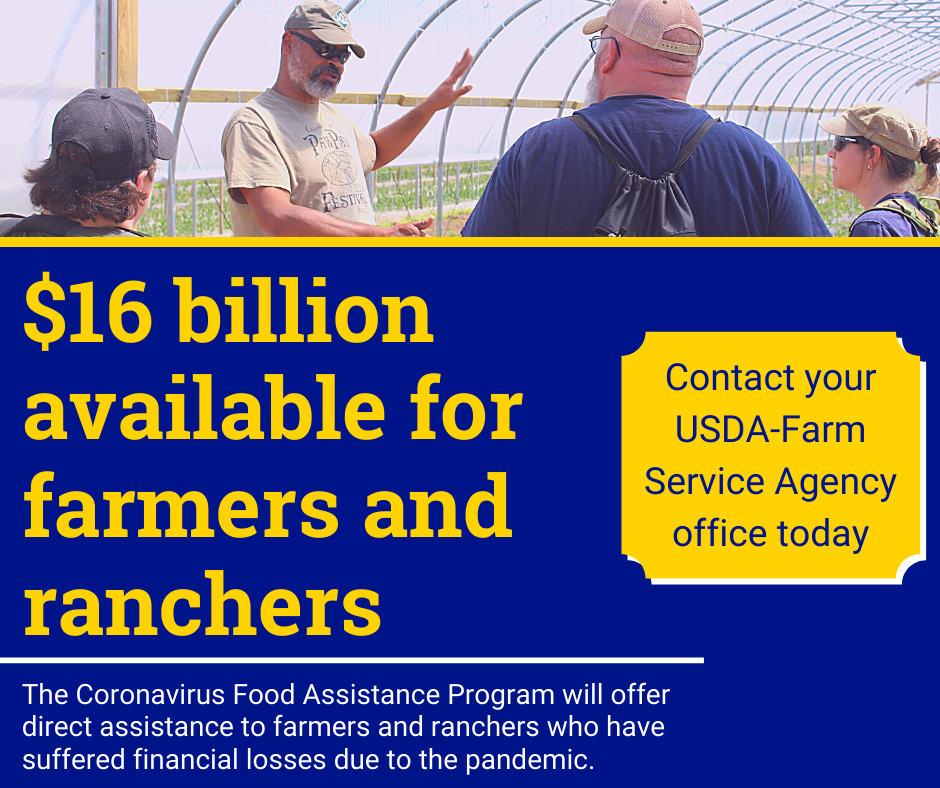
No, the Coronavirus Food Assistance Program (CFAP) is not food for the nation’s hungry, but rather assistance for the nation’s food producers. Details of how U.S. farmers can apply for this assistance are still scarce, but the most important message is to begin the process ASAP if you are a farmer who has experienced a loss due to the Coronavirus pandemic. Here is a way to contact your local Farm Service Agency (FSA) office which will be implementing this program:

Find your Farm Service Agency office

You must make a phone call to your local FSA office to start the process.

Direct support for farmers and ranchers available via CFAP will include:

  • Direct support based on actual losses because of price and disrupted supply chains.
  • Assist with adjustment and added marketing costs resulting from lost demand and short-term oversupply in the 2020 marketing year.

CFAP is available to farmers regardless of size and market outlet, if they suffered an eligible loss. Disruption to markets and demand may be significant and the USDA is already warning that these payments may only cover a portion of the impacts on farmers and ranchers.

PARTICULARLY IF YOU HAVE NOT USED FSA PROGRAMS IN THE PAST, GET READY BY COLLECTING:

  1. Tax Identification Number: TAX ID
  2. Farming Operating Structure: TYPES
  3. Adjusted Gross Income

BE PREPARED TO FILL OUT POSSIBLY THE FOLLOWING SIX (6) FORMS.
DO NOT SEND FORMS WITHOUT FIRST CONTACTING YOUR LOCAL FSA OFFICE

  • CCC-901 (Español) If applicable, this certification reports income from farming, ranching, and forestry, for those exceeding the adjusted gross income limitation ($900,000)
  • CCC-941 (Español) Reports your average adjusted gross income for programs where income restrictions apply.
  • CCC-942 If applicable, this certification reports income from farming, ranching, and forestry, for those exceeding the adjusted gross income limitation ($900,000)
  • AD1026 (Español) Ensures compliance with highly erodible land conservation and wetland conservation
  • AD2047 Provides basic customer contact information
  • SF3881 Collects your banking information to allow USDA to make payments to you via direct deposit

As with all emergency assistance, there will be those that are more prepared then others and getting in line as early as possible is to your advantage.

Contact ATTRA for Help

If you need help contact us here at ATTRA as we are always ready to help.

  1. Call our toll-free ATTRA helpline (U.S. only)
    800-346-9140 (English) 8 a.m. to 5 p.m Central Time
    800-411-3222 (Español) 8 a.m. to 5 p.m. Pacific Time
  2. Ask online, using the green chat box at the bottom of the ATTRA webpage.
  3. Via email to askanag@ncat.org


By Guy K. Ames, NCAT Horticulture Specialist

In Northwest Arkansas I’m seeing peach leaf curl in my orchard. It’s April, but the calendar date is not as important as the growth stage of the peaches. The professionals call this time “shuck split.” The “shuck,” or the last remnant of the flower, is splitting and falling from the growing young fruit. This is a crucial time for the developing fruit as it is growing rapidly, and this is not a good time for the tree to be stressed. This disease, incited by the fungus Taphrina deformans, causes the leaf to deform and swell irregularly (see photo). As you can imagine, leaf function—primarily photosynthesis and respiration—suffers and the tree is stressed. The more severe the curl (the more leaves are affected), the more stressful it is to the tree.

Managing Peach Leaf Curl

You’re going to want to do something about it, but there’s not much you can do once you see it on your trees other than to remember to spray next year during dormancy. Here’s why. The fungus overwinters in the tiny crevices around the leaf scale (or leaf bud). As soon as the leaf bud begins to swell in the early spring the fungus invades the leaf tissue. That’s right, the fungus is inside the leaf and thus protected from normal fungicide sprays! You should apply sprays of lime-sulfur (the best organic fungicide for this disease) sometime in March before the leaf buds begin to swell. If the trees have gone through severe infection, you can apply once in November when the leaves have fallen and then again in the spring before the new leaves emerge.

Helping an Infected Tree

A tree with a severe infection will sometimes drop all its infected leaves and try to push a new crop of leaves. This is understandably stressful for the tree, so if it happens, the grower could help the tree out by applying a quick release fertilizer of some sort. Organic growers could choose compost tea or fish emulsion. If the infection wasn’t severe (only a small percentage of leaves were infected), then you may need to do nothing. There is only the single infection period, so newly emerging leaves will be safe from T. deformans.

There are a few somewhat resistant varieties, including Clayton, Candor, and Frost, but this resistance is only relative to other more susceptible varieties and often can’t be relied upon for control.

Here’s hoping your leaves aren’t curly!

More Information

Guy shows examples of peach leaf curl and the leaf buds where the fungus overwinters in his video What is Peach Leaf Curl? on ATTRA Sustainable Agriculture’s YouTube channel.

For more on peach diseases, see the ATTRA Sustainable Agriculture publications Peach Diseases Identification Sheet and Peaches: Organic and Low-Spray Production.

Contact Guy and NCAT’s other agriculture specialists by emailing askanag@ncat.org or calling 800-346-9140.